350-401 Cisco Implementing Cisco Enterprise Network Core Technologies (350-401 ENCOR) v1.2 Free Practice Exam Questions (2026 Updated)
Prepare effectively for your Cisco 350-401 Implementing Cisco Enterprise Network Core Technologies (350-401 ENCOR) v1.2 certification with our extensive collection of free, high-quality practice questions. Each question is designed to mirror the actual exam format and objectives, complete with comprehensive answers and detailed explanations. Our materials are regularly updated for 2026, ensuring you have the most current resources to build confidence and succeed on your first attempt.
Which two items are found in YANG data models? (Choose two.)
What happens when a FlexConnect AP changes to standalone mode?
What is a TLOC in a Cisco Catalyst SD-WAN deployment?
Refer to the exhibit. When this Python script, which uses the requests module to communicate with a network device, is executed, what is the anticipated result?
When does a Cisco StackWise primary switch lose its role?
Which framework is used for third-party authorization?
Which technology collects location information through data packets received by the APs instead of using mobile device probes?
Refer to the exhibit.

What does the snippet of code achieve?
Which authorization framework gives third-party applications limited access to HTTP services?
Which characteristic applies to the endpoint security aspect of the Cisco Threat Defense architecture?
How is traffic classified when using Cisco TrustSec technology?
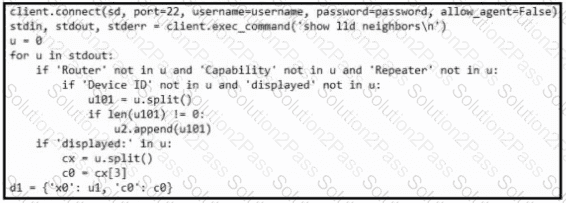
Refer to the exhibit. What is achieved by this Python script?
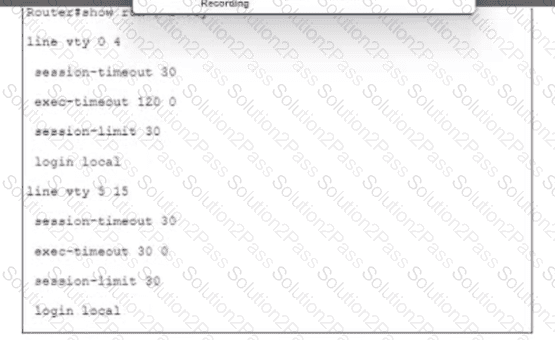
Refer to the exhibit. Only administrators from the subnet 10.10.10.0/24 are permitted to have access to the router. A secure protocol must be used for the remote access and management of the router instead of clear-text protocols. Which configuration achieves this goal?
What is one characteristic of Cisco Catalyst Center (formerly DNA Center) and vManage northbound APIs?
Which antenna type should be used for a site-to-site wireless connection?
A customer has several small branches and wants to deploy a Wi-Fi solution with local management using CAPWAP. Which deployment model meets this requirement?
Which two Cisco SD-Access components provide communication between traditional network elements and the controller layer? (Choose two.)
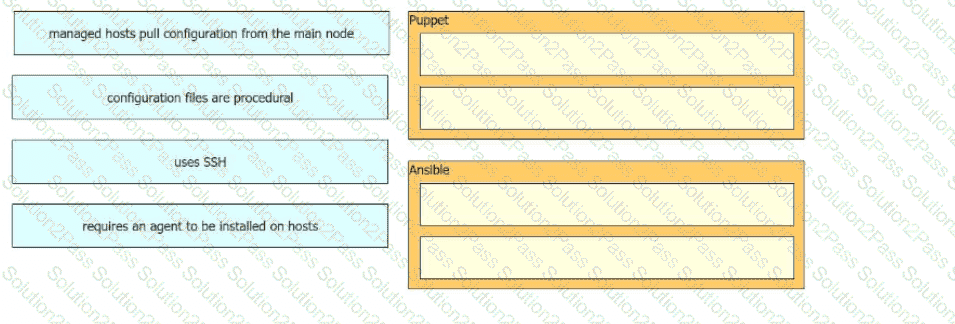
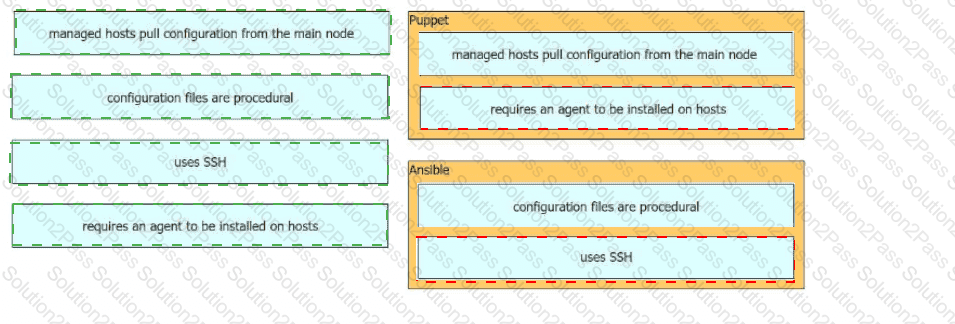
Drag and drop the characteristics from the left onto the corresponding orchestration tool on the right.
Which LISP device is responsible for publishing EID-to-RLOC mappings for a site?
Which lag/profile on a Cisco Catalyst 9800 Series WLC must be modified to allow Cisco ISE to dynamically assign VLANs to users on an 802.1X-based SSID?