New Year Sale Special - Limited Time 70% Discount Offer - Ends in 0d 00h 00m 00s - Coupon code: xmaspas7

Easiest Solution 2 Pass Your Certification Exams

FCSS_SDW_AR-7.6 Fortinet FCSS - SD-WAN 7.6 Architect Free Practice Exam Questions (2026 Updated)

Prepare effectively for your Fortinet FCSS_SDW_AR-7.6 FCSS - SD-WAN 7.6 Architect certification with our extensive collection of free, high-quality practice questions. Each question is designed to mirror the actual exam format and objectives, complete with comprehensive answers and detailed explanations. Our materials are regularly updated for 2026, ensuring you have the most current resources to build confidence and succeed on your first attempt.

Page: 1 / 2
Total 94 questions

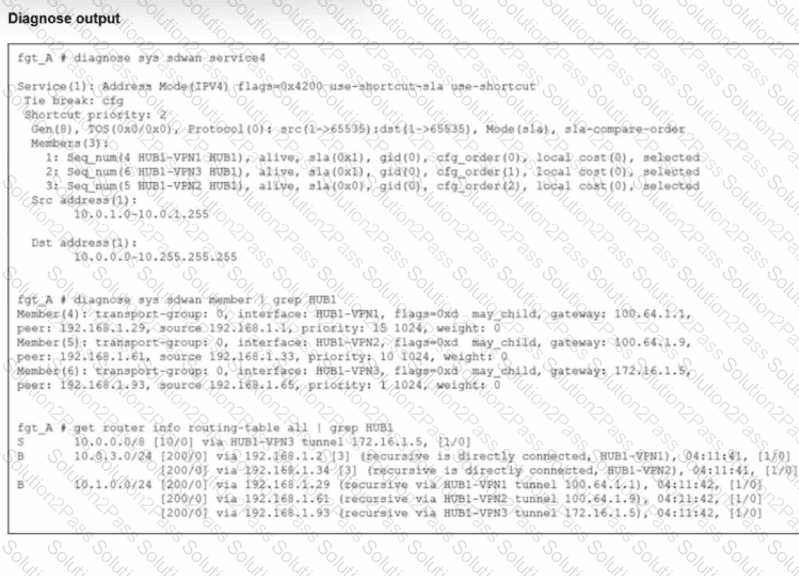
Refer to the exhibit.

An administrator is troubleshooting SD-WAN on FortiGate. A device behind branch1_fgt generates traffic to the 10.0.0.0/8 network.

The administrator expects the traffic to match SD-WAN rule ID 1 and be routed over HUB1-VPN1. However, the traffic is routed over HUB1-VPN3.

Based on the output shown in the exhibit, which two reasons, individually or together, could explain the observed behavior? (Choose two.)

A.

HUB1-VPN3 has a higher member configuration priority than HUB1-VPN1.

B.

The traffic matches a regular policy route configured with HUB1-VPN3 as the outgoing device

C.

HUB1-VPN1 does not have a valid route to the destination

D.

HUB1-VPN3 has a lower route priority value (higher priority) than HUB1-VPN1.

An SD-WAN member is no longer used to steer SD-WAN traffic. The administrator updated the SD-WAN configuration and deleted the unused member. After the configuration update, users report that some destinations are unreachable. You confirm that the affected flow does not match an SD-WAN rule.

What could be a possible cause of the traffic interruption?

A.

FortiGate, with SD-WAN enabled, cannot route traffic through interfaces that are not SD-WAN members.

B.

FortiGate can remove some static routes associated with an interface when the member is removed from SD-WAN.

C.

FortiGate removes the layer 3 settings for interfaces that are removed from the SD-WAN configuration.

D.

FortiGate administratively brings down interfaces when they are removed from the SD-WAN configuration.

(You plan a large SD-WAN deployment for a global company. You want to divide the network architecture into five geographical regions and install two hubs in each region for increased redundancy. You expect a significant amount of traffic within each region and limited traffic flow between spokes in different regions. You plan to connect the small branch sites to only the closest hub in their regions and the large branch sites to the two hubs in the regions.

Which statement about your plan is true? Choose one answer.)

A.

It is possible. You should use eBGP as the routing protocol between the regions.

B.

It is not possible. FortiOS 7.6 supports multihub topologies with up to four hubs.

C.

It is possible. You should use FortiManager and the overlay orchestrator multihub topology to simplify the deployment.

D.

It is not possible. In a region, all spokes must have either single-hub or dual-hub connectivity.

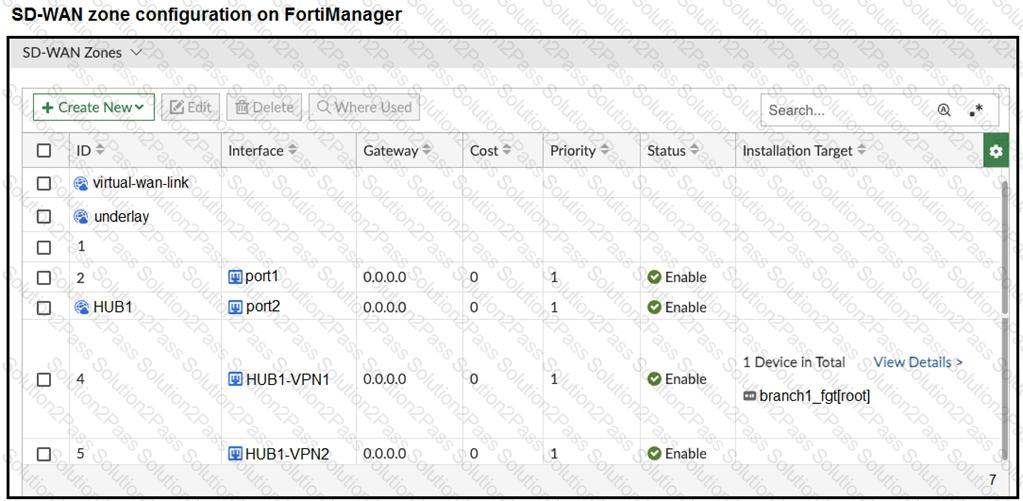
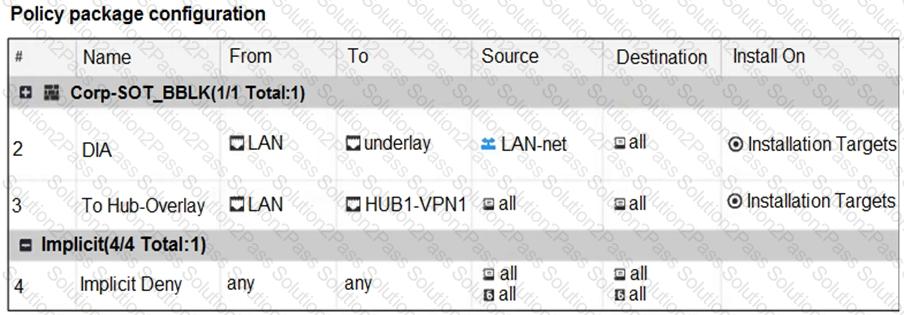
Refer to the exhibits.

The exhibits show the SD-WAN zone configuration of an SD-WAN template prepared on FortiManager and the policy package configuration.

When the administrator tries to install the configuration changes, FortiManager fails to commit.

What should the administrator do to fix the issue?

A.

Configure branch1_fgt as the installation target for policy 3.

B.

Configure HUB1 as the destination of policy 3.

C.

Configure a normalized interface for the IPsec tunnel HUB1-VPN1.

D.

Configure both HUB1-VPN1 and HUB1-VPN2 as the destination of policy 3

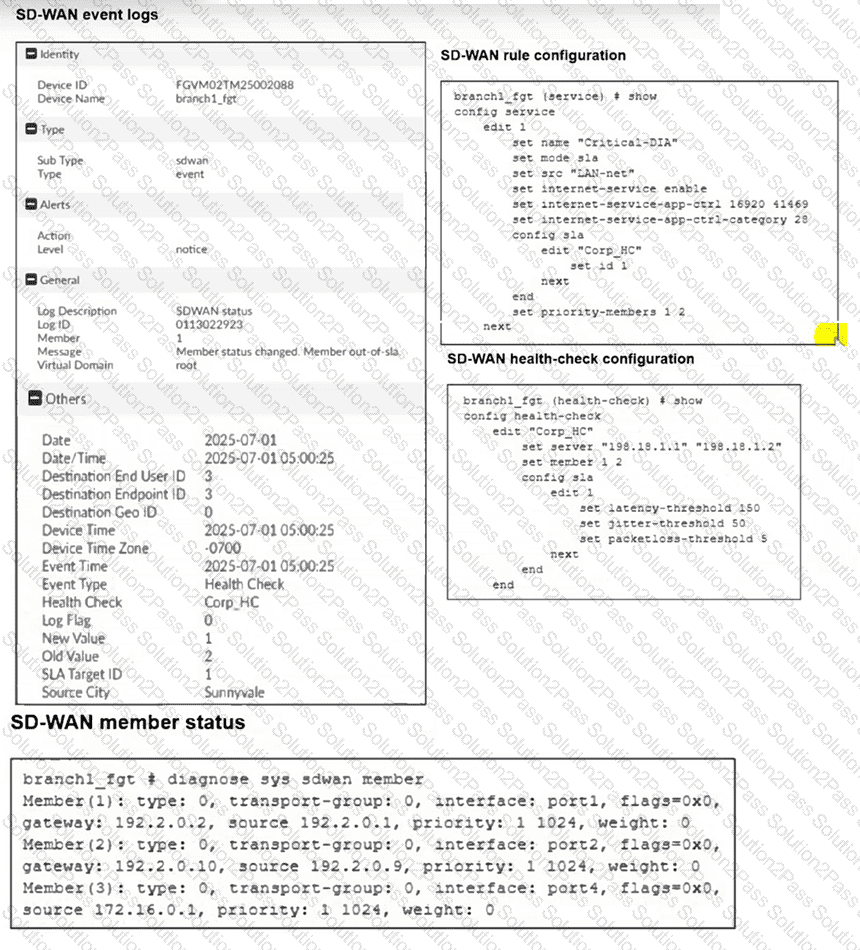
(Refer to the exhibits.

Two SD-WAN event logs, the member status, the SD-WAN rule configuration, and the health-check configuration for a FortiGate device are shown.

Immediately after the log messages are displayed, how will the FortiGate steer the traffic based on the information shown in the exhibits? Choose one answer.)

A.

FortiGate skips SD-WAN rule ID 1.

B.

FortiGate uses port2 to steer the traffic for SD-WAN rule ID 1.

C.

FortiGate uses port1 to steer the traffic for SD-WAN rule ID 1.

D.

FortiGate uses port1 or port2 to steer the traffic for SD-WAN rule ID 1.

Refer to the exhibits.

You use FortiManager to configure SD-WAN on three branch devices.

When you install the device settings. FortiManager prompts you with the error "Copy Failed" for the device branch1_fat When you click the log button. FortiManager displays the message shown in the exhibit.

A.

Based on the exhibits, which statement best describes the issue and how you can resolve it?

B.

Remove the installation target for the SD-WAN member port4. You cannot combine metadata variable and installation targets.

C.

Gateways for all members in a zone must be defined the same way. Specify the gateway of the SD-WAN member port! without metadata variables.

D.

Check the metadata variable definitions, and review the per-device mapping configuration.

E.

Check the connection between branch1_fgt and FortiManager

As an MSSP administrator, you are asked to configure ADVPN on an existing SD-WAN topology. FortiManager manages the customer devices in a dedicated ADOM. The previous administrator used the SD-WAN overlay topology.

Which two statements apply to this scenario? (Choose two.)

A.

You can activate auto-discovery VPN in the SD-WAN overlay template only if it is a single hub topology.

B.

When auto-discovery VPN is enabled, FortiManager updates the IPsec and BGP templates in the hub.

C.

After you enable auto-discovery VPN in the overlay template, you must select between ADVPN 2.0 and ADVPN 1.0.

D.

You can activate auto-discovery VPN in the SD-WAN overlay template for any type of topology, including a primary-primary dual-hub topology.

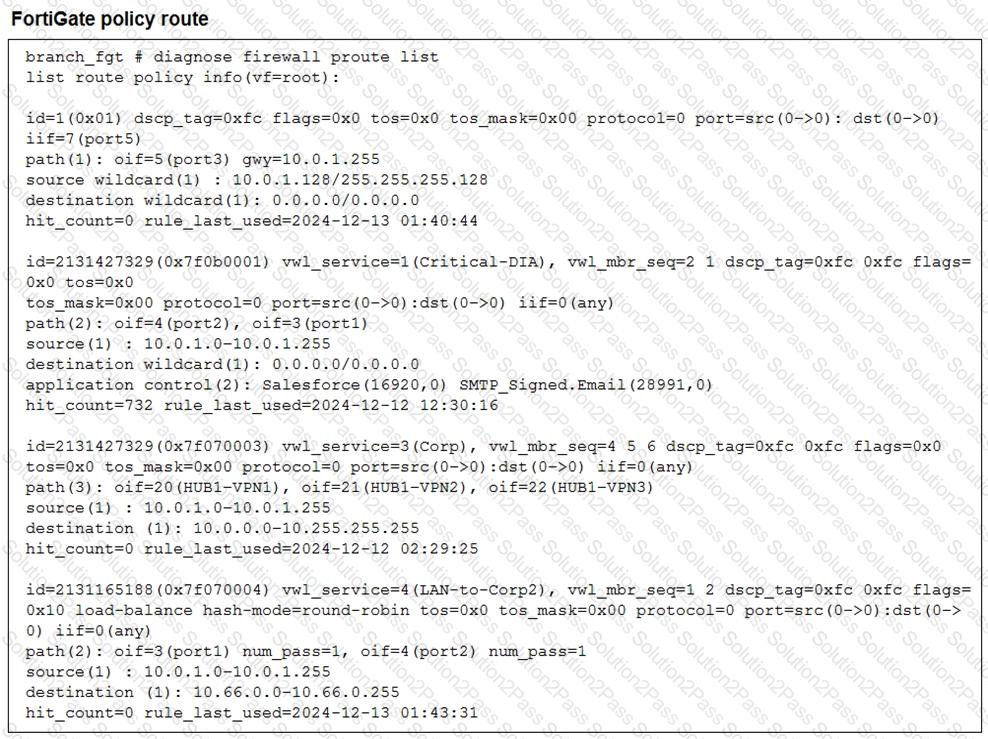
Refer to the exhibit.

What conclusions can you draw about the traffic received by FortiGate originating from the source LAN device 10.0.1.133 and destined for the company’s SMTP mail server at 10.66.0.125?

A.

FortiGate steers the traffic from the LAN device 10.0.1.133 to the company SMTP mail server 10.66 0.125 through port3.

B.

ForliGate steers the traffic from the LAN device 10.0.1.133 to the company SMTP mail server 10.66.0.125 through port2.

C.

FortiGate steers the traffic from the LAN device 10.0.1.133 to the company SMTP mail server 10.66.0.125 through the SD-WAN member ID 4.

D.

FortiGate steers the traffic from the LAN device 10.0.1.133 to the SMTP mail server 10.66.0.125 through the SD-WAN member ID 1 or 2.

You have configured the performance SLA with the probe mode as Prefer Passive.

What are two observable impacts of this configuration? (Choose two.)

A.

FortiGate passively monitors the member if TCP traffic is passing through the member.

B.

After FortiGate switches to active mode, the SLA performance rule falls back to passive monitoring after 3 minutes.

C.

FortiGate passively monitors the member if ICMP traffic is passing through the member.

D.

During passive monitoring, the SLA performance rule cannot detect dead members.

E.

FortiGate can offload the traffic that is subject to passive monitoring to hardware.

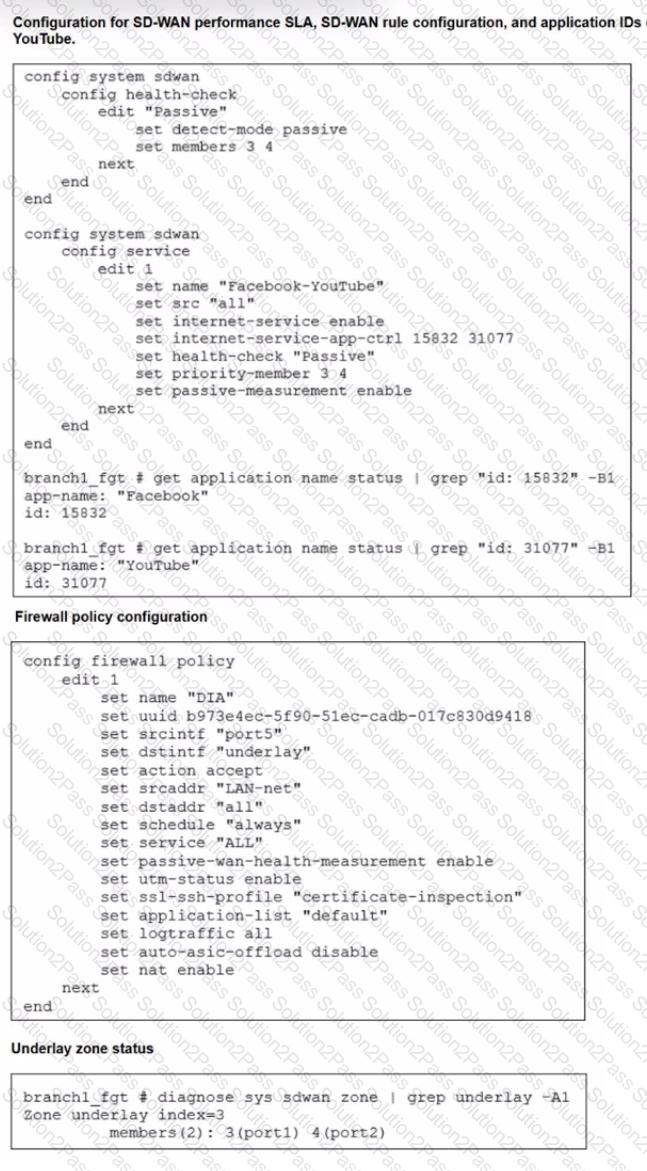
Refer to the exhibits.

The exhibits show the configuration for SD-WAN performance. SD-WAN rule, the application IDs of Facebook and YouTube along with the firewall policy configuration and the underlay zone status.

Which two statements are true about the health and performance of SD-WAN members 3 and 4? (Choose two.)

A.

Only related TCP traffic is used for performance measurement.

B.

The performance is an average of the metrics measured for Facebook and YouTube traffic passing through the member.

C.

Encrypted traffic is not used for the performance measurement.

D.

FortiGate identifies the member as dead when there is no Facebook and YouTube traffic passing through the member.

Which two statements correctly describe what happens when traffic matches the implicit SD-WAN rule? (Choose two.)

A.

The session information output displays no SD-WAN service id.

B.

Traffic is load balanced using the algorithm set for the v4-ecmp-mode setting.

C.

The traffic is distributed, regardless of weight, through all available static routes.

D.

Traffic does not match any of the entries in the policy route table.

E.

FortiGate flags the session with may_dirty and vwl_def ault.

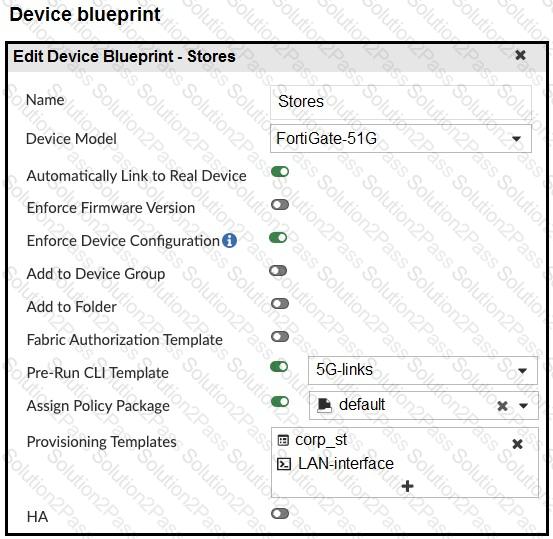
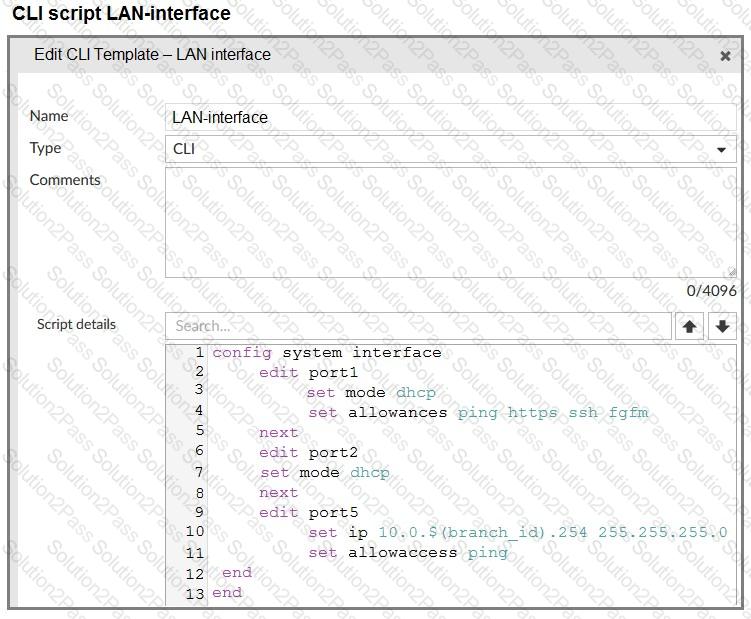
Refer to the exhibits.

The administrator configured a device blueprint and CLI scripts as shown in the exhibits, to prepare for onboarding FortiGate devices in the company’s stores. Later, a technician prepares a FortiGate 51G with a basic configuration and connects it to the network. The basic configuration contains the port1 configuration and the minimal configuration required to allow the device to connect to FortiManager.

After the device first connects to FortiManager, FortiManager updates the device configuration.

Based on the exhibits, which actions does FortiManager perform?

A.

FortiManager updates the device configuration according to the selected templates. It applies the corp_st template first.

B.

FortiManager does not update the port1 configuration because FortiManager does not change the configuration of interfaces with fgfm access.

C.

FortiManager updates access rights only for port1. FortiManager cannot update the IP address because it was already set manually.

D.

FortiManager updates the configuration of port1, port2, and port5. The three ports might get new IP addresses.

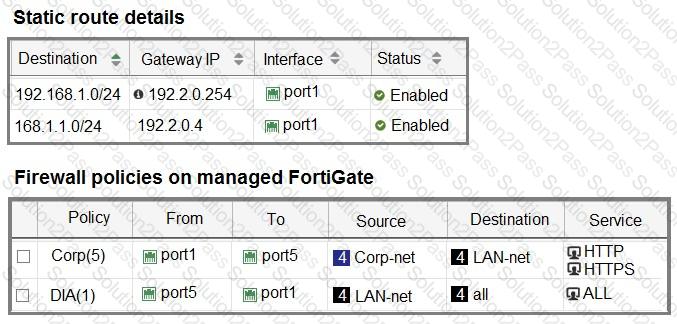
Refer to the exhibits.

The interface details, static route configuration, and firewall policies on the managed FortiGate device are shown.

You want to configure a new SD-WAN zone, named Underlay, that contains the interfaces port1 and port2.

What must be your first action?

A.

Define port1 as an SD-WAN member.

B.

Delete the static routes.

C.

Delete the SD-WAN Zone Test.

D.

Delete the firewall policies.

The FortiGate devices are managed by ForliManager, and are configured for direct internet access (DIA). You confirm that DIA is working as expected for each branch, and check the SD-WAN zone configuration and firewall policies shown in the exhibits.
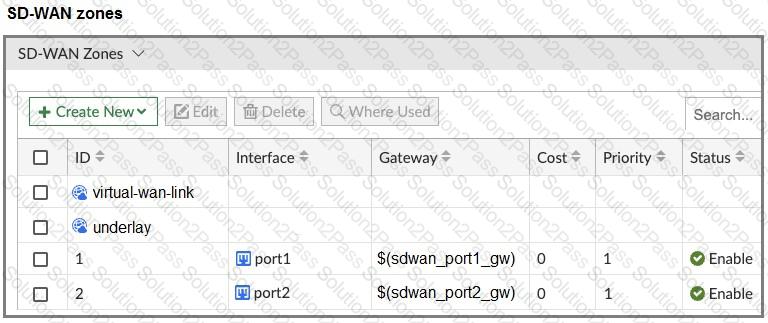

Then, you use the SD-WAN overlay template to configure the IPsec overlay tunnels. You create the associated SD-WAN rules to connect existing branches to the company hub device and apply the changes on the branches.

After those changes, users complain that they lost internet access. DIA is no longer working.

Based on the exhibit, which statement best describes the possible root cause of this issue?

A.

The SD-WAN overlay template defines a zone for each underlay interface and moves the interfaces into those zones.

B.

The SD-WAN overlay template didn’t configure a firewall policy to allow traffic through the overlay.

C.

The SD-WAN overlay template redefines the interface gateway addresses if they are defined with metadata variables.

D.

The SD-WAN overlay template updates the SD-WAN template and the rules.

When you use the command diagnose sys session list, how do you identify the sessions that correspond to traffic steered according to SD-WAN rules?

A.

You identify sessions steered according to SD-WAN rules with the flag vwl.

B.

You cannot identify SD-WAN sessions. You must use the sdwar. session filter.

C.

You identify sessions steered according to SD-WAN rules with the data vwl_mbr_seq.

D.

You identify sessions steered according to SD-WAN rules with the data 3dwan_service_id.

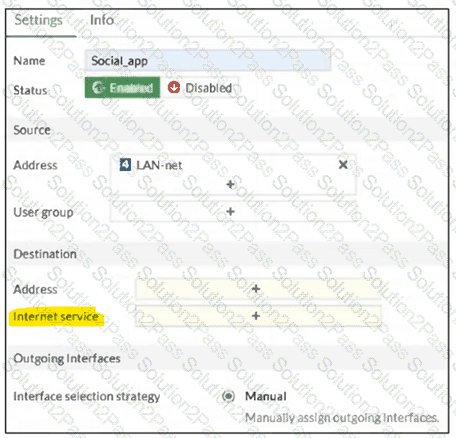
(Refer to the exhibit.

You configure SD-WAN on a standalone FortiGate device.

You want to create an SD-WAN rule that steers traffic related to Facebook and LinkedIn through the less costly internet link.

What must you do to set Facebook and LinkedIn applications as destinations from the GUI? Choose one answer.)

A.

Enable the visibility of the applications field as destinations of the SD-WAN rule.

B.

In the Internet service field, select Facebook and LinkedIn.

C.

You cannot configure applications as destinations of an SD-WAN rule on a standalone FortiGate device.

D.

Install a license to allow applications as destinations of SD-WAN rules.

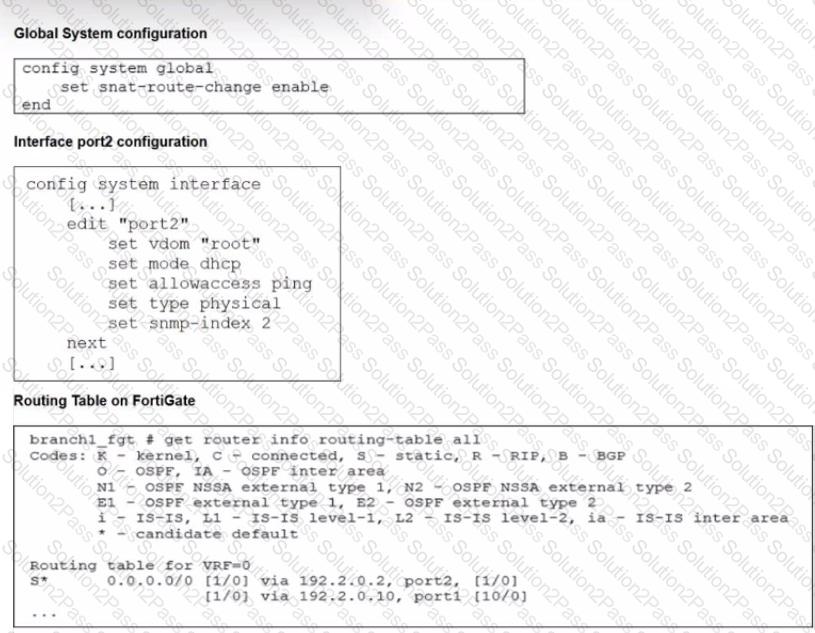
Refer to the exhibits.

The exhibits show the source NAT (SNAT) global setting. port2 interface settings, and the routing table on FortiGate.

The administrator increases the member priority on port2 to 20.

Upon configuration changes and the receipt of new packets, which two actions does FortiGate perform on existing sessions established over port2? (Choose two.)

A.

FortiGate continues routing all existing sessions over port2.

B.

FortiGate routes only new sessions over port2.

C.

FortiGate flags the SNAT session as dirty only if the administrator has assigned an IP pool to the firewall policies with NAT.

D.

FortiGate flags the sessions as dirty.

E.

FortiGate updates the gateway information of the sessions with SNAT so that they use port1 instead of port2.

Refer to the exhibit.

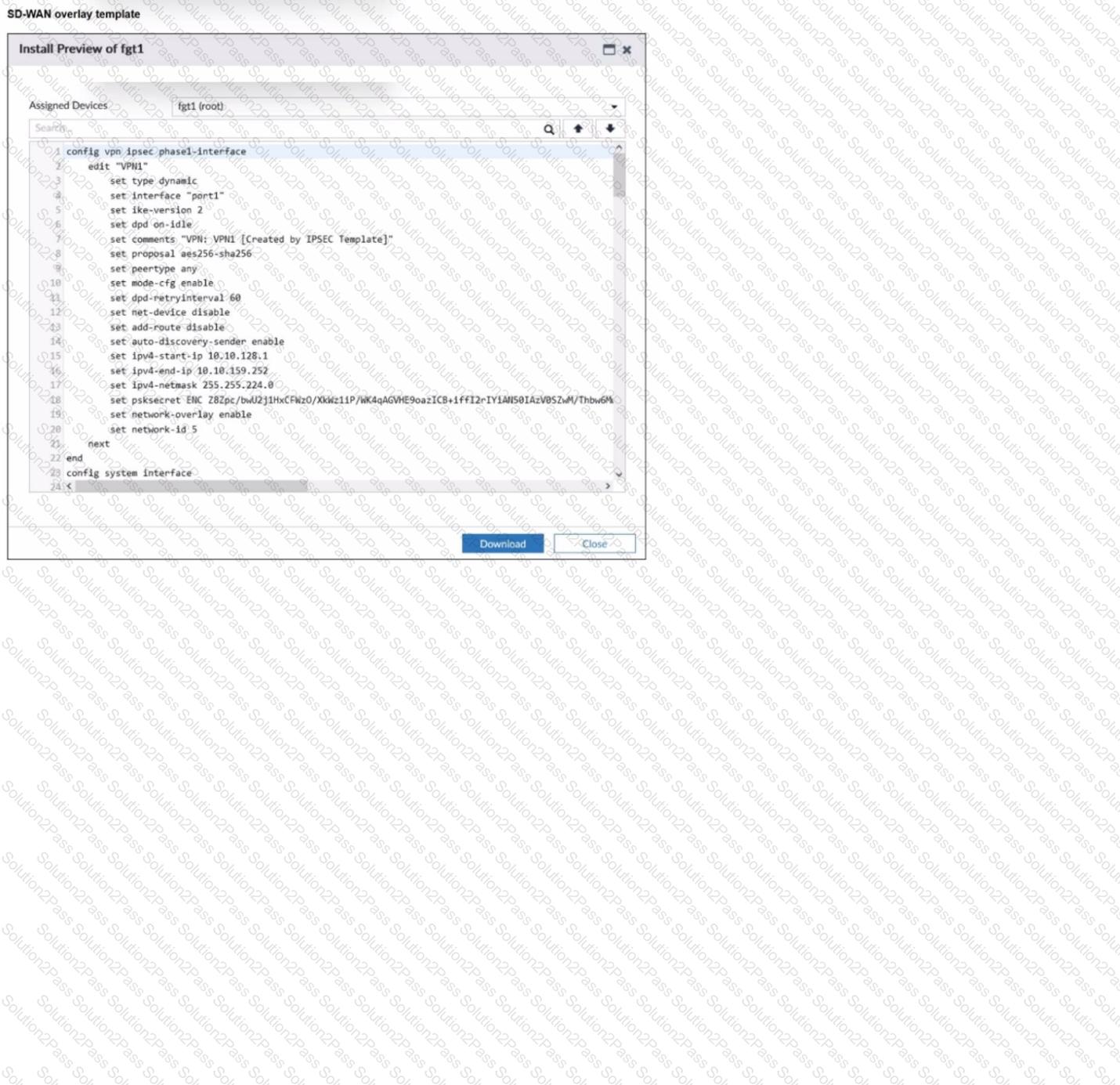
The administrator used the SD-WAN overlay template to prepare an IPsec tunnels configuration for a hub-and-spoke SD-WAN topology. The exhibit shows the FortiManager installation preview for one FortiGate device.

Based on the exhibit, which statement best describes the configuration applied to the FortiGate device?

A.

It is a spoke device that establishes dynamic IPsec tunnels to the hub. The local subnet range is 10.10.128.0/23.

B.

It is a hub device. It can send ADVPN shortcut offers.

C.

It is a hub device. It will automatically discover the spoke devices and add them to the SD-WAN topology.

D.

It is a spoke device that establishes dynamic IPsec tunnels to the hub It can send ADVPN shortcut requests.

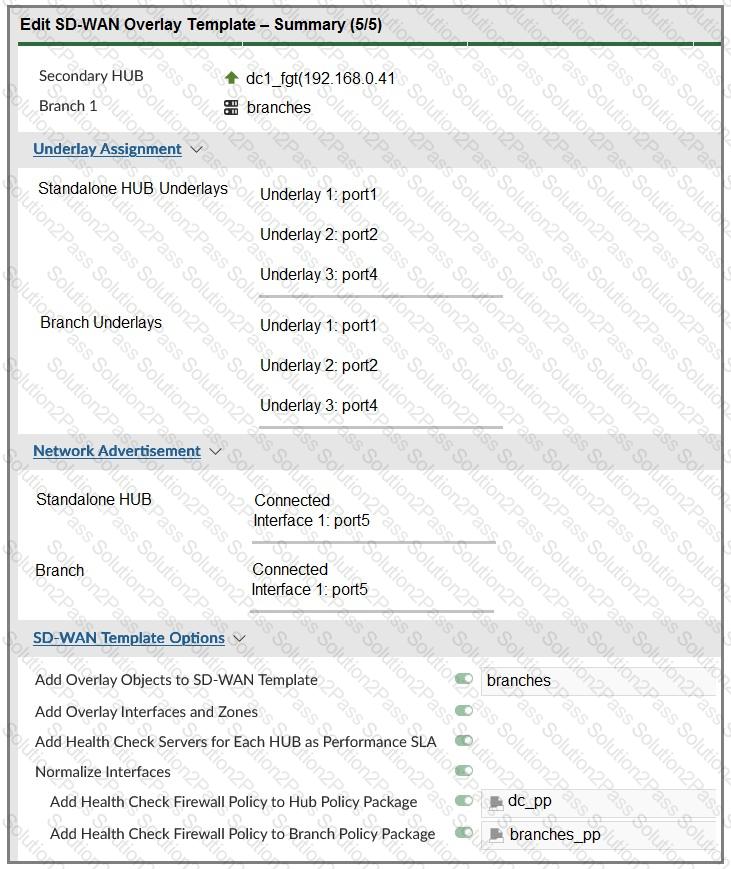
(Refer to the exhibits.

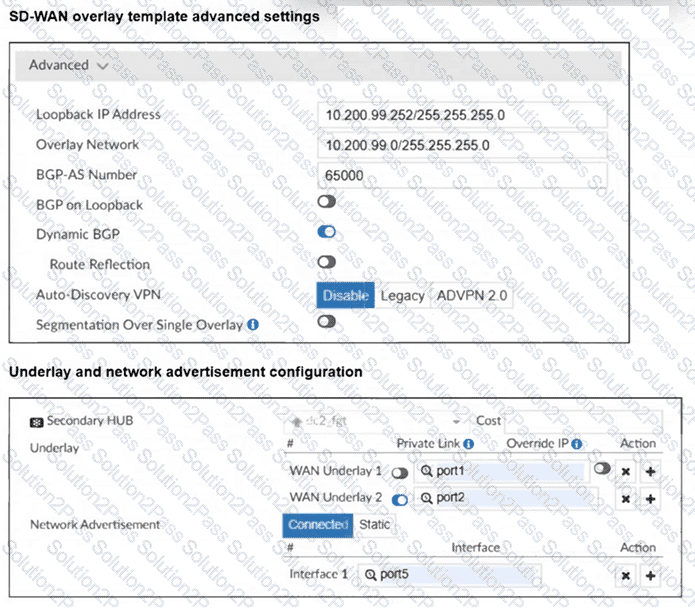
The SD-WAN overlay template advanced settings and the underlay and network advertisement settings are shown. These are the configurations for the secondary hub of a dual-hub SD-WAN topology created with the FortiManager SD-WAN overlay orchestrator.

Which two conclusions can you draw from the information shown in the exhibits? Choose two answers.)

A.

FortiManager will define port2 as a BGP neighbor.

B.

FortiManager will create an overlay tunnel on the port2 interface.

C.

FortiManager will create an overlay tunnel on the port1 interface.

D.

FortiManager will define port5 as a BGP neighbor.

Refer to the exhibit.

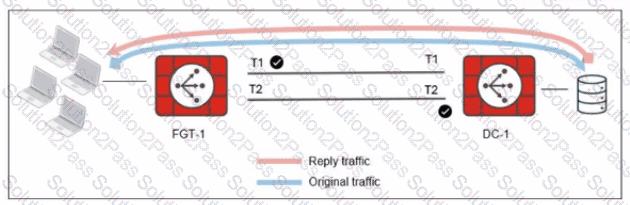
The administrator analyzed the traffic between a branch FortiGate and the server located in the data center, and noticed the behavior shown in the diagram.

When the LAN clients located behind FGT1 establish a session to a server behind DC-1, the administrator observes that, on DC-1, the reply traffic is routed overT2. even though T1 is the preferred member in

the matching SD-WAN rule.

What can the administrator do to instruct DC-1 to route the reply traffic through the member with the best performance?

A.

Enable snat-route-change under config system global.

B.

Enable reply-session under config system sdwan.

C.

Enable auxiliary-session under config system settings.

D.

FortiGate route lookup for reply traffic only considers routes over the original ingress interface.

Page: 1 / 2
Total 94 questions
Copyright © 2014-2026 Solution2Pass. All Rights Reserved