Winter Sale Limited Time 65% Discount Offer - Ends in 0d 00h 00m 00s - Coupon code: s2p65

Easiest Solution 2 Pass Your Certification Exams

NSE6_SDW_AD-7.6 Fortinet NSE 6 - SD-WAN 7.6 Enterprise Administrator Free Practice Exam Questions (2026 Updated)

Prepare effectively for your Fortinet NSE6_SDW_AD-7.6 Fortinet NSE 6 - SD-WAN 7.6 Enterprise Administrator certification with our extensive collection of free, high-quality practice questions. Each question is designed to mirror the actual exam format and objectives, complete with comprehensive answers and detailed explanations. Our materials are regularly updated for 2026, ensuring you have the most current resources to build confidence and succeed on your first attempt.

Page: 2 / 2
Total 95 questions

(Refer to the exhibits.

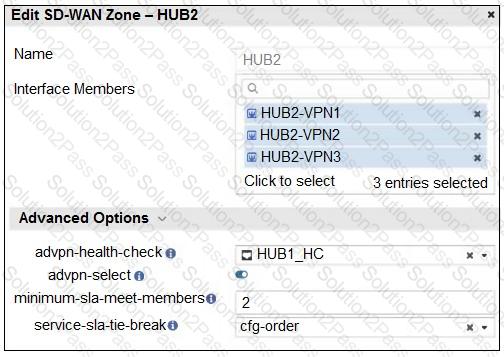
The SD-WAN overlay template advanced settings and the underlay and network advertisement settings are shown. These are the configurations for the secondary hub of a dual-hub SD-WAN topology created with the FortiManager SD-WAN overlay orchestrator.

Which two conclusions can you draw from the information shown in the exhibits? Choose two answers.)

A.

FortiManager will define port2 as a BGP neighbor.

B.

FortiManager will create an overlay tunnel on the port2 interface.

C.

FortiManager will create an overlay tunnel on the port1 interface.

D.

FortiManager will define port5 as a BGP neighbor.

(Refer to the exhibit.

Which statement correctly describes the role of the ADVPN device in handling traffic? Choose one answer.)

A.

This device is a spoke that has received a direct shortcut query from a remote spoke.

B.

This device is a hub, and two spokes, 192.2.0.1 and 10.0.3.101, established a shortcut.

C.

This device is a hub that has received a shortcut query from a spoke and has forwarded it to another spoke.

D.

This device is a spoke that has received a shortcut query from a remote hub.

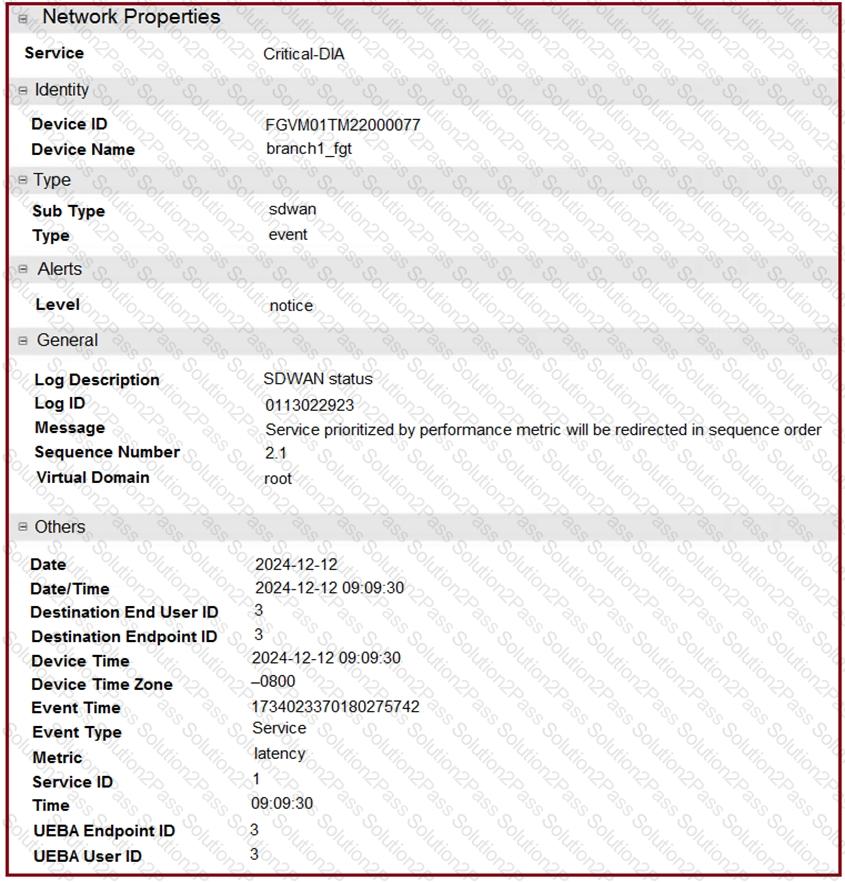
Refer to the exhibit.

An administrator is troubleshooting SD-WAN on FortiGate. A device behind branch1_fgt generates traffic to the 10.0.0.0/8 network.

The administrator expects the traffic to match SD-WAN rule ID 1 and be routed over HUB1-VPN1. However, the traffic is routed over HUB1-VPN3.

Based on the output shown in the exhibit, which two reasons, individually or together, could explain the observed behavior? (Choose two.)

A.

HUB1-VPN3 has a higher member configuration priority than HUB1-VPN1.

B.

The traffic matches a regular policy route configured with HUB1-VPN3 as the outgoing device

C.

HUB1-VPN1 does not have a valid route to the destination

D.

HUB1-VPN3 has a lower route priority value (higher priority) than HUB1-VPN1.

Refer to the exhibit.

What conclusions can you draw about the traffic received by FortiGate originating from the source LAN device 10.0.1.133 and destined for the company’s SMTP mail server at 10.66.0.125?

A.

FortiGate steers the traffic from the LAN device 10.0.1.133 to the company SMTP mail server 10.66 0.125 through port3.

B.

ForliGate steers the traffic from the LAN device 10.0.1.133 to the company SMTP mail server 10.66.0.125 through port2.

C.

FortiGate steers the traffic from the LAN device 10.0.1.133 to the company SMTP mail server 10.66.0.125 through the SD-WAN member ID 4.

D.

FortiGate steers the traffic from the LAN device 10.0.1.133 to the SMTP mail server 10.66.0.125 through the SD-WAN member ID 1 or 2.

Exhibit.

The administrator configured the IPsec tunnel VPN1 on a FortiGate device with the parameters shown in exhibit.

Based on the configuration, which three conclusions can you draw about the characteristics and requirements of the VPN tunnel? (Choose three.)

A.

The tunnel interface IP address on the spoke side is provided by the hub.

B.

The remote end can be a third-party IPsec device.

C.

The administrator must manually assign the tunnel interface IP address on the hub side

D.

The remote end must support IKEv2.

E.

This configuration allows user-defined overlay IP addresses.

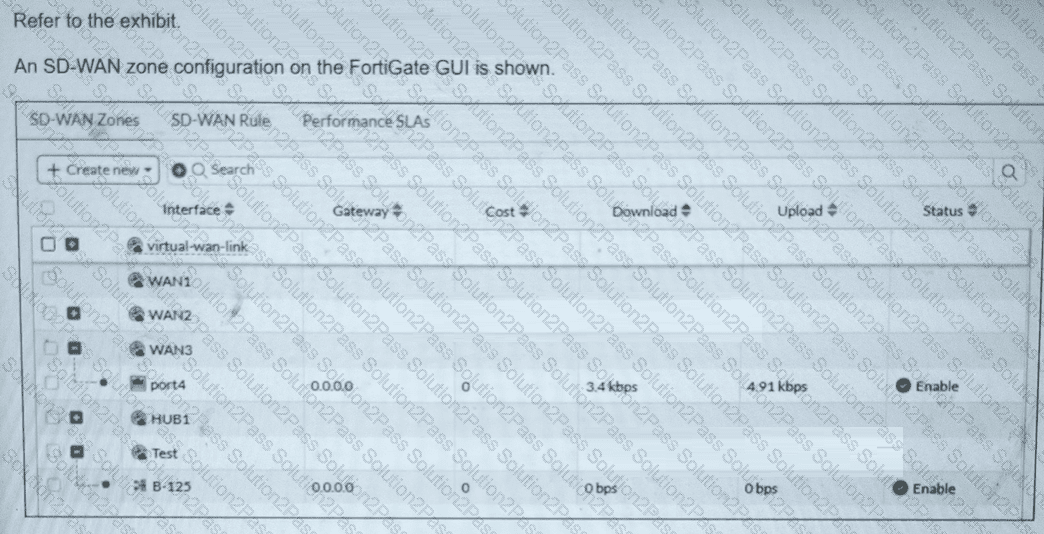
(Refer to the exhibit.

An SD-WAN zone configuration on the FortiGate GUI is shown.

What can you conclude about the zone and member configuration on this device? Choose one answer.)

A.

You can delete the virtual-wan-link zone.

B.

The WAN2 zone contains no member.

C.

You can delete the WAN1 zone.

D.

You can add the member B-125 to the WAN3 zone and keep it as a member of the Test zone.

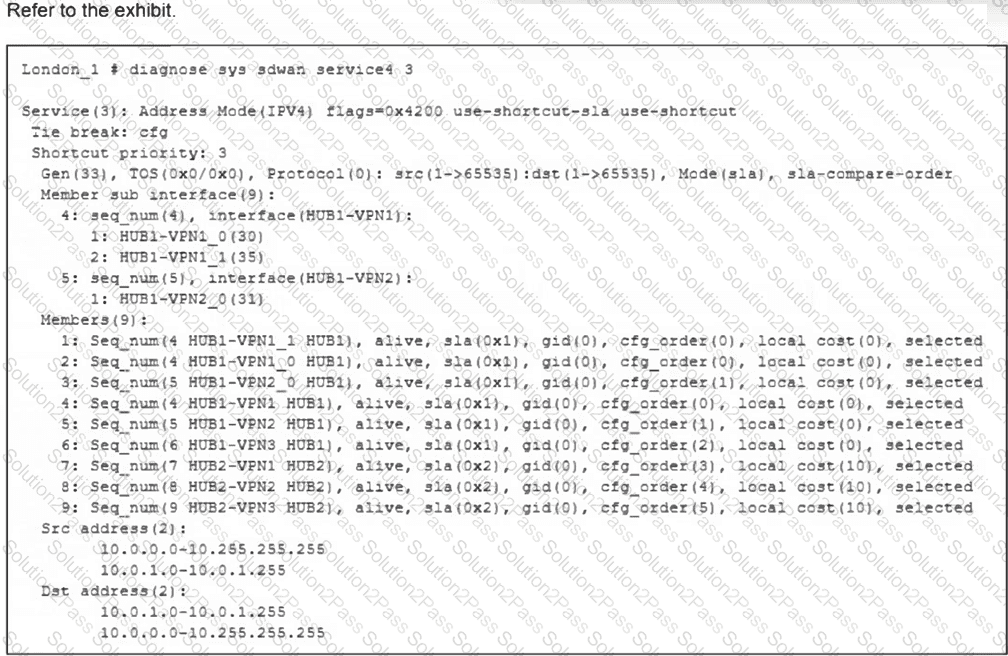
(Refer to the exhibits. You collected the output shown in the exhibits and want to know which interface TCP traffic will flow through from the user device 10.0.1.101 to the corporate file server 10.0.0.125. All SD-WAN links are stable.

Which interface will FortiGate use to steer the traffic? Choose one answer.)

A.

Only HUB1-VPN1

B.

Either HUB1-VPN1 or HUB1-VPN2

C.

Only HUB1-VPN2

D.

Either HUB1-VPN1, HUB1-VPN2, or HUB1-VPN3

Refer to the exhibit.

An administrator configures SD-WAN rules for a DIA setup using the FortiGate GUI. The page to configure the source and destination part of the rule looks as shown in the exhibit. The GUI page shows no option to configure an application as the destination of the SD-WAN rule Why?

A.

You cannot use applications as the destination when FortiGate is used for a DIA setup.

B.

FortiGate allows the configuration of applications as the destination of SD-WAN rules only on the CLI.

C.

You must enable the feature on the CLI.

D.

You must enable the feature first using the GUI menu System > Feature Visibility.

Page: 2 / 2
Total 95 questions
Copyright © 2014-2026 Solution2Pass. All Rights Reserved