SCR GARP Sustainability and Climate Risk Free Practice Exam Questions (2026 Updated)
Prepare effectively for your GARP SCR Sustainability and Climate Risk certification with our extensive collection of free, high-quality practice questions. Each question is designed to mirror the actual exam format and objectives, complete with comprehensive answers and detailed explanations. Our materials are regularly updated for 2026, ensuring you have the most current resources to build confidence and succeed on your first attempt.
A city planning commissioner consults with climate scientists to assess the impact of sea level rise on strategic infrastructure projects. The scientists discuss several climate model projections and indicate sea level rise has a fundamental relationship to GHG emissions, regardless of a specific warming scenario.
How should the scientists describe this relationship?
A venture capital coalition integrates ESG considerations into an investment strategy for generative AI startups. An external consultant assesses sustainability risks to align coalition strategy with ESG benchmarks. Which of the following insights will most effectively inform the coalition investment strategy?
A risk manager at an investment bank works on a climate disclosure project for a bank portfolio. To understand the climate impacts on the investment portfolio, the risk manager evaluates different metrics to measure climate risk exposure. The manager selects a metric that can be easily applied across asset classes. While the metric is sensitive to outliers, calculating the metric is simple and easy to communicate to investors. Which metric did the manager most likely select to measure climate risk exposure?
An investment analyst assesses climate-related stranded asset risk for a portfolio of energy companies. The analyst develops a list of companies potentially exhibiting stranded asset risk. After a more granular examination, the analyst summarizes corporate activity in the following table:
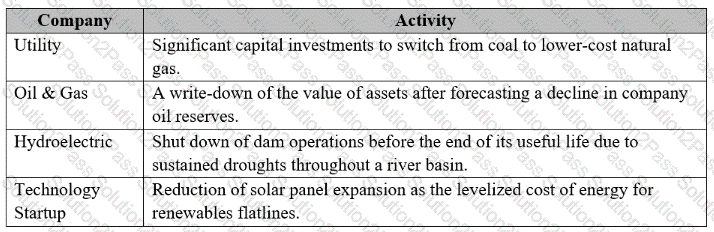
The analyst identifies the company with the highest stranded asset exposure for possible divestment. Which company does the analyst recommend for divestment?
A bank assesses lending portfolio alignment with various climate change scenarios. To assist in this process, the risk team applies the Paris Agreement Capital Transition Assessment (PACTA) tool to examine transition risk for power generation, automotive, and steel sectors. The team examines different PACTA metrics for each sector based on data availability and sectoral profile.
For sectors with no clear zero-carbon pathway, what metric will PACTA employ?
A multi-industry consortium convenes risk managers from across the globe to discuss climate impacts on global trade and economic growth. A climate modeler leads a discussion on macro-level physical changes in the Earth’s atmosphere and highlights two climatic trends that demonstrate an inverse relationship in recent decades.
What two trends does the modeler highlight?
Senior management of a sportswear manufacturer will issue a bond to optimize company capital structure, while providing investors with an opportunity to contribute to positive transformation of the fashion industry. Management prefers a bond with a high rate of issuance, and the company sustainability team researches various green and sustainable finance instruments and issuance information over the past 5 years. The team recommends a bond that globally posted the highest growth in issuance between 2019 and 2020.
Which bond did the team recommend?
Alimento Y Agricultura (AYA) is a food and agriculture conglomerate headquartered in Costa Rica with operations throughout Central America. AYA historically produced coffee, bananas, and sugar. Over the last decade, the company growing region experienced climate-related crop production challenges. The region suffered prolonged drought conditions and severe flooding events. AYA leadership may relocate existing coffee farm locations in response to these climate stressors.
Last year Costa Rica introduced mandatory climate risk reporting aligned with ISSB standards The government mandate compelled AYA to enhance its transition and physical risk assessment across the company. A newly formed sustainability governance team prioritizes the following objectives:
• Update TCFD reporting with new ISSB IFRS S2 requirements
• Initiate more comprehensive scenario analysis
• Conduct nature and water risk assessments
AYA previously reported climate risks aligned with all TCFD pillars, risk categories, and scenario analysis recommendations. Reporting includes all Scope 1 and Scope 2 emissions, reduction targets, and appointments of board officers responsible for climate risks. Scenario analysis is used to assess all banana, coffee, and sugar production climate risk exposure.
AYA uses 2°C and 4°C climate scenarios to assess company impacts from physical and transition risk. Under the 2°C scenario transition risk increases, while under the 4°C scenario water risk significantly increases.
AYA appoints an SCR certificate holder to the position of nature risk manager to advance nature-based assessments. The manager contracts with a nature risk consultancy to better understand and manage exposure to nature-related risks and impacts. The consultancy identifies crop production, water quality, and water quantity as the primary nature-based risks.
The consultancy produces the following graph to demonstrate coffee crop productivity:
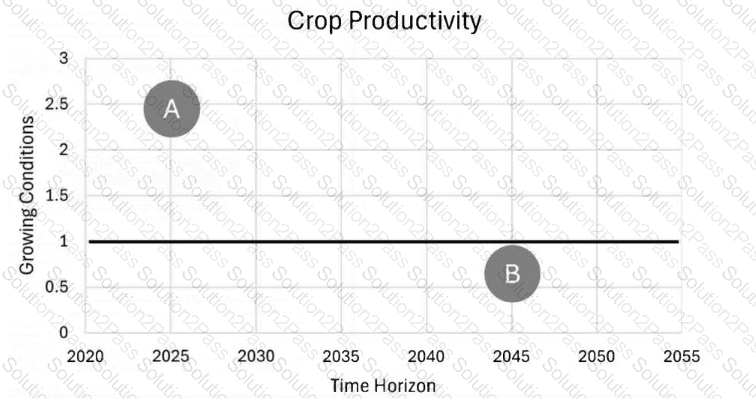
If growing conditions fall below 1, it is not economical for AYA to continue coffee production in the region. Point A indicates current growing conditions. Point B is a forecast of future conditions under a 4°C scenario, created by the consultancy model.
After identifying nature risks broadly, AYA performs a water risk assessment (WRA). The WRA assesses historical and future water withdrawal rates and identifies operational water dependencies.
Following the WRA, the company engages with existing stakeholders to adapt existing business strategy. AYA initiates a pilot project with upstream farmers to protect their land. AYA will either train or pay local farmers to plant shrubbery and buffer zones to reduce erosion and runoff of sediments, nutrients, and pathogens from local crop production and industry.
Which LEAP concept best describes Point A in the context of coffee growing conditions?
Leaders of an energy company meet to address physical and transition risks to company operations. At the meeting, the CRO recommends a strategy to mitigate physical climate risk to the company. Which of the following strategies will the CRO most likely recommend?
An ESG scorecard for sovereign debt issuers has the following information:
Country 1No carbon policy and high corruption risk
Country 2High-level carbon policy and low corruption risk
Country 3Detailed carbon policy and low corruption risk
Based only on this information, the country with the lowest ESG risk is:
A climate scientist is invited to a morning news program to discuss human influence on Earth’s climate. Prior to the program, a producer asserts climate change is a natural process, citing Earth’s historical climate shifts. What example does the scientist most likely provide to highlight human influence on climate?
A European bank surveyed its most prominent clients to assess interest in sustainability-linked loans (SLLs) and green loans. The survey came after a recent study showed higher profitability rates of SLLs and green products than classical banking products. After positive feedback, the bank decides to introduce SLLs and green loans. The bank’s sustainability loan officer writes a new loan product guideline for corporate clients that explains SLLs and green loans.
How will the bank officer describe these loan types?
Which of the following is an example of a just’ transition with regards to climate change?
In response to consumer demand for eco-friendly products, a global personal care company develops a net-zero transition plan. The company sustainability team recommends an appropriate carbon accounting method for the plan. Which of the following country-level emission accounting methods is most likely recommended and why?
The board of directors of a growing asset management firm recommends the firm expand its ERM framework to incorporate climate risks. In response, the risk team references the COSO ERM framework for applying ESG-related risks to develop and propose a strategy to implement climate risk into the various ERM components.
How will the risk team modify the existing strategy component of the company’s ERM framework?
After launching new large-scale sites for engine testing, a global automaker prepares a GHG inventory report according to the GHG Protocol. An analyst on the sustainability team gathers data for the assessment. The analyst identifies emissions from production processes, previously deemed irrelevant at the corporate level, now constitute over 25% of company aggregated GHG emissions across plant sites.
Which GHG Protocol principle did the company analyst follow?
In response to a survey showing consumers consider sustainability a key factor in purchasing decisions, a group of cosmetics companies announce a collaboration to develop an environmental impact assessment and sustainability framework for cosmetics products. The framework enables customers to evaluate the environmental impact of products they purchase. The framework draft includes definitions of climate, green, and sustainable finance.
Which of the following definitions is appropriate for the proposed framework?
In response to policy and technology changes, a cement manufacturer looks for new opportunities to raise profits by reducing GHG emissions. Because the cement industry accounts for a considerable percentage of global emissions, the manufacturer joins a coalition of company peers. The coalition lobbies country governments to adhere to the Paris Agreement nationally determined contributions (NDCs).
Which of the following actions does the coalition recommend?
A multinational footwear company prepares its annual GHG inventory. The company sustainability director organizes data according to the GHG Protocol and prepares a set of recommended actions to lower company emissions.
Which action is the director most likely to recommend to reduce company Scope 3 emissions?
The CRO for a large agriculture company reviews reference scenarios as part of an annual climate scenario analysis exercise. The CRO creates a transition risk matrix that compares four different scenarios - W, X, Y, Z. Scenarios are compared according to scale of emissions cuts and pace of emission cuts. Scale is depicted as business as usual (BAU) to net-zero. Pace is depicted as orderly to disorderly. The CRO uses this matrix to explain transition risk to the company’s executive members:
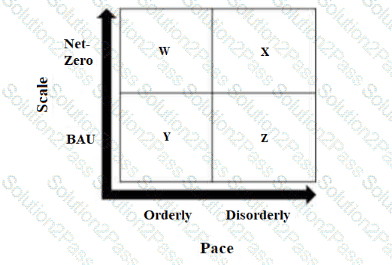
How should the CRO rank the reference scenarios from lowest level of transition risk to highest level of transition risk?