HPE7-A07 HP Aruba Certified Campus Access Mobility Expert Written Exam Free Practice Exam Questions (2026 Updated)
Prepare effectively for your HP HPE7-A07 Aruba Certified Campus Access Mobility Expert Written Exam certification with our extensive collection of free, high-quality practice questions. Each question is designed to mirror the actual exam format and objectives, complete with comprehensive answers and detailed explanations. Our materials are regularly updated for 2026, ensuring you have the most current resources to build confidence and succeed on your first attempt.
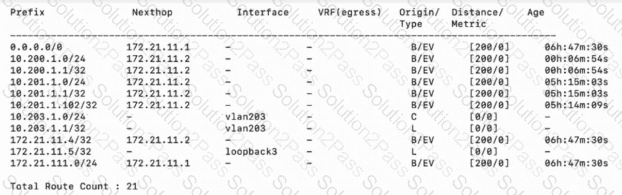
Which statement is true given the following CLI output from a CX 6300?
What directly affects the MCS used by wireless stations? (Select two.)
Exhibit.
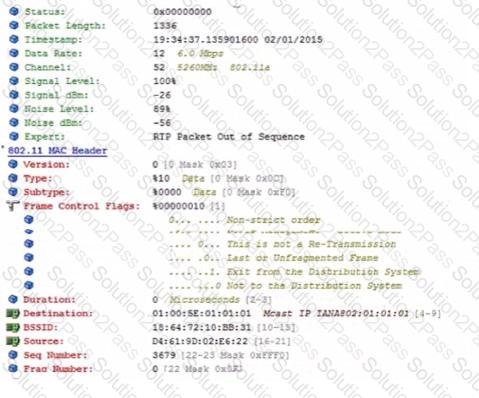
A university runs its own TV station in the city The IT department deploys a multimedia server so the TV productions can be sent out to the entire campus over the IP network using multicast-based communications in order to improve the bandwidth consumption. PlM sparse Mode and IGMP snooping features are enabled.
When wireless users join the multicast groups, all users connected to the same WLAN experience poor network performance. However, wired users are not affected in this way While troubleshooting the network administrator saves the packet captures shown in the exhibit and concludes that all users even those not joining the multicast group, receive the same multicast flow at slow speeds.
Which features should the network administrator enable to fix the problem?
Exhibit.
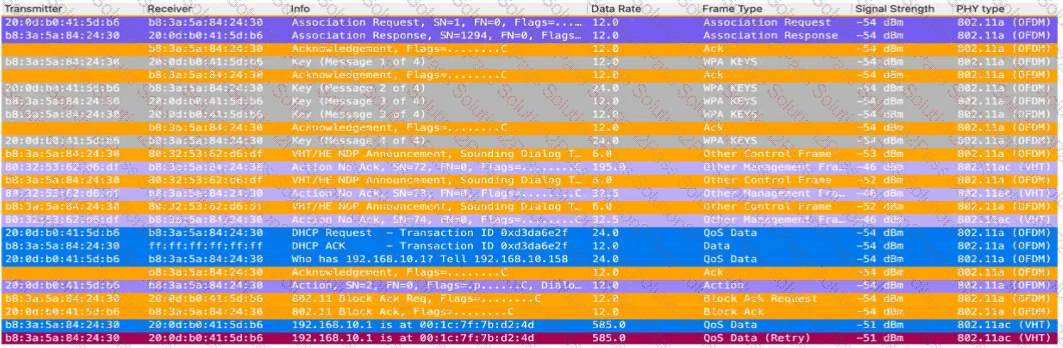
A customer is reporting mat connectivity is Tailing for some wireless client Devices. What are your conclusions from the capture? (Select two.)
A customer would like to allow their IT Helpdesk to configure IoT devices to connect to a single SSID using a unique PSK that other devices cannot use.
Which solution would you recommend?
You configured" a bridged mode SSID with WPA3-Enterprise and EAP-TLS security. When you connect an Active Directory joined client that has valid client certificates. ClearPass shows the following error.
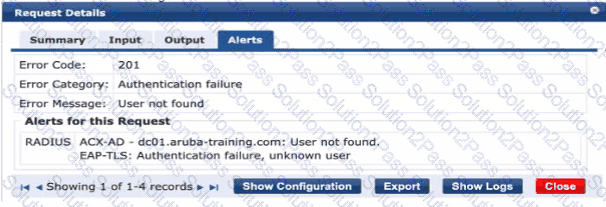
What is needed to resolve this issue?
A client connecting to a tunneled open network is receiving the wrong VLAN Your customer has a gateway and has sent over a packet capture from a switch port mirror taken from the upstream switch with a packet capture from the IPsec tunnel and the GRE tunnel to help Identify the VLAN being sent from the controller to the AP.
Where will you see the VLAN assignment?
An ACME company employee complained about a recent poor-quality VoIP call while moving around their office environment HPE Aruba Networking Central reported a fair UCC score for this call while your VoIP engineer reported that their systems reported a MOS of 2, 3. The VoIP devices are operating over the 5GHz frequency band.
What are the possible contributing factors? (Select two.)
A customer's infrastructure is set up to use both primary and secondary gateway clusters on the SSID profile based on best practices. Why do they have an equal split of their 260 APs across the primary and secondary gateway clusters?
Match each Group Based Policy (GBP) rote description to its respective role ID.


Refer to the exhibit.
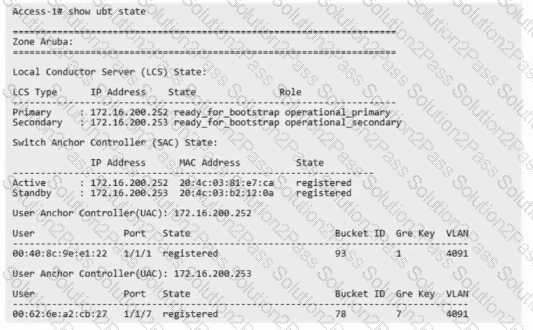
To which devices has AP-1 established tunnels?
A customer is evaluating device profiles on a CX 6300 switch. The test device has the following attribute:
MAC address = 81:cd:93:13:ab:31
The test device needs to be assigned the "iot-prod" role. In addition, the "iot-default" role must be applied for any other device connected to interface 1/1/1.
This is a lab environment with no configuration of any external authentication server for the test.

Given the configuration example, what is required to meet this testing requirement?
A customer wan a gateway connected to a device on gigabitethernet 0/0/3 configures an Asset ID TLV on the device for inventory management.
Exhibit.
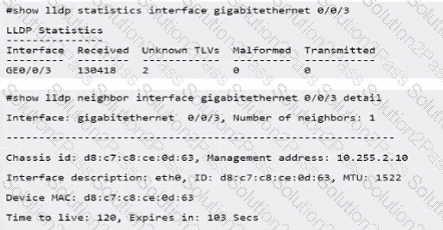
The customer mentions me Asset ID is not shown What is causing the issue?
You recently added HPE Aruba Networking ClearPass as an authentication server to a group in HPE Aruba Networking Central. RADIUS authentication with Local User Roles (LUR) works fine, but the same access points cannot use Downloadable User Roles (DUR).
What should be corrected in this configuration to fix the issue with DUR?
You are troubleshooting a WLAN deployment with APs and gateways set up with an 802.1X tunneled SSIO. End-users are complaining that they can’t connect to die enterprise SSID. Which possible AP tunnel states could be the cause of the Issue? (Select two.)