Pre-Winter Sale Special - Limited Time 70% Discount Offer - Ends in 0d 00h 00m 00s - Coupon code: xmaspas7

Easiest Solution 2 Pass Your Certification Exams

JN0-106 Juniper Junos - Associate (JNCIA-Junos) Junos OS 21.2 Free Practice Exam Questions (2026 Updated)

Prepare effectively for your Juniper JN0-106 Junos - Associate (JNCIA-Junos) Junos OS 21.2 certification with our extensive collection of free, high-quality practice questions. Each question is designed to mirror the actual exam format and objectives, complete with comprehensive answers and detailed explanations. Our materials are regularly updated for 2026, ensuring you have the most current resources to build confidence and succeed on your first attempt.

Page: 1 / 2
Total 99 questions

Which two statements are correct about a Routing Engine? (Choose two.)

A.

It processes management traffic.

B.

It processes CoS marked traffic.

C.

It forwards transit traffic.

D.

It maintains routing tables.

Which two operational mode commands would you use to verify CPU and memory utilization on a Junos device? (Choose two.)

A.

show chassis routing-engine

B.

show chassis environment

C.

show system processes extensive

D.

show system resource-monitor summary

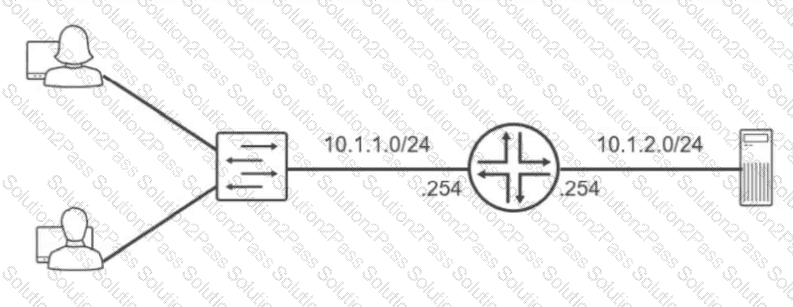
Exhibit:

Referring to the exhibit, which routing configuration is required for these two users to access the remote server?

A.

Users and the server require a default gateway.

B.

Trunk ports must be enabled on the switch.

C.

Users must connect directly to the router.

D.

A routing protocol must be enabled on the router.

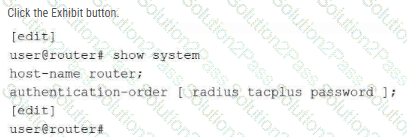
Exhibit:

You have configured multiple authentication methods on your Junos device, including RADIUS, TACACS+, and local user accounts. A user attempts to log in, but the RADIUS server is unavailable. Referring to the exhibit, which statement is correct?

A.

The user is prompted to select a different authentication method.

B.

The login attempt fails immediately.

C.

Junos will continue to attempt to authenticate with the RADIUS server until it responds.

D.

Junos attempts the next configured authentication method.

Which statement describes the primary purpose of a routing policy in Junos OS?

A.

It controls which routes are accepted or advertised by a routing protocol. B. It determines the physical interface used for forwarding traffic. C. It sets the maximum number of routes in the routing table. D. It enables automatic rollback of routing changes.

Which two statements are correct about Junos OS? (Choose two.)

A.

Junos OS provides the ability to run unsigned third-party binaries.

B.

Junos OS provides modularization of software processes.

C.

Junos OS combines security and routing policies.

D.

Junos OS separates the control plane and the forwarding plane.

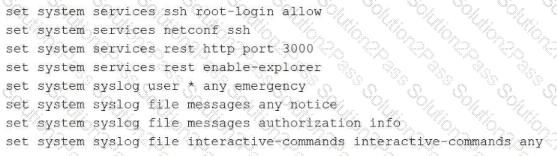
Click the Exhibit button.

Which command displays the output in the format shown in the exhibit?

A.

show configuration | display inheritance

B.

show configuration | display set

C.

show configuration

D.

show configuration | display detail

Your team alerts you that users connected to ge-0/0/5 are experiencing intermittent slowness. You log in to the switch and want to see live, real-time traffic updates for that interface to determine whether the link is being over-utilized. Which monitoring command should you use in this scenario?

A.

show chassis hardware

B.

monitor interface ge-0/0/5

C.

show interfaces terse

D.

show interfaces ge-0/0/5 extensive

What are two fiber-optic connector types? (Choose two.)

A.

LC

B.

RJ-45

C.

SC

D.

BNC

You are using the factory default configuration on a new Juniper router. You must successfully commit the configuration and activate the device. Which component must be configured before Junos OS will allow you to accomplish this task?

A.

a system hostname

B.

a root-authentication password

C.

at least one logical interface with family inet enabled

D.

a management IP address on the fxp0 interface

Which routing table is used for IPv6 unicast routes by default?
A.

inet.0

B.

inet.6

C.

inet.1

D.

inet6.0

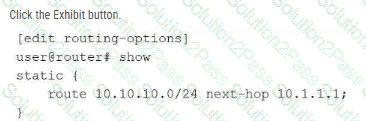
Referring to the exhibit, you are configuring a Junos router to provide connectivity to a building across town on the network 10.10.10.0/24. The next-hop router is at 10.10.1.1, which is reachable using interface ge-0/0/1. After committing the configuration in the exhibit, users report they still cannot reach the 10.10.10.0/24 network, and the route does not appear as active in the routing table. In this scenario, which statement is correct?

A.

The next-hop address 10.1.1.1 is not directly connected or reachable through another route.

B.

Static routes must include the outgoing interface as the next hop.

C.

The static route requires a preference value to be specified or it will not install.

D.

The static route requires the retain keyword to remain active in the routing table.

Which two functions are performed by the PFE? (Choose two.)

A.

It maintains the routing table.

B.

It implements firewall filters.

C.

It selects active routes.

D.

It forwards transit traffic.

Your switch01 device lost network connectivity after a configuration change. You must recover the device to a known working state using the rescue configuration that was previously saved. The device is only accessible using the console. In this scenario, which command sequence will successfully restore the rescue configuration?

A.

user@switch01 > configure

[edit]

user@switch01# load override rescue

[edit]

user@switch01# commit

B.

user@switch01 > request system configuration rescue delete

user@switch01 > reboot

C.

user@switch01 > configure

[edit]

user@switch01# rollback rescue

load complete

[edit]

user@switch01# commit

D.

user@switch01 > request system configuration rescue save

user@switch01 > configure

[edit]

user@switch01# commit

What are two requirements for root password recovery in Junos? (Choose two.)

A.

You must have console access to the device.

B.

You must have saved the rescue configuration in advance.

C.

You must load the factory default configuration.

D.

You must reboot the device.

What information would you find using the CLI help command?

A.

a URL for accessing the technical documentation

B.

message of the day

C.

hyperlinks for remediation actions

D.

an explanation for specific system log error messages

What are two characteristics of IPv6 addressing? (Choose two.)

A.

The IPv6 address is represented by a 128-bit address.

B.

The IPv6 header automatically includes a checksum.

C.

IPv6 uses ARP to discover neighboring devices.

D.

IPv6 addresses that begin with fe80 are not routable.

Your routing policy has three terms. A route matches the first term with an accept action. In this scenario, what happens next?

A.

The route is rejected by default.

B.

The route is evaluated by the second term.

C.

The route is sent to the next policy chain.

D.

The route is accepted and no further terms are evaluated.

Which two statements about prefix lists in Junos are correct? (Choose two.)

A.

Prefix lists can be re-used in multiple routing policies.

B.

Prefix lists can be used in both firewall filters and routing policies.

C.

Prefix lists cannot be used in routing policies.

D.

Prefix lists cannot be used in firewall filters.

Which two statements accurately describe the relationship between the routing table and the forwarding table on a Junos device? (Choose two.)

A.

The routing table resides in the data plane for fast lookups.

B.

The routing table selects the best route based on routing information.

C.

The forwarding table is built from the routing table.

D.

The routing table is built from the forwarding table.

Page: 1 / 2
Total 99 questions
Copyright © 2014-2026 Solution2Pass. All Rights Reserved