Pre-Summer Sale Special - Limited Time 70% Discount Offer - Ends in 0d 00h 00m 00s - Coupon code: xmaspas7

Easiest Solution 2 Pass Your Certification Exams

NCP-NS-7.5 Nutanix Certified Professional - Network and Security (NCP-NS) 7.5 Free Practice Exam Questions (2026 Updated)

Prepare effectively for your Nutanix NCP-NS-7.5 Nutanix Certified Professional - Network and Security (NCP-NS) 7.5 certification with our extensive collection of free, high-quality practice questions. Each question is designed to mirror the actual exam format and objectives, complete with comprehensive answers and detailed explanations. Our materials are regularly updated for 2026, ensuring you have the most current resources to build confidence and succeed on your first attempt.

Page: 2 / 2
Total 106 questions

An enterprise has deployed a VPC called FinanceVPC using Nutanix Flow Virtual Networking. The Finance team needs the following connectivity: Internal servers in the VPC must reach an on-premises corporate data-center via a point-to-point encrypted link. Some servers in the VPC must also access the public internet with source NAT and receive inbound access via floating IPs. The corporate network uses overlapping IP space with other VPCs in the environment, so address translation is necessary for those workloads. The networking design must support routing via BGP for future site expansions and provide low-latency north-south connectivity. Which actions should the administrator take to satisfy this requirement?

A.

Use two No-NAT External Networks—one for the on-prem link and one for Internet access; configure static routes for both without NAT.

B.

Use a single No-NAT External Network for both on-prem and Internet access; configure BGP and direct routing out to the internet without NAT.

C.

Use a No-NAT External Network for the on-premises link and a NAT External Network for Internet access. Configure a VPN tunnel to the on-premises location and enable BGP on the VPC router for the on-premises link.

D.

Use a single NAT External Network for both the on-prem link and Internet access; configure a default route to the external network and enable SNAT and floating IPs for all traffic.

Exhibit:

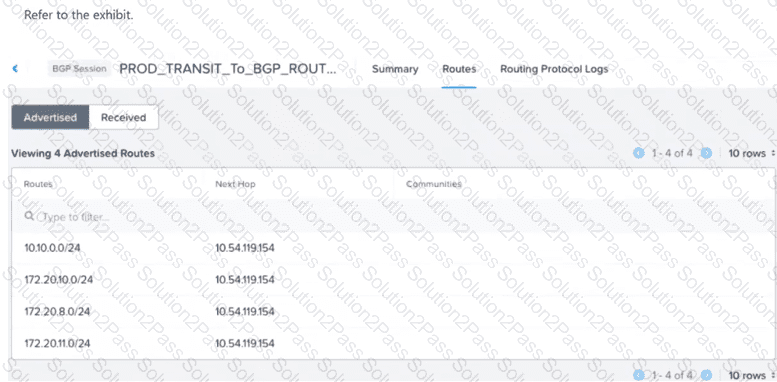
A VM with IP address 172.20.9.5 resides on a subnet with CIDR 172.20.9.0/24. The VPC is successfully peered via BGP with an external router... External networks outside the VPC are unable to reach the VM. What configuration change should be made to enable reachability for the VM?

A.

Modify the ERP values within the VPC to advertise a CIDR of 172.20.8.0/22

B.

Apply a PBR rule for the VM's address forwarding traffic to the IP of the No-NAT external Gateway address

C.

Apply a default route to the VPC sending all traffic to the NAT External Network

D.

Associate a NAT external network to the VPC and apply a floating IP address to the VM

Which statement accurately describes the behavior of a Flow Network Security policy operating in Monitor mode?

A.

All matching traffic is discovered and denied, but not allowed.

B.

Traffic is blocked unless it matches an "allow" rule in Enforce mode.

C.

Only East-West traffic is discovered, but North-South traffic is not.

D.

All matching traffic is discovered and allowed, but not blocked.

An administrator creates a VPC named AppVPC1 in Nutanix Cloud Infrastructure (NCI) with separate subnets for the web, app, and database tiers. The database subnet must remain isolated from external networks; however, all tiers need to communicate with each other internally. What should the administrator configure to limit external access to only the web and app subnets?

A.

Enable NAT Gateway on the database subnet for outbound communication.

B.

Configure a routing policy in the VPC to deny external traffic to and from the database subnet.

C.

Attach the web and app subnets to the external network through an AHV managed bridge.

D.

Create Static Routes on the physical network to interconnect the VPC subnets.

What is the role of the Network Controller in Flow Virtual Networking?

A.

Distribute the network traffic load across multiple guest VMs efficiently.

B.

It enables you to configure and manage common administrative tasks that are applicable to the platform and various Nutanix apps.

C.

It is used to create VPN, VTEP, or BGP gateways to connect subnets using VPN connections, Layer 2 subnet extensions over VPN or VTEP, or over BGP session.

D.

It manages configuration, monitoring, and optimization of network resources.

An administrator has configured a VPC with multiple overlay subnets and attached a VPN gateway using IPSec. After enabling Jumbo Frames on the physical network, VMs are still experiencing packet drops. What is the most likely reason?

A.

MTU on guest VMs exceeds recommended size for IPSec.

B.

DHCP relay is misconfigured.

C.

Jumbo frames are not supported on overlay subnets.

D.

Floating IP is missing on the VPN gateway.

An administrator needs to isolate communication between VMs in Production and Development environments. Each VM is categorized by Environment and Site category values. The administrator wants this isolation to apply only to VMs located at Site: Branch-001. Which configuration best meets the requirement?

A.

Create a Quarantine Policy between Environment:Production and Environment:Development. Scope the policy to Site: Branch-001.

B.

Create a Quarantine Policy blocking traffic between (Environment: Production + Site: Branch-001) and (Environment: Development + Site: Branch-001).

C.

Create an Isolation Policy between Environment:Production and Environment:Development. Scope the policy to Site: Branch-001.

D.

Create an Isolation Policy blocking traffic between (Environment: Production + Site: Branch-001) and (Environment: Development + Site: Branch-001).

Which two statements are true with respect to Flow Network Security Policies? (Choose two.)

A.

Flow Network Security is a stateful firewall.

B.

Flow Network Security supports L3 and L4-based firewall rules.

C.

Flow Network Security supports L7-based firewall rules.

D.

Flow Network Security supports rules based on L2 MAC Addresses.

An administrator uses Nutanix Flow to secure a three-tier application (Web, App, and Database tiers). After observing the traffic, they find that: The Web tier communicates with the App tier over HTTP (port 80) The App tier communicates with the Database tier over TCP port 1433 The Database tier does not initiate connections The Web tier receives inbound HTTP traffic from the corporate DMZ on port 8080 No other traffic should be allowed What should the administrator do to document and then securely apply these flows in Nutanix Flow?

A.

Use Flow Network Visualization to capture observed flows and convert them into microsegmentation security policies.

B.

Add all VMs to a single security policy to simplify communication.

C.

Disable traffic-flow discovery and configure all policies manually.

D.

Manually create isolation policies between all VMs in the environment.

A VM with IP address 172.20.10.5 on a Subnet with CIDR 172.20.10.0/24 is unable to be routed externally from the VPC. The VPC is successfully peered via BGP... However, when checking the BGP Session, no routes are being advertised by the VPC. What is the most likely configuration issue?

A.

There is no default route within the VPC to send traffic to the NAT external network.

B.

The VM does not have a Floating IP assigned to allow external connectivity.

C.

The VPC does not have a NO-NAT network configured to advertise the routes.

D.

A network Policy is blocking outbound access for the VM.

Which two options are supported as a Secured Entity in Flow Network Security Application Policies? (Choose two.)

A.

Subnet Category

B.

vNIC Category

C.

VPC Category

D.

VG Category

Page: 2 / 2
Total 106 questions
Copyright © 2014-2026 Solution2Pass. All Rights Reserved