NCP-NS-7.5 Nutanix Certified Professional - Network and Security (NCP-NS) 7.5 Free Practice Exam Questions (2026 Updated)
Prepare effectively for your Nutanix NCP-NS-7.5 Nutanix Certified Professional - Network and Security (NCP-NS) 7.5 certification with our extensive collection of free, high-quality practice questions. Each question is designed to mirror the actual exam format and objectives, complete with comprehensive answers and detailed explanations. Our materials are regularly updated for 2026, ensuring you have the most current resources to build confidence and succeed on your first attempt.
An administrator has a VPC with a single active gateway node that successfully peers with an external router using a single BGP GW and session. To eliminate a single point of failure, the administrator deploys a second BGP gateway to the VPC. After the second gateway is added and shows a healthy state, the external router still only sees a single BGP session. What is the most likely reason for the second session not being established on the external router?
When cloning a Flow Network Security policy, what should be verified before enabling Enforce mode?
What type of policy would be used to block all traffic between VMs in the category Environment:Sandbox and VMs in the category Environment:Production?
Which policy mode blocks all traffic that is not explicitly allowed by the policy?
A junior network operator is assigned two predefined roles in Prism Central... Role A: Prism Viewer Role B: VPC Admin The operator reports being able to successfully create, update, and delete Virtual Private Clouds (VPCs). However, the operator is unable to create a VM into the VPC. How does Prism Central determine the operator's effective permissions?
When setting up a Network Function VM for Service Insertion, an administrator needs to configure the vNICs that will be used for redirecting traffic. What is the correct configuration for the vNICs on the Network Function VM?
An administrator receives a ticket reporting unwanted traffic between production and development servers. The administrator reviews the Flow Network Security logs and finds the following:

How can the administrator resolve the issue?
A service-insertion firewall VM protects user VMs access to the internet. The virtual and physical switches, as well as all user VMs, currently use the default MTU size of 1500. Everything functions normally until a user VM is migrated to another host. After the migration, the user reports that some websites fail to load while ping to those same sites still succeeds. Routing and security policies appear normal. Which two configuration changes could resolve the issue? (Choose two.)
Refer to Exhibit:
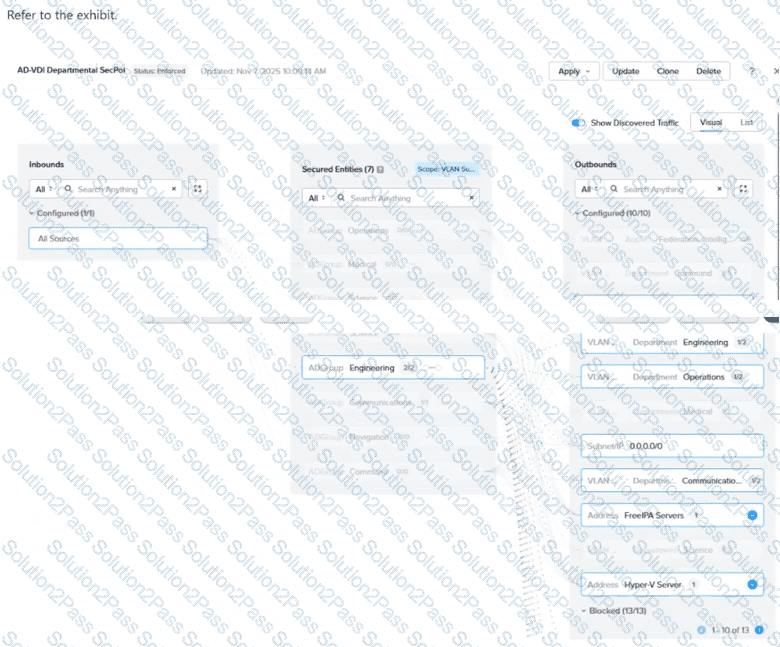
In the AD-VDI Departmental SecPol policy shown in the exhibit, ADGroup: Engineering is configured as a secured entity in a VDI Security Policy. Prism Central shows 2 / 2 active sessions under this group, but the administrator confirms that three Engineering users are currently logged in to persistent VDI desktops. The third user's VM shows no ADGroup assignment in its VM details in Prism Central, even after the user has successfully logged in. All three users are members of the same AD group, and the Domain Controller event logs confirm a successful interactive login for the third user. Which condition explains why the third user's VM is not being assigned the ADGroup: Engineering category?
An administrator has deployed a microsegmentation policy in Nutanix Flow that allows certain VM traffic based on Active Directory (AD) user group membership. Users in a specific AD group report they are unable to access the VMs, while other users can connect without issues. The administrator suspects the problem is related to identity-based policy mapping. What should the administrator do to troubleshoot and resolve the access issue related to the identity-based policy?
Which policy mode records traffic without enforcing rule actions?
Refer to Exhibit:
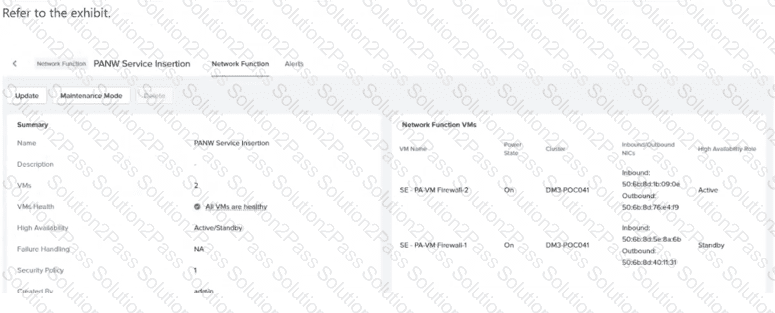
An organization uses an FNS-NG Service Chain to steer application traffic through a pair of third-party firewall Network Function VMs operating in Active/Standby mode. Users suddenly report that all application access is blocked. The administrator reviews Prism Central - > Network & Security - > Network Functions, where the summary shown in the exhibit is displayed. Additional information: Alert: "Network Function 'PANW Service Insertion' virtual NIC pair(s) are unhealthy." Both firewall VMs are powered on and reachable. The security policy using the service chain has not been changed. Based on the exhibit and findings, what is the most likely cause of the traffic outage?
An administrator is using Flow Network Security to secure a 3-tier application and has already created and assigned the categories. The administrator does not have the details of the rules that need to be allowed to secure the application. How can the administrator use Flow Network Security to monitor the traffic and help with the policy creation without impacting the applications connectivity?
Which step is required to prepare an AHV cluster for Flow Virtual Networking?
An administrator recently deployed a new set of virtual machines... 3-tier web application... restricted as follows: Only application VMs can talk to database VMs on port 3306 Frontend VMs should only communicate with application VMs on port 8080 Which action will correctly create and configure the Security Policies in Nutanix Flow to satisfy this task?
An administrator manages a four-node cluster Each node has a 4 available 10GB uplinks, and all four are configured as an Active/Active bundle. They want to use Flow Virtual Networking to provide networking to the VMs in the cluster with the following requirements: VMs should be in a single VPC. VMs should be reachable by their real IP addresses. The VPC should have access to the most north/south bandwidth possible. No changes can be made to the physical infrastructure. How can this best be achieved?
While configuring a new security policy in a Nutanix microsegmentation environment, an administrator wants the policy to remain flexible even if virtual machines change subnets or obtain new IP addresses. Which configuration approach should the administrator use when defining the policy scope?
What is the first step in preparing a Nutanix cluster for Flow Virtual Networking?
A newly-deployed Flow Virtual Networking VPC environment is experiencing connectivity issues... A packet capture on the physical switch shows packets are being fragmented. What is the probable cause of the packet fragmentation and performance issues?
Refer to Exhibit:
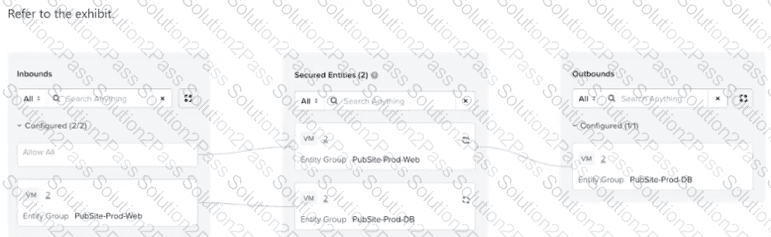
An administrator is tasked with configuring an application policy for a two-tier public website with Web and DB components. The database servers need to communicate with each other for replication, but the web servers should not be able to communicate with each other. The administrator configures the policy... and sets it to Enforce mode. Later testing reveals that the web servers are able to communicate with each other. What should the administrator do to resolve this?