CAPM PMI Certified Associate in Project Management (CAPM) Free Practice Exam Questions (2026 Updated)
Prepare effectively for your PMI CAPM Certified Associate in Project Management (CAPM) certification with our extensive collection of free, high-quality practice questions. Each question is designed to mirror the actual exam format and objectives, complete with comprehensive answers and detailed explanations. Our materials are regularly updated for 2026, ensuring you have the most current resources to build confidence and succeed on your first attempt.
What is the process of determining the stakeholders impacted by a business problem or opportunity?
Stakeholder requirements
Stakeholder identification
Stakeholder analysis
Stakeholder characteristics
The Answer Is:
CExplanation:
In the PMBOK® Guide and the PMI Guide to Business Analysis, understanding the human landscape of a project is critical. While identifying who the stakeholders are is the first step, determining how they are impacted requires a deeper dive.
Why Choice C is correct:
Defining the Impact: Stakeholder Analysis is the technique used to systematically gather and analyze quantitative and qualitative information to determine whose interests should be taken into account throughout the project.
Evaluating Influence and Interest: It involves identifying the stakeholders ' goals, expectations, and levels of influence. Crucially, it assesses how the business problem or the proposed solution will affect their daily work, power dynamics, or specific business units.
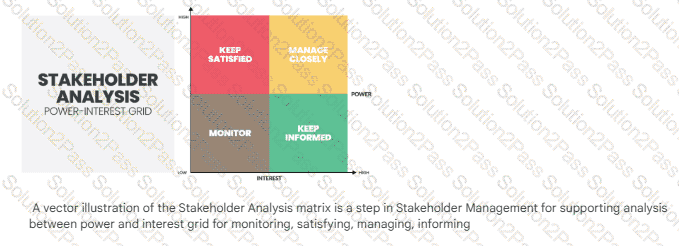
Output: This analysis typically results in a Stakeholder Register or models such as the Power/Interest Grid, which categorize stakeholders so the project manager can develop appropriate engagement strategies.
Analysis of other options:
A (Stakeholder requirements): These are the specific needs or conditions that a stakeholder requires to be met by a product or service. Requirements are the result of discussions with stakeholders; they are not the process of determining who is impacted by a problem.
B (Stakeholder identification): This is the initial process of simply listing the people, groups, or organizations that could be involved. While it precedes analysis, " Identification " is about finding the names, whereas " Analysis " (Choice C) is the specific process of determining the impact and relationship to the business problem.
D (Stakeholder characteristics): This refers to the traits or attributes of a stakeholder (such as their location, attitude, or knowledge level). Like requirements, these are data points gathered during the analysis, not the name of the process itself.
Key Concept: The Project Management Institute (PMI) teaches that Stakeholder Analysis (Choice C) is an ongoing activity. As a business problem evolves or a new opportunity is defined, the project manager must re-analyze the stakeholder landscape to ensure that those who are most impacted are properly engaged and that their potential resistance or support is managed effectively.
The planned work contained in the lowest level of work breakdown structure (WBS) components is known as:
Work packages.
Accepted deliverables.
The WBS dictionary.
The scope baseline.
The Answer Is:
AExplanation:
According to the PMBOK® Guide and the Standard for Project Management, specifically within the Create WBS process of the Project Scope Management Knowledge Area, the planned work contained in the lowest-level components of the Work Breakdown Structure (WBS) is known as Work packages.
As per PMI standards, a WBS is a hierarchical decomposition of the total scope of work to be carried out by the project team to accomplish the project objectives and create the required deliverables. A Work package is unique because:
Estimating and Managing: It represents the level at which cost and duration can be reliably estimated and managed.
Accountability: It can be assigned to a specific individual or organizational unit for execution.
Control Accounts: Work packages are grouped into " Control Accounts, " which are management control points where scope, budget, and schedule are integrated and compared to the earned value for performance measurement.
Decomposition: While a WBS can have many levels, the " Work Package " is the terminal point of that decomposition.
The other options are incorrect based on the following PMI definitions:
Accepted deliverables: These are the outputs of the Validate Scope process that have been formally signed off by the customer or sponsor. They are results, not the " planned work components " of the WBS itself.
The WBS dictionary: This is a Project Document that provides detailed deliverable, activity, and scheduling information about each component in the WBS. It supports the WBS but is not the component itself.
The scope baseline: This is an integrated component of the project management plan that includes the Project Scope Statement, the WBS, and the WBS Dictionary. It is the " parent " container of the WBS, not the lowest-level component.
As per the PMI Lexicon of Project Management Terms, the work package is the smallest unit of the WBS and serves as the foundation for defining activities in the Define Activities process.
Exhibit A is an example of which of the following types of Sequence Activities?
Activity-on-arrow diagramming
Precedence diagramming
Project schedule network diagramming
Mathematical analysis diagramming
The Answer Is:
BExplanation:
In the context of the PMI standards and the PMBOK® Guide, the Precedence Diagramming Method (PDM) is the standard tool and technique used for the Sequence Activities process.
Definition of PDM: This is a method used to create a project schedule network diagram. In this method, activities are represented by " nodes " (usually boxes), and the arrows represent the logical relationships (dependencies) between those activities.
Key Characteristics of PDM (Exhibit A Style):
It supports four types of dependencies: Finish-to-Start (FS), Finish-to-Finish (FF), Start-to-Start (SS), and Start-to-Finish (SF).
It is the most commonly used method in modern project management software.
It allows for the inclusion of leads and lags between activities.
Standard Representation: When an exam refers to a standard diagram showing boxes linked by arrows to show the flow of work, it is almost invariably referring to a Precedence Diagram.
Analysis of Other Options:
A. Activity-on-arrow (AOA) diagramming: Also known as Arrow Diagramming Method (ADM). In this older method, the arrows represent the activities, and the nodes represent milestones or events. It only supports Finish-to-Start relationships and is rarely used today.
C. Project schedule network diagramming: While PDM is a type of project schedule network diagram, " Project schedule network diagramming " is the general name of the output of the Sequence Activities process, whereas the question asks for the specific type or method shown in an exhibit (which typically illustrates the PDM technique).
D. Mathematical analysis diagramming: This is not a standard PMI term for a sequencing technique. Mathematical analysis usually refers to the Critical Path Method (CPM) or PERT, which are techniques used to calculate schedule dates using the network diagram, rather than the diagramming method itself.
Assigned risk ratings are based upon:
Root cause analysis.
Risk probability and impact assessment.
Expert judgment.
Revised stakeholders ' tolerances.
The Answer Is:
BExplanation:
According to the PMBOK® Guide and the Standard for Risk Management in Portfolios, Programs, and Projects, risk ratings are the primary output of the Perform Qualitative Risk Analysis process.
The assignment of these ratings is fundamentally based on the following two dimensions:
Risk Probability Assessment: Investigates the likelihood that a specific risk will occur.
Risk Impact Assessment: Investigates the potential effect on a project objective (such as schedule, cost, quality, or performance) if the risk occurs.
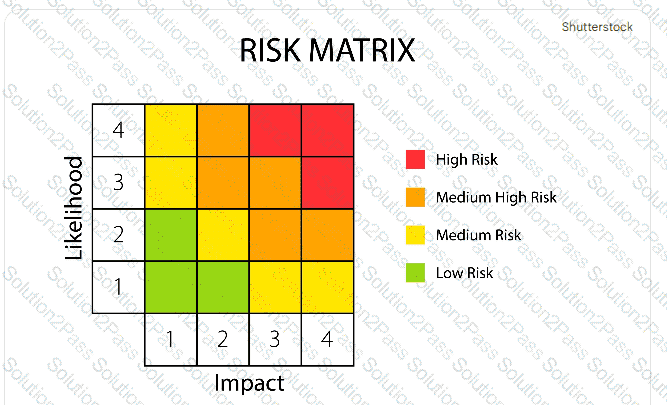
By combining these two variables, typically through a Probability and Impact Matrix, the project team can calculate a Risk Score (Probability $\times$ Impact). This score determines the risk ' s priority level (e.g., Low, Medium, High), which is the " assigned risk rating. "
Choice A (Root cause analysis) is a tool used in Identify Risks to understand why a risk might happen, but it does not provide the numerical or qualitative rating itself.
Choice C (Expert judgment) is a tool/technique used to help determine the values, but the ratings themselves are formally based on the assessment of probability and impact.
Choice D (Revised stakeholders ' tolerances) influences the thresholds (what is considered " High " or " Low " ), but the individual risk rating remains a product of its specific probability and impact.
In addition to the project charter, what other artifact is produced as a result of the Develop Project Charter process ' ?
Assumption log
Milestone list
Business case
Risk register
The Answer Is:
AExplanation:
According to the PMBOK® Guide (specifically the 6th and 7th Editions), the Develop Project Charter process is the very first step in the project life cycle. While the primary output is the Project Charter itself, there is a second, critical output that is often overlooked in study.
The Assumption Log: This is the secondary output of the Develop Project Charter process. Strategic and high-level business assumptions and constraints are typically identified in the business case before the project is initiated and will flow into the project charter. Throughout the process of creating the charter, the project manager uses the Assumption Log to document all high-level technical and operational assumptions and constraints that will affect the project.
Purpose: It serves as a repository for any factor that is considered to be true, real, or certain without proof or demonstration. Because these assumptions are not yet proven, they represent potential risks that must be validated during the planning phase.
Why other options are incorrect:
Option B: Milestone list: While a high-level summary of milestones is contained within the Project Charter, the formal " Milestone List " is an output of the Define Activities process in the Planning process group.
Option C: Business case: The Business Case is an input to the Develop Project Charter process, not an output. It is a business document created by the sponsor or organization to justify the investment before the project manager even starts the charter.
Option D: Risk register: The Risk Register is an output of the Identify Risks process. While the Project Charter contains " high-level overall project risks, " the detailed register is not created until the planning phase.
What is an output of the plan resource management process
Project charter
Risk register
Scope baseline
Stakeholder register
The Answer Is:
DExplanation:
According to the PMBOK® Guide, the Plan Resource Management process involves defining how to estimate, acquire, manage, and use team and physical resources. While the primary output is the Resource Management Plan, this process often results in Project Documents Updates.
Stakeholder Register Updates: During Plan Resource Management, the project manager identifies the roles and responsibilities required for the project. In doing so, they may identify new stakeholders or realize that the requirements/expectations of existing stakeholders have changed based on the resource strategy. Therefore, the Stakeholder Register is frequently updated as an output of this process.
Other Outputs:
Resource Management Plan: The primary document describing how resources are categorized, allocated, and managed.
Team Charter: A document that establishes the team values, agreements, and operating guidelines.
Project Documents Updates: Including the Assumption Log and Risk Register.
Analysis of other options:
A. Project charter: This is an output of the Develop Project Charter process (Initiating Phase) and actually serves as an input to Plan Resource Management.
B. Risk register: The Risk Register is an output of Identify Risks. While it may be updated during resource planning, the Stakeholder Register is a more direct document update associated with identifying the people needed for the project.
C. Scope baseline: This is an output of the Create WBS process within the Project Scope Management knowledge area.
Per PMI standards, Plan Resource Management ensures that the project team is structured correctly, and updating the Stakeholder Register is a necessary step to reflect the people involved in or impacted by that resource structure.
An adaptive team schedules 20 story points in the upcoming sprint. Historically, the team completes 25 story points on average per sprint. Each sprint is two weeks, and there is one day of float.
What is the likelihood the team will complete all 20 story points in the upcoming sprint?
50-75%
25-50%
75-100%
0-25%
The Answer Is:
CExplanation:
In Agile and Scrum methodologies, specifically regarding Empirical Process Control, a team ' s historical performance is the most reliable predictor of future performance. This is primarily measured through Velocity.
Why Choice C is correct:
Velocity Comparison: The team ' s average velocity is 25 story points. They have only planned 20 story points for the upcoming sprint. Since 20 is significantly less than their historical average (80% of their typical capacity), the team is working with a " buffer. "
Confidence Levels: In Agile estimation, if a team takes on work that is well below their average velocity, the probability of completion is very high. Statistically, since they usually finish 25, the likelihood of finishing 20—barring a major impediment—is extremely high (near certain).
Capacity and Float: The mention of " one day of float " further supports a high completion rate, as it indicates the team has built-in time to handle unexpected issues or administrative tasks without impacting the delivery of the 20 points.
Analysis of other options:
A and B (25-75%): These ranges would be more applicable if the team had scheduled exactly 25 points (their average) or slightly more. When a team schedules at their exact average, the probability of finishing everything is typically closer to 50% (since an average implies they sometimes do more and sometimes do less).
D (0-25%): This would only be the case if the team scheduled significantly more than their average velocity (e.g., scheduling 40 points when they usually only finish 25).
Key Concept: The Project Management Institute (PMI) and the Agile Practice Guide emphasize that Velocity (Choice C) is a measure of a team’s capacity. By scheduling work below their demonstrated capacity, the team increases the " probability of success " and ensures a sustainable pace, which is one of the core principles of the Agile Manifesto. This approach reduces the risk of carrying over unfinished stories to the next sprint.
An electronics firm authorizes a new project to develop a faster, cheaper, and smaller laptop after improvements in the industry and electronics technology. With which of the following strategic considerations is this project mainly concerned?
Customer request
Market demand
Technological advance
Strategic opportunity
The Answer Is:
CExplanation:
According to the PMBOK® Guide, projects are typically authorized as a result of one or more strategic considerations (often documented in a Business Case). These factors, known as " Project Initiatives " or " Business Needs, " include:
Technological Advance: This occurs when an organization authorizes a project to take advantage of new scientific or technical breakthroughs to improve its products or services. In this scenario, the firm is specifically responding to improvements in electronics technology to create a product that is faster, cheaper, and smaller.
Contextual Alignment: While creating a better laptop might meet a " Market Demand " (Choice B) or represent a " Strategic Opportunity " (Choice D), the primary driver cited in the question is the shift in industry and electronics technology. Therefore, the project is categorized under Technological Advance.
Other Strategic Considerations defined by PMI:
Market Demand: e.g., An automaker authorizing a project to build more fuel-efficient cars in response to a gasoline shortage.
Customer Request: e.g., An electric utility authorizing a project to build a new substation to serve a new industrial park.
Legal Requirement: e.g., A chemical manufacturer authorizing a project to establish guidelines for the handling of a new toxic material.
Social Need: e.g., A non-governmental organization authorizing a project to provide potable water systems to communities during a crisis.
In this specific case, because the impetus for the project is the technical improvement in the electronics field, Choice C is the most accurate verified answer.
In agile projects while performing scope management. What is the definition of requirements
Metrics
Sprint
Charter
Backlog i
The Answer Is:
DExplanation:
In Agile and Adaptive environments, as described in the PMBOK® Guide and the Agile Practice Guide, requirements are not captured in a static scope statement but are managed dynamically through a Backlog.
Backlog (Choice D): In Agile, the Product Backlog is the primary document (an ordered list) representing the project scope. It consists of user stories, features, or requirements that need to be addressed. Requirements are " refined " and prioritized within this backlog throughout the project, rather than being finalized upfront. This aligns with the Agile principle of " responding to change over following a plan. "
Sprint (Choice B): A Sprint is a time-boxed iteration (typically 1–4 weeks) during which a specific set of work is completed. While requirements from the backlog are selected for a Sprint Backlog, the Sprint itself is a container for work, not a definition of the requirements themselves.
Charter (Choice C): The Project Charter (or Agile Charter) is a high-level document that authorizes the project. While it may contain a high-level vision and objectives, it does not define the detailed requirements that evolve during the project.
Metrics (Choice A): These are measurements (such as velocity or cycle time) used to track progress and quality, but they do not define the functional or non-functional requirements of the product.
In scope management for adaptive lifecycles, the Product Backlog serves as the evolving " single source of truth " for what the team needs to build, ensuring that the most valuable requirements are always addressed first.
The Monitoring and Controlling Process Group includes processes that:
Establish the scope, objectives, and course of action of a project,
Define a new project or a new phase of an existing project.
Track, review, and regulate the progress and performance of a project.
Complete the work defined in the project management plan.
The Answer Is:
CExplanation:
In accordance with the PMBOK® Guide, the Monitoring and Controlling Process Group consists of those processes required to track, review, and regulate the progress and performance of the project; identify any areas in which changes to the plan are required; and initiate the corresponding changes.
The key benefit of this process group is that project performance is measured and analyzed at regular intervals, appropriate events, or exception conditions to identify variances from the project management plan. It involves:
Comparing actual performance against the project management plan.
Assessing performance to determine whether any corrective or preventive actions are indicated.
Identifying new risks and analyzing, tracking, and monitoring existing risks.
Maintaining an accurate, timely information base concerning the project’s product(s) and their associated documentation through completion.
Providing forecasts to update current cost and current schedule information.
Monitoring implementation of approved changes as they occur.
Analysis of Distractors:
A. Establish the scope, objectives, and course of action of a project: This defines the Planning Process Group. Planning is about establishing the " road map, " whereas Monitoring and Controlling is about ensuring the team stays on that map.
B. Define a new project or a new phase of an existing project: This defines the Initiating Process Group, which involves obtaining authorization to start the project or phase.
D. Complete the work defined in the project management plan: This defines the Executing Process Group. Execution is the act of performing the work, while Monitoring and Controlling is the act of overseeing that performance to ensure it meets the defined standards and baselines.
What is the purpose of the project management process groups?
To define a new project
To track and monitor processes easily
To logically group processes to achieve specific project objectives
To link specific process inputs and outputs
The Answer Is:
CExplanation:
According to the PMBOK® Guide, the Project Management Process Groups are defined as a logical grouping of project management inputs, tools and techniques, and outputs. Their primary purpose is to organize the project management processes to achieve specific project objectives efficiently.
Logical Grouping: The five process groups (Initiating, Planning, Executing, Monitoring and Controlling, and Closing) are independent of project phases. They provide a structured way to manage the flow of work throughout the project life cycle.
Achieving Objectives: Each group focuses on a distinct functional area:
Initiating: To define a new project or a new phase by obtaining authorization.
Planning: To establish the scope, refine objectives, and define the course of action.
Executing: To complete the work defined in the project management plan.
Monitoring and Controlling: To track, review, and regulate progress and performance.
Closing: To formally complete or close the project, phase, or contract.
Why other options are incorrect:
Option A: Defining a new project is specifically the purpose of the Initiating Process Group, not the purpose of all process groups collectively.
Option B: While tracking and monitoring is a benefit, it is specifically the focus of the Monitoring and Controlling Process Group. The collective purpose of all groups is broader organization.
Option D: Linking inputs and outputs is a mechanical function of how processes interact (the " how " ), but the " purpose " (the " why " ) of the groups themselves is to provide the logical structure to reach project goals.
Plan Communications Management develops an approach and plan for project communications based on stakeholders ' needs and requirements and:
Available organizational assets
Project staff assignments
Interpersonal skills
Enterprise environmental factors
The Answer Is:
AExplanation:
According to the PMBOK® Guide, specifically within the Project Communications Management knowledge area, the Plan Communications Management process is the process of developing an appropriate approach and plan for project communication activities based on stakeholders’ information needs and requirements, and available organizational assets.
Available Organizational Assets (Option A): These are the Organizational Process Assets (OPAs) that influence how communications are managed. They include existing communication guidelines, templates (like status report formats), historical information from previous projects, and established communication requirements. Because the communication plan must align with " how the company does things, " these assets are a fundamental driver of the plan ' s development.
Enterprise Environmental Factors (Option D): While EEFs are indeed an input to this process (reflecting the organization ' s culture, infrastructure, and external constraints), the standard PMI definition for the development of the approach specifically pairs stakeholder needs with the assets available to fulfill those needs.
Project Staff Assignments (Option B): These are an input to the process (providing a list of who is on the team), but they do not define the overarching communication approach or strategy.
Interpersonal Skills (Option C): These are Tools and Techniques (specifically Communication Styles Assessment) used during the process to understand how to communicate, but the plan itself is built upon the requirements of stakeholders and the assets of the organization.
In the PMI framework, the Communications Management Plan ensures that the right information reaches the right people at the right time via the right channel, utilizing the organization ' s existing frameworks to ensure consistency and efficiency.
A key stakeholder has left the project management team. The team now has a new key stakeholder who is requesting project reports from team members out of sequence.
What should the project manager do first?
Extend an iteration review invite to the new stakeholder.
Perform qualitative risk analysis.
Engage with the new stakeholder.
Allow team members to share project status reports.
The Answer Is:
CExplanation:
According to the PMBOK® Guide, specifically the Stakeholder Engagement and Communications Management knowledge areas, the arrival of a new key stakeholder is a significant change that requires immediate management action.
Why Choice C is correct:
Assess and Align: The project manager must first engage with the new stakeholder to understand their specific information needs, expectations, and influence on the project. This is a prerequisite to any other action.
Clarify Procedures: By engaging directly, the PM can explain the existing Communications Management Plan and the established reporting cadence. This prevents team disruption (team members being distracted by ad-hoc requests) while ensuring the stakeholder feels supported.
Relationship Building: Building rapport with a " key " stakeholder early is essential for long-term project success and conflict prevention.
Analysis of other options:
A (Extend an iteration review invite): While this is a good secondary step for transparency (especially in Agile), it doesn ' t address the immediate issue of the stakeholder ' s " out of sequence " report requests. The PM first needs to understand why they need those reports before just inviting them to a meeting.
B (Perform qualitative risk analysis): While the change in stakeholders is a risk, the PMBOK® Guide emphasizes that personal engagement and communication management are the primary tools for stakeholder issues. Risk analysis is a backend process; engagement is the active resolution.
D (Allow team members to share reports): This is incorrect. Allowing " out of sequence " reporting bypasses the Communications Management Plan and the Change Control processes. It leads to " noise, " potential misinformation, and wastes the team ' s productive time. The PM should act as a buffer.
Key Concept: When a new stakeholder enters the project, the Project Manager must perform the Identify Stakeholders and Plan Stakeholder Engagement processes. Choice C is the " first " logical step in these processes—initiating a dialogue to align the stakeholder ' s needs with the project ' s governance framework.
How many Project Management Process Groups are there?
3
4
5
6
The Answer Is:
CExplanation:
According to the PMBOK® Guide (Project Management Body of Knowledge), project management is performed through the integration of processes. These processes are logically grouped into five categories known as the Project Management Process Groups.
These groups are independent of process phases and are applied to every project or project phase to manage the flow of work:
Initiating Process Group: Those processes performed to define a new project or a new phase of an existing project by obtaining authorization to start.
Planning Process Group: Those processes required to establish the scope of the effort, refine the objectives, and define the course of action required to attain the objectives.
Executing Process Group: Those processes performed to complete the work defined in the project management plan to satisfy the project requirements.
Monitoring and Controlling Process Group: Those processes required to track, review, and regulate the progress and performance of the project; identify any areas in which changes to the plan are required; and initiate the corresponding changes.
Closing Process Group: Those processes performed to formally complete or close the project, phase, or contract.
Process Groups vs. Knowledge Areas: While there are 5 Process Groups, there are 10 Knowledge Areas (such as Scope, Schedule, Cost, etc.).
Process Groups vs. Project Life Cycle: Process Groups are not the same as project phases. Most process groups will typically be repeated within each phase of a project ' s life cycle.
Continuous Nature: The Monitoring and Controlling process group occurs concurrently with all other process groups (except Initiating in some frameworks) to ensure the project stays on track.
Which quality tool incorporates the upper and lower specification limits allowed within an agreement?
Control chart
Flowchart
Checksheet
Pareto diagram
The Answer Is:
AExplanation:
According to the PMBOK® Guide, specifically within the Control Quality process, a Control Chart is a graphic display of process data over time and against established control limits.
Specification Limits: These are based on the requirements of the agreement (contract) or the customer ' s needs. They represent the maximum and minimum values allowed. If a product or service falls outside these limits, it is considered nonconforming (a defect).
Control Limits vs. Specification Limits:
Control Limits (Upper and Lower Control Limits - UCL/LCL) are calculated statistically (usually $\pm3$ sigma) and show the natural variation of the process. They determine if the process is " in control. "
Specification Limits (Upper and Lower Specification Limits - USL/LSL) are provided by the customer or contract. A process can be " in control " (statistically stable) but still " out of spec " if the control limits fall outside the specification limits.
Purpose: The control chart allows the project manager to identify when a process is behaving unpredictably (out of control) or when it is in danger of violating the contractual specification limits.
Comparison with other options:
B. Flowchart: This is a graphical representation of a process showing how various elements of a system relate. It is used to identify where quality problems might occur but does not track data against specification limits.
C. Checksheet: Also known as a tally sheet, this is used to organize facts in a manner that will facilitate the effective collection of useful data about a potential quality problem. It is a data collection tool, not an analytical chart for limits.
D. Pareto diagram: This is a specific type of vertical bar chart used to identify the vital few sources that are responsible for causing most of a problem ' s effects. It follows the 80/20 rule and does not incorporate upper or lower specification limits.
Plan Schedule Management is a process in which Knowledge Area?
Project Scope Management
Project Human Resource Management
Project Integration Management
Project Time Management
The Answer Is:
DExplanation:
According to the PMBOK® Guide and the Standard for Project Management, the process Plan Schedule Management belongs to the Project Time Management (often referred to in newer editions as Project Schedule Management) Knowledge Area.
This process is the first step in managing a project ' s timeline and occurs within the Planning Process Group. Its primary purpose is to establish the policies, procedures, and documentation for planning, developing, managing, executing, and controlling the project schedule.
Key outputs of this process, as defined by PMI standards, include the Schedule Management Plan, which identifies:
Project schedule model development: The methodology and scheduling tool to be used.
Level of accuracy: The acceptable range used in determining realistic activity duration estimates.
Units of measure: Defined for each of the resources (such as staff hours, staff days, or weeks).
Organizational procedure links: The Work Breakdown Structure (WBS) provides the framework for the schedule management plan.
Control thresholds: Variance thresholds for monitoring schedule performance.
The other options are incorrect based on the following Knowledge Area mappings:
Project Scope Management: This area includes processes like Plan Scope Management, Collect Requirements, Define Scope, and Create WBS.
Project Human Resource Management: (Now referred to as Project Resource Management) This area includes processes like Plan Resource Management and Estimate Activity Resources.
Project Integration Management: This area includes high-level processes that coordinate all other knowledge areas, such as Develop Project Charter and Develop Project Management Plan.
As per the PMI Process Group and Knowledge Area Mapping, Plan Schedule Management provides the necessary guidance and direction on how the project schedule will be managed throughout the project.
In project management, which document is used to start the initial risk identification?
Assumption log
Risk management plan
Risk register
Issue log
The Answer Is:
AExplanation:
In the PMBOK® Guide, the process of Identify Risks begins early in the project life cycle. To find where risks might be hiding, project managers look at the documents that contain uncertainty.
Why Choice A is correct:
The Nature of Assumptions: Every project is built on assumptions (factors considered to be true, real, or certain without proof). By their very nature, assumptions are sources of potential risk because if an assumption proves false, the project may be negatively impacted.
Constraints and Risks: The Assumption Log tracks both assumptions and constraints. Constraints (like a hard deadline or a fixed budget) are also primary drivers of project risk.
Initial Identification: During the initiation and early planning phases, the Assumption Log is one of the first documents created (often alongside the Project Charter). Reviewing it is a fundamental step in the initial risk identification process to ensure that " what we think we know " doesn ' t become " what causes us to fail. "
Analysis of other options:
B (Risk management plan): This document describes how risk management activities will be structured and performed. It provides the methodology and the tools, but it does not contain the actual risks themselves.
C (Risk register): This is the output of the risk identification process. You don ' t use the register to start identifying risks; you identify risks and then record them in the register.
D (Issue log): Issues are risks that have already occurred. While looking at old issues can help identify future risks, the Issue Log is primarily a tool for tracking current problems, not for the forward-looking discovery of new risks at the start of a project.
Key Concept: The Project Management Institute (PMI) emphasizes that Assumptions Analysis is a key technique in risk management. By using the Assumption Log (Choice A) as a starting point, the project manager systematically explores the " blind spots " of the project, turning uncertainties into identified risks that can be managed proactively.
Lessons learned documentation is gathered during which of the following Project Management Process Groups?
Planning
Executing
Closing
Initiating
The Answer Is:
CExplanation:
According to the PMBOK® Guide, the formal gathering, ritualization, and archiving of lessons learned documentation is a primary activity of the Closing Process Group (specifically within the Close Project or Phase process).
While modern project management encourages the continuous recording of lessons learned throughout the project lifecycle (to the Lessons Learned Register), the formalization of these documents for the benefit of the organization occurs during Closing.
Final Archive: During the Closing phase, the project manager reviews all previous documentation to ensure that all " knowledge gained " is finalized.
Organizational Process Assets (OPAs): The primary output of this activity is an update to the Corporate Knowledge Base. This ensures that future project managers can benefit from the successes and failures of the current project.
Administrative Closure: This involves documenting the reasons for any deviations from the original plan and the effectiveness of the risk responses implemented.
A. Planning: This group focuses on defining the course of action. While you might review lessons learned from past projects here, you are not yet gathering them for the current project.
B. Executing: During execution, the team is performing the work. While the Lessons Learned Register (a project document) is updated during execution, the " Lessons Learned Documentation " as a formal project closure deliverable is a function of the Closing group.
D. Initiating: This group is for authorizing the project. At this stage, there is no project performance to reflect upon or document.
In the most recent editions of the PMBOK® Guide, there is a distinction between:
Lessons Learned Register: An active document used throughout the project (Executing/Monitoring).
Lessons Learned Repository: The final resting place for the documentation after the project is closed (Closing).
For the purpose of this examination, the act of " gathering " the final documentation for organizational use is strictly tied to the Closing of the project or phase.
In an organization with a projectized organizational structure, who controls the project budget?
Functional manager
Project manager
Program manager
Project management office
The Answer Is:
BExplanation:
According to the PMBOK® Guide, the organizational structure significantly influences how resources are assigned and who holds the power over project constraints, including the budget.
Projectized Organizational Structure: In this type of structure, the organization is arranged by projects rather than functional departments.
Authority: The Project Manager (PM) has a high to almost total level of authority.
Budget Control: Because the project is the primary unit of the organization, the Project Manager has full control over the project budget and the resources assigned to the project.
Reporting Lines: Team members are often co-located and report directly to the Project Manager. There are usually no functional managers, or if they exist, their role is minimal and focused on administrative support rather than project direction.
The " Varying Degrees " of Authority:
Functional Structure: The Functional Manager has full control of the budget; the PM has little to no authority (often just a coordinator).
Matrix Structure: Authority is shared between the Functional Manager and the PM. In a Strong Matrix, the PM has more control; in a Weak Matrix, the Functional Manager maintains control.
Projectized Structure: This is the opposite of the Functional structure. The PM is the primary decision-maker for the budget.
Comparison with other options:
A. Functional manager: In a functional organization, this individual controls the budget. In a projectized organization, functional managers typically do not exist in a way that interferes with project-level financial decisions.
C. Program manager: While a Program Manager oversees a group of related projects and may allocate funds to those projects, the day-to-day control and management of a specific project ' s budget within a projectized structure rests with the Project Manager.
D. Project management office (PMO): A PMO provides support, templates, and governance. While they may monitor budget performance or provide the framework for financial reporting, they do not " control " the individual project ' s budget in the same direct capacity as the Project Manager in this structure.
A project manager is reviewing some techniques that can be used to evaluate solution results. The intent is to evaluate the solution in the larger context to ensure it does not behave in unacceptable ways when deployed to production.
Which evaluation technique should be used here?
Performance testing
Integration testing
Day-in-the-life testing
Exploratory testing
The Answer Is:
CExplanation:
In the PMI Guide to Business Analysis and Solution Evaluation, testing isn ' t just about checking if a button works; it ' s about ensuring the solution thrives within the complexities of a real-world environment.
Why Choice C is correct:
Holistic Evaluation: Day-in-the-life (DITL) testing (also known as " operational testing " ) involves observing how the solution performs during a typical workday. It focuses on the " larger context " mentioned in the prompt.
Simulating Reality: It goes beyond isolated functional tests to see how the software interacts with other business processes, human workflows, and external stressors that only happen during actual production use.
Preventing Unacceptable Behavior: By simulating a full cycle of business operations, the team can identify if the solution causes bottlenecks, data corruption in other systems, or user fatigue—behaviors that might not appear in a controlled, technical test environment.
Analysis of other options:
A (Performance testing): This focuses specifically on technical metrics like speed, responsiveness, and stability under a particular workload (e.g., how many users can log in at once). While important for production, it doesn ' t evaluate the " behavioral " or " business process " context as deeply as DITL testing.
B (Integration testing): This checks if two or more components or systems exchange data correctly. While it looks at a " larger context " than unit testing, it is still a technical check of interfaces rather than a broad evaluation of the solution’s impact on the business day.
D (Exploratory testing): This is an unscripted, simultaneous process of learning, test design, and test execution. It is excellent for finding hidden bugs ( " edge cases " ), but it is usually performed by testers " breaking " the system, rather than evaluating the solution’s behavior in a standard operational business context.
Key Concept: The Project Management Institute (PMI) emphasizes that the ultimate goal of any project is to deliver Business Value. Day-in-the-life testing (Choice C) is the final safeguard to ensure that when the " Go " button is pressed, the solution doesn ' t just work technically, but also integrates seamlessly into the daily lives of the people using it, ensuring sustainable success in production.
Which of the following types of a dependency determination is used to define the sequence of activities?
Legal
Discretionary
Internal
Resource
The Answer Is:
BExplanation:
According to the PMBOK® Guide, specifically within the Sequence Activities process, dependencies are categorized to define the logical relationship between project tasks. There are four primary types of dependency determination: Mandatory, Discretionary, External, and Internal.
Discretionary dependencies (also known as " preferred logic, " " preferential logic, " or " soft logic " ) are established based on knowledge of best practices within a particular application area or a specific aspect of the project where a specific sequence is desired, even though there are other acceptable sequences.
Expert Choice: These dependencies are defined by the project team based on experience. For example, a team might decide to complete the internal electrical wiring before installing the drywall because it is a " best practice, " even though it is technically possible to do parts of them simultaneously.
Scheduling Flexibility: During schedule compression (like Fast Tracking), discretionary dependencies are the first to be reviewed and potentially removed or overlapped to shorten the project duration.
Risk: While they reflect the preferred way of working, they can sometimes limit scheduling options if not clearly documented as " discretionary. "
A. Legal: While legal requirements (like obtaining a permit before building) create dependencies, they are classified under Mandatory Dependencies (Hard Logic). " Legal " is a reason for the dependency, not the PMI-defined category name for the determination type.
C. Internal: Internal dependencies involve a precedence relationship between project activities and are generally within the project team’s control. While this is a valid type of dependency, the question asks which is used to " define the sequence " based on choice or best practice, which points specifically to the logic type (Discretionary) rather than the project boundary (Internal).
D. Resource: Resource constraints can influence a schedule (Resource Leveling), but they are not one of the four formal types of Dependency Determination used in the Sequence Activities process.
In the PMI framework, every dependency has two attributes. It is either:
Mandatory (Required by law or physical limitations) OR Discretionary (Based on best practices).
External (Involves parties outside the team) OR Internal (Under the team ' s control).
An adaptive team ' s velocity dropped significantly in the last sprint due to the planned vacation of two team members. The project sponsor wants to know how many more sprints it would take to complete the remaining project.
How should the project manager calculate the anticipated velocity for future sprints?
Use the velocity of the last sprint, as it is the most recent one to share.
Add a 30% buffer to the velocity to calculate future velocity.
Calculate the average of the past five sprints to predict future velocity.
Change the adaptive tool that the team is using to calculate velocity.
The Answer Is:
CExplanation:
In Agile and Adaptive environments, Velocity is the measure of the amount of work a team can tackle during a single sprint and is the primary metric used for long-term planning.
Why Choice C is correct:
Stabilization: Velocity often fluctuates due to external factors like holidays, sick leave, or planned vacations (as seen in this scenario). Using a single outlier—like a sprint where two people were missing—would result in a pessimistic and inaccurate forecast.
Historical Averaging: The Agile Practice Guide recommends using an average of past performance (typically the last 3 to 5 sprints) to smooth out anomalies. This " Average Velocity " provides a more stable and realistic predictor of what the team can achieve in a normal capacity.
Forecasting: To answer the sponsor ' s question about " how many more sprints, " the project manager would take the remaining points in the Product Backlog and divide them by this average velocity.
Analysis of other options:
A (Use the velocity of the last sprint): This is incorrect because the last sprint was an anomaly. Two team members were on vacation, making that velocity significantly lower than the team ' s actual capacity. Predicting the entire project ' s future based on a temporary staffing shortage would lead to an unnecessarily long and inaccurate timeline.
B (Add a 30% buffer): While buffers are used in traditional project management for risk, Agile relies on empirical data. Arbitrarily adding a percentage (like 30%) is " guesswork " and does not reflect the team’s demonstrated historical performance.
D (Change the adaptive tool): The problem is not the tool; it is the data being used. Changing software (like Jira or ADO) will not change the fact that people were on vacation. Velocity is a human metric, not a software problem.
Key Concept: The Project Management Institute (PMI) emphasizes Empirical Process Control. Velocity is a tool for the team to measure its own capacity. By calculating the average (Choice C), the project manager accounts for both high-productivity and low-productivity periods, providing the sponsor with a forecast based on the team ' s " true " long-term cadence rather than a temporary dip.
Which is a tool or technique used in Define Scope?
Templates, forms, and standards
Change requests
Product analysis
Project assumptions
The Answer Is:
DExplanation:
According to the PMBOK® Guide, the Define Scope process is the process of developing a detailed description of the project and product. To do this effectively, the project manager and team must move from high-level requirements to specific technical deliverables.
Product Analysis: This is a critical tool and technique for projects that have a product as a deliverable (as opposed to a service or result). It includes techniques such as product breakdown, systems analysis, requirements analysis, systems engineering, value engineering, and value analysis.
Translating Requirements: Product analysis helps the team translate high-level descriptions into meaningful deliverables. It asks questions like: " What are the components of this product? " and " How will it function to meet the customer ' s needs? "
Scope Definition: By performing product analysis, the team can define the boundaries of the project more clearly, ensuring that all necessary work—and only the necessary work—is included in the Project Scope Statement.
Integration with Technical Teams: This tool often requires the involvement of subject matter experts (SMEs) who understand the technical specifications required to build the product.
Comparison with other options:
A. Templates, forms, and standards: These are examples of Organizational Process Assets (OPAs). While they are used as an input to the Define Scope process to provide a framework, they are not categorized as a " tool or technique " in the PMI methodology.
B. Change requests: These are a common output of many monitoring and controlling processes. While defining scope might trigger a change to the charter or requirements, it is not a " tool " used to define the scope itself.
C. Project assumptions: Assumptions are factors that, for planning purposes, are considered to be true, real, or certain without proof. These are documented in the Project Scope Statement (an output) or analyzed as part of a data analysis technique, but " assumptions " themselves are not a tool.
Which characteristics do effective project managers possess?
Project management knowledge, performance skills, and personal effectiveness
Preparedness, project management knowledge, and personality characteristics
General management, preparedness, and project management knowledge
Assertiveness, collaboration, and performance skills
The Answer Is:
AExplanation:
According to the PMBOK® Guide (specifically in earlier versions defining the PM Competency Development Framework) and aligned with the PMI Talent Triangle®, an effective project manager must balance three specific dimensions of competence:
Project Management Knowledge: This refers to what the project manager knows about project management. it involves understanding the processes, tools, techniques, and standards (such as the PMBOK® Guide) required to manage a project effectively.
Performance Skills: This refers to what the project manager is able to do or accomplish while applying their project management knowledge. It is the practical application of theory to meet project requirements and navigate the project life cycle.
Personal Effectiveness: This refers to how the project manager behaves when performing activities within the project environment. It encompasses attitudes, core personality characteristics, and leadership qualities—such as integrity, the ability to lead a team, and the capacity to manage stress and conflict.
Modern Context: In more recent PMI standards, these characteristics have evolved into the PMI Talent Triangle®, which emphasizes:
Ways of Working (formerly Technical Project Management/Knowledge).
Power Skills (formerly Leadership/Personal Effectiveness).
Business Acumen (Strategic and Business Management).
Analysis of Other Options:
B. Preparedness, project management knowledge, and personality characteristics: While " preparedness " is a good trait, it is not a formal dimension of competency defined in PMI documents. " Personality characteristics " is only one subset of " Personal Effectiveness. "
C. General management, preparedness, and project management knowledge: General management is a helpful background, but the PMI definition focuses specifically on the intersection of specialized PM knowledge, the ability to perform, and personal behavior.
D. Assertiveness, collaboration, and performance skills: Assertiveness and collaboration are specific " Power Skills " or " Personal Effectiveness " traits, but they do not cover the broad requirement of having foundational " Project Management Knowledge. "
Which is an example of analogous estimating?
Estimates are created by individuals or groups with specialized knowledge.
Estimates are created by using information about resources of previous similar projects.
Estimates are created by analyzing data.
Estimates are created at the task level and aggregated upwards.
The Answer Is:
BExplanation:
According to the PMBOK® Guide, Analogous Estimating is a technique for estimating the duration or cost of an activity or a project using historical data from a similar activity or project. It is frequently used in the Estimate Costs and Estimate Activity Durations processes.
How it Works: It uses the values of parameters—such as scope, cost, budget, and duration—or measures of scale (size, weight, complexity) from a previous, similar project as the basis for estimating the same parameter or measure for a current project.
When to Use: It is generally used when there is a limited amount of detailed information about the project (e.g., in the early phases of a project).
Accuracy and Cost: Analogous estimating is generally less costly and time-consuming than other techniques, but it is also generally less accurate. It is most reliable when the previous projects are similar in fact and not just in appearance, and the project team members preparing the estimates have the needed expertise.
Top-Down Approach: This is often referred to as a " top-down " estimating technique because it looks at the project as a whole based on past performance rather than breaking it down into minute details.
Analysis of Other Options:
A. Estimates are created by individuals or groups with specialized knowledge: This describes Expert Judgment. While expert judgment is often used during analogous estimating to determine if a past project is a valid comparison, the definition of analogous estimating specifically hinges on the use of historical data from similar projects.
C. Estimates are created by analyzing data: This is a broad description of Data Analysis (such as Alternative Analysis or Reserve Analysis). While estimating involves data, it is not the specific definition of the analogous technique.
D. Estimates are created at the task level and aggregated upwards: This describes Bottom-Up Estimating, which is the opposite of analogous estimating. Bottom-up estimating is more detailed and accurate but requires a well-defined WBS.
The number of potential communication channels for a project with 5 stakeholders is:
10.
12.
20.
24.
The Answer Is:
AExplanation:
According to the PMBOK® Guide (Project Communications Management), specifically within the Plan Communications Management process, the number of potential communication channels is a key indicator of the complexity of a project ' s communications.
The formula used to calculate the number of potential communication channels is:
$$Total\ Channels = \frac{n(n - 1)}{2}$$
Where $n$ represents the number of stakeholders.
Step-by-Step Calculation for 5 Stakeholders:
Identify the number of stakeholders: $n = 5$
Plug the value into the formula: $\frac{5(5 - 1)}{2}$
Subtract 1 from the number of stakeholders: $5 \times 4 = 20$
Divide by 2: $20 / 2 = 10$
Therefore, a project with 5 stakeholders has 10 potential communication channels.
Key Insight: This calculation is vital for project managers because it demonstrates how communication complexity grows exponentially as more stakeholders are added. For example, adding just one more stakeholder (moving from 5 to 6) increases the channels from 10 to 15. Managing these channels effectively is essential to ensure that the right information reaches the right people at the right time.
Analysis of Distractors:
B, C, and D: These values do not align with the mathematical result of the communication channels formula ($n(n-1)/2$). Option C (20) represents the numerator of the formula ($5 \times 4$) before dividing by 2.
The purpose of inspection in Perform Quality Control is to keep errors:
in line with a measured degree of conformity.
out of the hands of the customer.
in a specified range of acceptable results.
out of the process.
The Answer Is:
BExplanation:
According to the PMBOK® Guide, specifically within the Control Quality process (formerly Perform Quality Control), the primary purpose of Inspection is to keep errors out of the hands of the customer.
Definition of Inspection: Inspection is the examination of a work product to determine if it conforms to documented standards. It is often referred to as a " peer review, " " audit, " or " walkthrough. "
The Goal of Control Quality: While " Prevention " (in the Manage Quality process) keeps errors out of the process, " Inspection " (in the Control Quality process) focuses on identifying errors in the final product before that product is delivered to the client.
Verified Deliverables: The result of a successful inspection is a Verified Deliverable. This becomes an input to the Validate Scope process, where the customer formally accepts the deliverable. If the inspection fails, the deliverable is flagged for defect repair to ensure the customer never receives a non-conforming item.
Comparison with Other Options:
In line with a measured degree of conformity (A): This describes the result of the measurement, but " degree of conformity " is more closely related to Precision and Attribute Sampling rather than the fundamental purpose of inspection.
In a specified range of acceptable results (C): This is the definition of Tolerances. While inspection checks if a result falls within a tolerance, the purpose is to catch the outliers before they reach the user.
Out of the process (D): This is the definition of Prevention. Prevention is about designing the process so that errors are not created in the first place. Inspection is the safety net that catches errors that the prevention stage missed.
Which type of managers do composite organizations involve?
Functional managers and manager of project managers
Functional managers only
Project managers only
Technical managers and project managers
The Answer Is:
AExplanation:
According to the PMBOK® Guide, a Composite Organization (also referred to as a Hybrid Structure) is an organizational framework that involves a combination of functional, matrix, and projectized characteristics.
In a composite organization, the structure typically includes:
Functional Managers: Who manage the traditional permanent departments (e.g., HR, Engineering, Finance).
Manager of Project Managers: Often residing within a Project Management Office (PMO) or a projectized division, this role oversees a group of project managers who may be assigned to specific high-priority projects full-time, even within a functional environment.
Key Characteristics of Composite Organizations:
They allow for the coexistence of different structures to meet specific strategic needs. For example, a functional organization may create a special project team to handle a critical project, granting that team a projectized structure and a dedicated project manager while the rest of the company remains functional.
Choice A is correct because it reflects the duality of authority present in these structures, involving both departmental leaders and those who specifically oversee project management personnel.
Choice B and C are incorrect as they describe specialized " siloed " structures (Functional or Projectized), rather than the blended nature of a composite system.
Choice D is incorrect as " Technical Manager " is not a standard organizational classification used by PMI to define composite reporting structures.
Construction of a building has stopped due to a supplier ' s failure to deliver concrete. The project schedule is behind by three months.
What should the project manager do to overcome this problem and put the project back on track?
Follow the risk response plan and allocate resources, if needed, to overcome the issue.
Consult the legal department and subject matter experts (SMEs) regarding what to do to avoid failure.
Extend the time of product delivery and use management reserve to cover any losses.
Accept any penalties that might occur and continue working as initially planned.
The Answer Is:
AExplanation:
According to the PMBOK® Guide, specifically within the Monitor Risks and Implement Risk Responses processes, a project manager must act decisively when a known or unknown risk materializes into an issue.
Why Choice A is correct:
Risk Response Implementation: A professional project manager should have identified " supplier failure " as a potential risk during the planning phase. The Risk Register would contain a pre-approved Risk Response Plan (e.g., a secondary supplier, expedited shipping, or technical alternatives).
Resource Allocation: To address a three-month delay, the PM may need to utilize contingency reserves or reallocate human and material resources to perform " crashing " or " fast-tracking " once the concrete arrives to compress the schedule.
Structured Approach: Following the plan ensures that the response is calculated and authorized, rather than reactive or emotional.
Analysis of other options:
B (Consult legal/SMEs to avoid failure): While legal advice might be necessary for contract breaches, the primary goal of the PM is to " put the project back on track. " Legal action is a recovery of damages, not a schedule recovery technique. Furthermore, " avoiding failure " is proactive; the failure has already occurred, so the PM must now move to mitigation or corrective action.
C (Extend delivery and use management reserve): Management reserves are typically for " unknown-unknowns " and require senior management approval. Simply extending the deadline is a passive move that doesn ' t " overcome " the problem or put the project " back on track " —it simply moves the goalposts.
D (Accept penalties): This is a " passive acceptance " strategy. In a high-impact scenario like a three-month construction delay, passive acceptance is rarely acceptable to stakeholders. The PM is expected to explore all possible corrective actions before resigning to penalties.
Key Concept: The Project Management Institute (PMI) emphasizes that the Risk Register is a living document. When an issue occurs, the PM evaluates the effectiveness of the planned response. If the original plan is insufficient, the PM should issue a Change Request to implement more aggressive recovery measures, ensuring the project aligns as closely as possible with the original Schedule Baseline.
The activity tailoring is necessary because:
the members of the project team need to select the appropriate order of every tool, technique, input, and output listed in the PMBOK Guide, this is required for all projects
each project is unique, and the members of the project team should select the appropriate tools, techniques, inputs, and outputs from the PMBOK Guide
the members of the project team need to understand the PMBOK Guide processes, which are applied to all projects
each project is unique, and the project team must plain how to apply all the tools, techniques, inputs, and outputs in the PMBOK Guide
The Answer Is:
BExplanation:
According to the PMBOK® Guide, Tailoring is the deliberate adaptation of the selected project management processes, inputs, tools, techniques, outputs, and life cycle phases to make them fit the specific environment and the work of the project.
Uniqueness of Projects: Every project is unique due to its specific objectives, stakeholders, complexity, risks, and organizational context. Because of this, it is neither practical nor efficient to use every single process or tool described in the PMBOK Guide for every project.
Team Responsibility: It is the responsibility of the project manager and the project management team to select only what is necessary to manage the project effectively. This prevents " over-management " and ensures that project resources are focused on activities that add value.
Framework vs. Methodology: The PMBOK Guide is a global standard and framework, not a rigid methodology. It provides a " menu " of best practices from which the team must choose based on the project’s needs.
Why other options are incorrect:
Option A: Tailoring is not about selecting a specific " order " for every single item in the guide for every project; it is about deciding what to include and what to exclude.
Option C: While the team needs to understand the processes, simply " understanding " them does not explain why tailoring is necessary. Furthermore, the processes are not applied to all projects in the same way.
Option D: This is incorrect because the team should not apply all tools, techniques, inputs, and outputs. Applying everything would result in unnecessary bureaucracy and wasted effort. Tailoring is the act of omitting unnecessary elements just as much as it is about selecting necessary ones.
An adaptive project team is meeting for the first time and deciding on the project management approach. After defining the project artifacts, one team member argues that the events are missing. The scrum master coaches the team to complete the planning.
Which two of the following elements should be included? (Choose two)
Daily scrum
Increments
Sprint retrospective
Sprint backlog
Product backlog
The Answer Is:
A, CExplanation:
According to the Agile Practice Guide and the Scrum Guide, Scrum is defined by three specific categories: Roles, Artifacts, and Events (also called Ceremonies).
Defining " Events " : The team member correctly pointed out that the " events " are missing. In Scrum, there are five formal events for inspection and adaptation: The Sprint, Sprint Planning, Daily Scrum, Sprint Review, and Sprint Retrospective.
Daily Scrum (Option A): A 15-minute event for the Developers to synchronize activities and create a plan for the next 24 hours.
Sprint Retrospective (Option C): An event held at the end of the sprint to plan ways to increase quality and effectiveness by inspecting how the last Sprint went with regards to people, relationships, processes, and tools.
Coaching the Team: The Scrum Master’s role is to ensure the team understands the framework. By identifying these missing events, the team completes the " heartbeat " of the Scrum process, allowing for the empirical process control of transparency, inspection, and adaptation.
Analysis of other options:
Option B (Increments): This is an Artifact, not an event. The Increment is a concrete stepping stone toward the Product Goal.
Option D (Sprint backlog): This is an Artifact, not an event. It is the set of Product Backlog items selected for the Sprint, plus a plan for delivering them.
Option E (Product backlog): This is an Artifact, not an event. It is an emergent, ordered list of what is needed to improve the product.
Per PMI standards, when a team is organizing their approach and identifies that events are missing, they must select from the timeboxed activities defined in the framework, such as the Daily Scrum and the Sprint Retrospective.
Which Project Time Management process includes bottom-up estimating as a tool or technique?
Estimate Activity Resources
Sequence Activities
Estimate Activity Durations
Develop Schedule
The Answer Is:
AExplanation:
According to the PMBOK® Guide (Project Management Body of Knowledge), specifically within the Project Schedule Management knowledge area (historically referred to as Project Time Management):
Estimate Activity Resources (Option A): This is the process of estimating the types and quantities of material, human resources, equipment, or supplies required to perform each activity. Bottom-up estimating is a key tool and technique for this process. It involves estimating the resources for each specific activity or work package and then aggregating (rolling up) those estimates to higher levels of the Work Breakdown Structure (WBS). This is used when an activity cannot be estimated with a reasonable degree of confidence at a high level.
Estimate Activity Durations (Option C): While this process also uses various estimating techniques (Analogous, Parametric, Three-Point), the standard PMI mapping places " Bottom-up estimating " primarily as a tool for Estimate Activity Resources and Estimate Costs. For durations, the aggregation of individual activity estimates into a total is part of the scheduling logic, but the formal " Bottom-up " tool designation is most strictly associated with resources and costs.
Sequence Activities (Option B): This process focuses on identifying and documenting relationships among the project activities using the Precedence Diagramming Method (PDM). It does not involve estimating quantities or values.
Develop Schedule (Option D): This is the process of analyzing activity sequences, durations, resource requirements, and schedule constraints to create the project schedule model. It uses the outputs of the estimating processes rather than performing the bottom-up estimation itself.
In the PMI framework, Bottom-up Estimating provides the greatest level of detail and accuracy, though it is more time-consuming than top-down methods. It ensures that every component of a work package is accounted for before being summarized for the project as a whole.
What does expert judgment provide as an input to the resource management plan?
Geographic distribution of facilities and resources
Physical resource management policies and procedures
Estimated lead times based on lessons learned
Templates for the resource management plan
The Answer Is:
CExplanation:
According to the PMBOK® Guide, specifically within the Plan Resource Management process, Expert Judgment is a tool and technique used to process various inputs. When experts provide their judgment for this plan, they leverage their specialized knowledge and experience from previous similar projects.
Estimated Lead Times: Experts can provide valuable insight into how long it takes to acquire specific resources (both human and physical), taking into account market conditions, vendor reliability, and internal procurement cycles. This information is often derived from lessons learned and historical data that may not be formally documented yet.
Application of Expertise: In addition to lead times, Expert Judgment in this process is used to determine:
Preliminary effort levels and requirements for resources.
The level of risk associated with resource acquisition.
Organizational culture and its impact on resource management.
Analysis of other options:
A. Geographic distribution: This is typically categorized as Enterprise Environmental Factors (EEF). It is a factual constraint of the organization ' s infrastructure rather than a " judgment " provided by an expert to build the plan.
B. Physical resource management policies: These are considered Organizational Process Assets (OPA). These are existing documents and procedures that the project manager must follow; they are inputs to the process, not something created by expert judgment during the process.
D. Templates: These are also Organizational Process Assets (OPA). Templates are pre-existing standardized formats provided by the organization or the PMO.
Per PMI standards, Expert Judgment is the bridge that turns raw data and high-level requirements into a realistic and actionable Resource Management Plan by incorporating practical experience regarding timelines and resource availability.
Which key benefit can a project manager obtain by identifying stakeholders?
Identify the appropriate focus for engagement of each stakeholder.
Assess the risk exposure for each stakeholder.
Map stakeholder power and influence grid.
Identify the appropriate channels of communication with all stakeholders.
The Answer Is:
AExplanation:
According to the PMBOK® Guide, the process of Identify Stakeholders is the process of identifying project stakeholders regularly and analyzing and documenting relevant information regarding their interests, involvement, interdependencies, influence, and potential impact on project success.
The Key Benefit: The primary advantage of this process is that it enables the project team to identify the appropriate focus for engagement for each stakeholder or group of stakeholders. By understanding who the stakeholders are and what they care about early on, the project manager can tailor engagement strategies to ensure their support and minimize potential negative impacts.
Strategic Alignment: This identification allows the project manager to prioritize stakeholders based on their influence and interest, ensuring that limited project resources are spent engaging the right people at the right time.
Why other options are incorrect:
Option B: Assessing risk exposure for each stakeholder is not the primary goal of the Identify Stakeholders process. While stakeholders can source risks, " risk exposure " is specifically addressed within the Project Risk Management knowledge area.
Option C: Mapping the power and influence grid is a Tool and Technique (Data Representation) used during the Identify Stakeholders process, but it is not the ultimate " key benefit " or goal of the process itself. It is a means to reach the benefit described in Option A.
Option D: Identifying communication channels is the specific focus of the Plan Communications Management process. Identifying who they are (Identify Stakeholders) must happen before you can determine how to talk to them (Plan Communications).
Monte Carlo is which type of risk analysis technique?
Probability
Quantitative
Qualitative
Sensitivity
The Answer Is:
BExplanation:
According to the PMBOK® Guide, specifically within the Perform Quantitative Risk Analysis process, Monte Carlo simulation is a primary tool and technique used to numerically analyze the combined effect of individual project risks and other sources of uncertainty on overall project objectives.
In the PMI framework, risk analysis is divided into two main stages:
Perform Qualitative Risk Analysis: The process of prioritizing individual project risks by assessing their probability of occurrence and impact. This is subjective and uses descriptors like " High, " " Medium, " or " Low. "
Perform Quantitative Risk Analysis: The process of numerically analyzing the effect of identified risks on overall project objectives. This is where Monte Carlo simulation resides.
Simulation: It uses a computer model to simulate the project many times (often thousands of iterations) using random values for variable inputs (like cost or duration) based on probability distributions (e.g., triangular, normal, or beta).
Output: The result is a probability distribution of the total project cost or completion date. It helps the project manager determine the " probability of success " (e.g., " There is an 80% chance we will finish the project for $500,000 or less " ).
S-Curve: The results are often plotted on a cumulative frequency distribution, known as an S-curve.
A. Probability: While Monte Carlo uses probability distributions as inputs, " Probability " is a component of risk, not the category of the analysis technique itself.
C. Qualitative: This is the earlier stage of risk management. Qualitative analysis is used to quickly filter and prioritize risks, whereas Monte Carlo is used for a deep-dive, data-driven numerical assessment.
D. Sensitivity: Sensitivity analysis is another tool within the Perform Quantitative Risk Analysis process (often visualized with a Tornado Diagram). While it is related, Monte Carlo is a simulation technique, while Sensitivity analysis looks at the impact of changing one variable at a time.
The primary benefit of using a Monte Carlo simulation is that it quantifies the overall project risk rather than just looking at individual risks in isolation. This allows for more accurate contingency reserve planning and realistic communication with stakeholders regarding project deadlines and budgets.
Which of the following events would result in a baseline update?
A project is behind schedule and the project manager wants the baseline to reflect estimated actual completion.
A customer has approved a change request broadening the project scope and increasing the budget.
One of the risks identified in the risk management plan occurs, resulting in a schedule delay.
One of the key project team resources has left the team and no replacement is available.
The Answer Is:
BExplanation:
According to the PMBOK® Guide, a Baseline (Scope, Schedule, or Cost) is the approved version of a project plan. It can only be changed through formal Change Control procedures and is used as a basis for comparison to actual results.
Approved Change Requests: When a change request is formally approved through the Perform Integrated Change Control process, and that change affects the project ' s scope, schedule, or cost, the corresponding baselines must be updated. This ensures that the " yardstick " used to measure performance reflects the new, agreed-upon reality of the project.
The Baseline ' s Purpose: The baseline exists to track variances. If you changed the baseline every time a project was late or a risk occurred (Options A, C, and D), you would lose the ability to measure how far the project has drifted from the original plan.
Analysis of Other Options:
A. A project is behind schedule...: This is often referred to as " re-baselining to hide delays. " Baselines should not be updated simply because performance is poor; the baseline must remain to show the extent of the delay.
C. A risk occurs, resulting in a delay: When a risk occurs, it is handled using contingency reserves or workarounds. While it impacts the actual data, it does not automatically change the baseline unless a formal change request is approved to modify the project ' s end date.
D. Resource leaves with no replacement: This is a project constraint or issue. While it will likely cause a variance in the schedule and cost, the baseline remains the same so the project manager can report the negative impact of that resource loss against the original plan.
Which technique is used in Perform Quantitative Risk Analysis?
Sensitivity analysis
Probability and impact matrix
Risk data quality assessment
Risk categorization
The Answer Is:
AExplanation:
According to the PMBOK® Guide, specifically within the Perform Quantitative Risk Analysis process, numerical analysis is performed on the combined effect of identified individual project risks and other sources of uncertainty on overall project objectives.
Sensitivity Analysis: This is a quantitative technique used to determine which individual project risks or other sources of uncertainty have the most potential impact on project outcomes. It helps to correlate the variations in project outcomes with variations in elements of the quantitative risk model.
Tornado Diagram: A common display for sensitivity analysis is the Tornado Diagram, which graphs the calculated correlation coefficient for each element of the quantitative risk model that can influence the project outcome.
Other Quantitative Techniques: Perform Quantitative Risk Analysis also utilizes:
Representations of Uncertainty (e.g., probability distributions like beta, triangular, or lognormal).
Decision Tree Analysis (to evaluate the Expected Monetary Value - EMV).
Influence Diagrams.
Simulations (typically using Monte Carlo analysis to provide a distribution of possible project durations or costs).
Comparison with other options:
B. Probability and impact matrix: This is a tool used in Perform Qualitative Risk Analysis. It is a descriptive (non-numerical) method used to prioritize risks by mapping their probability and impact into categories like " High, " " Medium, " or " Low. "
C. Risk data quality assessment: This is a technique used in Perform Qualitative Risk Analysis to evaluate the degree to which the data about individual project risks is accurate and reliable.
D. Risk categorization: This is a technique used in Perform Qualitative Risk Analysis to group risks by sources (using a Risk Breakdown Structure), by area of the project affected, or other useful categories to identify the areas of the project most exposed to the effects of uncertainty.
In a project using agile methodology, who may perform the quality control activities?
A group of quality experts at specific times during the project
The project manager only
All team members throughout the project life cycle
Selected stakeholders at specific times during the project
The Answer Is:
CExplanation:
In an agile or adaptive environment, as outlined in the Agile Practice Guide and the PMBOK® Guide, quality is not a phase or a separate department ' s responsibility; it is " built-in " to the process.
Collective Responsibility: Unlike traditional (predictive) projects where a separate Quality Assurance (QA) team might perform inspections at the end of a phase, Agile teams follow the principle of collective ownership. Every team member—developers, testers, and even the Product Owner—is responsible for the quality of the increments being produced.
Continuous Quality: Quality control activities occur " throughout the project life cycle " rather than at specific intervals. This is achieved through practices such as:
Pair Programming: Real-time code review and quality checking.
Test-Driven Development (TDD): Writing tests before the code itself to ensure requirements are met.
Continuous Integration (CI): Frequently integrating work to catch defects early.
Definition of Done (DoD): A shared checklist that every work item must meet to ensure consistent quality before it is considered complete.
The Role of the Team: Agile teams are cross-functional. This means the people doing the work are also the ones verifying it, leading to faster feedback loops and a significant reduction in rework.
Analysis of Other Options:
A. A group of quality experts at specific times during the project: This describes a traditional " Silo " or Waterfall approach where quality is a hand-off. In Agile, waiting for " specific times " or external experts creates bottlenecks.
B. The project manager only: In Agile, the Project Manager (or Scrum Master) acts as a servant-leader who facilitates the process. They do not have the technical oversight to perform all quality control activities personally.
D. Selected stakeholders at specific times during the project: While stakeholders participate in the Sprint Review to validate that the product meets their needs, the actual quality control (ensuring the product is built correctly and is free of defects) is the responsibility of the delivery team during the iteration.
Which format can a network diagram take?
Flow chart
Control chart
Affinity diagram
Cause-and-effect diagram
The Answer Is:
AExplanation:
According to the PMBOK® Guide, a project schedule network diagram is a graphical representation of the logical relationships (dependencies) among the project schedule activities.
Logical Flow: The network diagram is essentially a specialized flow chart that moves from left to right, showing the sequence of work. It uses nodes (representing activities) and arrows (representing logical dependencies) to illustrate how the project " flows " from initiation to completion.
Precedence Diagramming Method (PDM): This is the most common flow chart format used in network diagrams today. It depicts four types of dependencies: Finish-to-Start (FS), Finish-to-Finish (FF), Start-to-Start (SS), and Start-to-Finish (SF).
Purpose: Unlike a standard business flow chart that might show decision loops, a project network flow chart is typically " acyclic " (no loops), focusing on the path required to reach the project finish.
Analysis of Other Options:
B. Control chart: This is a Quality Management tool used to determine whether a process is stable or has predictable performance. It tracks data over time against mean and control limits; it does not show activity sequences or dependencies.
C. Affinity diagram: This is a Data Representation technique used to organize large numbers of ideas into groups for review and analysis (often used after a brainstorming session). It is not used for scheduling or sequencing.
D. Cause-and-effect diagram: Also known as a Fishbone or Ishikawa diagram, this is a root-cause analysis tool used in Quality Management to identify the potential causes of a specific problem. It does not map the chronological flow of project work.
What type of meeting is held to discuss prioritized product backlog items?
Status
Daily standup
Iteration planning
Release planning
The Answer Is:
CExplanation:
In an agile/adaptive environment, as described in the PMBOK® Guide and the Agile Practice Guide, Iteration Planning (also known as Sprint Planning in Scrum) is the primary event where the team and the Product Owner discuss and commit to a set of prioritized items from the product backlog.
Objective: The goal is to define what can be delivered in the upcoming iteration and how that work will be achieved.
The Process:
The Product Owner presents the prioritized Product Backlog items (User Stories).
The Team reviews these items, asks clarifying questions, and determines their capacity for the iteration.
The team then moves these items from the Product Backlog to the Iteration Backlog (or Sprint Backlog).
The Result: The meeting concludes with a defined Iteration Goal and a plan for the work that will be completed during the timebox.
Analysis of Other Options:
A. Status: This is a general term often associated with traditional/predictive projects. While status is discussed in various agile ceremonies, " Status " is not a formal meeting dedicated to the detailed selection of backlog items for an upcoming work cycle.
B. Daily standup: This is a short, 15-minute meeting held every day for the team to synchronize activities and identify impediments. It is meant to discuss progress on current work, not to plan or prioritize the backlog.
D. Release planning: This is a higher-level planning event where the team and stakeholders look at a longer horizon (multiple iterations) to determine when a group of features will be released to the customer. It focuses on the " big picture " rather than the specific task-level details of a single iteration.
Expected monetary value (EMV) is computed by which equation?
Value of each possible outcome multiplied by probability of occurrence
Value of each possible outcome multiplied by probability of non-occurrence
Multiplying the value of each possible outcome by the probability of occurrence and adding the products together
Multiplying the value of each possible outcome by the probability of non-occurrence and adding the products together
The Answer Is:
CExplanation:
According to the PMBOK® Guide, specifically within the Perform Quantitative Risk Analysis process, Expected Monetary Value (EMV) is a statistical concept that calculates the average outcome when the future includes scenarios that may or may not happen (i.e., analysis under uncertainty).
The Concept: EMV is used to quantify risks (both threats and opportunities) to determine the overall contingency reserve or to choose between different project paths using a Decision Tree.
The Formula:
$$EMV = \sum (P \times I)$$
Where:
$P$ = Probability of the outcome occurring.
$I$ = Impact (the monetary value of the outcome).
Calculation Method: You identify every possible outcome, multiply the monetary value (Impact) of that outcome by its probability of occurrence, and then sum all the results together.
Opportunities are expressed as positive values.
Threats are expressed as negative values.
Analysis of Other Options:
A. Value of each... multiplied by probability: This describes the calculation for a single risk event, but it does not account for the total EMV of a project or a decision node, which requires the sum of all potential outcomes.
B and D. Probability of non-occurrence: These are incorrect. Risk management calculations focus on the probability of the event actually happening ($P$). While the probability of non-occurrence ($1 - P$) exists, it is not the multiplier used to determine the expected value of the risk itself.
Which is the correct formula for calculating expected activity cost for three-point estimating?
Ce = (C0 + 6Cm + Cp)/4
Ce = (6C0 + Cm + Cp)/4
Ce = (C0 + 4Cm + Cp)/6
Ce = (C0 + C„, + 4Cp) / 6
The Answer Is:
CExplanation:
According to the PMBOK® Guide, specifically within the Estimate Costs process, Three-point estimating is used to define an approximate range for an activity ' s cost, thereby improving the accuracy of the estimate by factoring in uncertainty and risk.
The formula provided in option C is the Beta Distribution, which is historically derived from the Program Evaluation and Review Technique (PERT). This is the most commonly used formula in PMI-based exams when " Three-point estimating " is mentioned without specifying a simple average.
The variables are defined as:
$C_e$ (Expected Cost): The calculated " weighted " average.
$C_o$ (Optimistic Cost): The cost based on a best-case scenario.
$C_m$ (Most Likely Cost): The cost based on a realistic appraisal of the work and expenses.
$C_p$ (Pessimistic Cost): The cost based on a worst-case scenario.
In the Beta Distribution, the Most Likely ($C_m$) estimate is given a weight of 4, while the Optimistic and Pessimistic estimates are given a weight of 1 each. The total weight is 6 ($1 + 4 + 1$), which is why the sum is divided by 6. This " weights " the result toward the most realistic outcome while still allowing the risks (pessimistic) and opportunities (optimistic) to influence the final number.
A, B, and D: These represent mathematically incorrect weightings that do not align with the standard Beta (PERT) or Triangular distribution formulas recognized by PMI.
Triangular Distribution (Alternative): While not listed as an option here, the other common three-point formula is the simple average: $C_e = (C_o + C_m + C_p) / 3$. This is used when there is less historical data available.
This formula is identical to the one used for Three-point Duration Estimating, simply swapping " Time " ($t$) for " Cost " ($c$). It is a primary tool for reducing the bias that often occurs with single-point estimates.
A project manager builds consensus and overcomes obstacles by employing which communication technique?
Listening
Facilitation
Meeting management
Presentation
The Answer Is:
BExplanation:
According to the PMBOK® Guide (Project Communications Management and Project Resource Management), Facilitation is a key communication and interpersonal skill used to lead a group toward a successful decision, solution, or conclusion.
A facilitator acts as a neutral party to ensure that there is effective communication among participants, that all sides of an issue are heard, and that the group works together to reach a common goal. In the context of project management, facilitation is specifically used to:
Build Consensus: By ensuring that all stakeholders ' requirements and concerns are considered, a facilitator helps the team reach a " win-win " agreement or a collective decision.
Overcome Obstacles: Facilitation techniques help resolve conflicts and remove roadblocks by focusing the team on the project objectives rather than personal disagreements.
Support Processes: It is a critical tool in processes like Develop Project Charter, Collect Requirements, and Plan Risk Responses.
Analysis of Distractors:
A. Listening: While active listening is a vital component of communication, it is a passive-receptive skill. Facilitation is the active application of listening and other skills to drive a group toward a specific outcome.
C. Meeting management: This involves the logistics of a meeting (preparing an agenda, inviting the right people, and keeping time). While good meeting management helps, it does not inherently guarantee consensus-building or the overcoming of complex obstacles like facilitation does.
D. Presentation: This is a formal delivery of information to an audience. It is generally a one-way communication flow and is less effective for building consensus or solving interactive team obstacles.
What is one of the objectives of Project Risk Management?
Decrease the probability and impact of an event on project objectives.
Distinguish between a project risk and a project issue so that a risk mitigation plan can be put in place.
Increase the probability and impact of positive events.
Removal of project risk.
The Answer Is:
CExplanation:
According to the PMBOK® Guide, specifically within the Project Risk Management knowledge area, the fundamental objective of project risk management is to increase the probability and/or impact of positive risks (opportunities) and to decrease the probability and/or impact of negative risks (threats).
Opportunities vs. Threats: In PMI methodology, " risk " is an uncertain event or condition that, if it occurs, has a positive or negative effect on one or more project objectives. Therefore, risk management is not just about avoiding bad things; it is equally about capturing good things.
Managing Opportunities: Strategies for positive risks include Escalate, Exploit, Share, Enhance, and Accept. By " Enhancing " a risk, the project manager actively works to increase the chance of the opportunity occurring or the magnitude of the benefit it provides.
Optimizing Project Success: By focusing on both sides of the risk spectrum, the project manager maximizes the likelihood of project success. For example, finishing a project early (a positive risk) is just as much a subject of risk management as a potential delay (a negative risk).
Continuous Process: Risk management is iterative. Throughout the project life cycle, new opportunities may emerge that require the team to shift resources or change tactics to " Increase the impact " of those positive events.
Comparison with other options:
A. Decrease the probability and impact of an event...: This statement is incomplete. While we want to decrease the impact of negative events (threats), we want to increase the impact of positive events.
B. Distinguish between a project risk and a project issue...: While distinguishing between the two is an important administrative task (risks are uncertain future events, issues are current certainties), it is a step in the process, not a primary objective of the entire Risk Management knowledge area.
D. Removal of project risk: It is virtually impossible to " remove " all project risk. Even if specific risks are avoided, the act of doing a project inherently involves uncertainty. The goal is to manage and optimize risk, not necessarily eliminate it entirely.
Status of deliverables, implementation status for change requests, and forecasted estimates to complete are examples of:
Earned value management.
Enterprise environmental factors.
Organizational process assets.
Work performance information.
The Answer Is:
DExplanation:
In accordance with the PMBOK® Guide (Project Integration Management) and the Monitoring and Controlling Process Group, project data is transformed into information and reports through a specific hierarchy. Work performance information consists of the performance data collected from various controlling processes, analyzed in context, and integrated based on relationships across areas.
Contextual Analysis: While " Work Performance Data " is the raw observation (e.g., " the cost is $100 " ), Work Performance Information is the result of comparing that data against the project management plan (e.g., " the cost is $100, which is $20 over the baseline " ).
Examples in Practice:
Status of Deliverables: Knowing if a deliverable is started, in progress, or completed relative to the schedule.
Implementation Status for Change Requests: Tracking which approved changes have been successfully integrated into the project.
Forecasted Estimates: Calculated values such as Estimate to Complete (ETC) and Estimate at Completion (EAC) which predict future performance based on current trends.
Data Flow: Work Performance Data (Input) $\rightarrow$ Data Analysis (Tool) $\rightarrow$ Work Performance Information (Output) $\rightarrow$ Work Performance Reports (Output of Monitor and Control Project Work).
Analysis of Distractors:
A. Earned value management: This is a specific methodology or tool used to generate work performance information (like CV, SV, CPI, and SPI). It is the calculation method, not the category of the items listed.
B. Enterprise environmental factors: These are internal or external factors, not under the control of the project team, that influence, constrain, or direct the project (e.g., marketplace conditions or organizational culture).
C. Organizational process assets: These are the plans, processes, policies, procedures, and knowledge bases specific to and used by the performing organization (e.g., templates or lessons learned). While status reports might eventually become OPAs, the active status and forecasts during the project are categorized as performance information.
Two members of the team are having a conflict..............or partially resolve the problem
Two members of the team are having a conflict. The project manager decides that, in this case, the best solution is to bring some degree of satisfaction to all parties, in order to temporarily or partially resolve the problem.
Which technique should the project manager use?
Withdraw/Avoid
Smooth/Accommodate
Compromise/Reconcile
Collaborate/Problem Solve
The Answer Is:
CExplanation:
According to the PMBOK® Guide, the scenario described is the textbook definition of the Compromise/Reconcile conflict management technique. When a project manager looks for a middle ground where everyone gets something but no one gets everything, they are compromising.
Compromise/Reconcile: This technique involves searching for solutions that bring some degree of satisfaction to all parties in order to temporarily or partially resolve the conflict. This approach occasionally results in a " lose-lose " situation because both parties must give up something to reach an agreement.
When to use it: It is most effective when the parties need a quick solution to a complex issue, when the goals of both parties are equally important, or when a temporary fix is needed to keep the project moving while a permanent solution is sought.
Key Phrase Match: The question explicitly mentions " some degree of satisfaction " and " temporarily or partially resolve, " which are the definitive markers for this technique in PMI standards.
Analysis of other options:
A. Withdraw/Avoid: This involves retreating from the conflict or postponing the issue. It does not provide satisfaction to the parties; it simply ignores the problem.
B. Smooth/Accommodate: This technique emphasizes areas of agreement rather than differences. It involves one party conceding their position to maintain harmony, often resulting in a " lose-win " outcome.
D. Collaborate/Problem Solve: This is the " win-win " approach. It involves incorporating multiple viewpoints and leads to a permanent resolution through consensus. Because the question specifies a temporary or partial resolution, this option is incorrect.
Per PMI standards, while Compromise/Reconcile provides a helpful " middle way " to maintain momentum, the project manager should be aware that it may not resolve the underlying root cause of the conflict.
A tool and technique used in the Develop Project Charter process is:
change control tools
expert judgment
meetings
analytical techniques
The Answer Is:
BExplanation:
According to the PMBOK® Guide (Project Management Body of Knowledge), specifically within the Project Integration Management knowledge area and the Develop Project Charter process:
Expert Judgment (Option B): This is a primary tool and technique used during the initiation of a project. It involves taking into account the perspective and expertise of individuals or groups with specialized knowledge in functional areas, industry groups, or technical disciplines. For the Project Charter, expert judgment is used to evaluate the inputs (such as the business case and agreements) to ensure the project ' s high-level boundaries and strategic alignment are sound.
Meetings (Option C): While meetings are listed as a tool and technique in many processes (including Develop Project Charter), Expert Judgment is often considered the more fundamental professional technique cited in PMI literature for the high-level decision-making required during initiation. However, in modern PMBOK editions, both are valid; but in standardized exam contexts, Expert Judgment is frequently the " best " answer for determining project feasibility and strategic alignment.
Change Control Tools (Option A): These are tools and techniques specifically for the Perform Integrated Change Control process, used later in the project to manage changes to baselines.
Analytical Techniques (Option D): While used in various processes to analyze data (such as trend analysis or variance analysis), they are more prominently featured in the Monitor and Control and Close Project or Phase processes rather than the initial chartering phase.
In the PMI framework, Expert Judgment from stakeholders, consultants, or professional associations ensures that the Project Charter provides a valid foundation for the project, authorizing the project manager to apply organizational resources to project activities.
Which activity may occur at project or phase closure?
Acceptance of deliverables
Change requests
Project management plan updates
Benchmarking
The Answer Is:
AExplanation:
According to the PMBOK® Guide, the Close Project or Phase process involves the finalization of all activities across all of the Project Management Process Groups to formally complete the project, phase, or contractual obligations.
Acceptance of Deliverables: While formal " Validated Deliverables " are confirmed through the Control Quality process and " Accepted Deliverables " are obtained during the Validate Scope process, the Close Project or Phase process involves the final transition and formal sign-off of these deliverables to the customer or sponsor. This includes ensuring that all delivery requirements have been met and obtaining formal written acknowledgment that the project or phase is complete.
Administrative Closure: This activity ensures that the project has met all the requirements for completion. It includes gathering all project records, analyzing project success or failure, documenting lessons learned, and archiving project information for future use by the organization.
Transfer of Product: A key component of closure is the formal transfer of the final product, service, or result (the deliverable) to the production or operations department or to the customer.
Analysis of Other Options:
B. Change requests: These typically occur during the Executing and Monitoring and Controlling phases. By the time the project reaches formal closure, all changes should have been processed and implemented.
C. Project management plan updates: Updates to the plan occur throughout the project as a result of the Direct and Manage Project Work or Monitor and Control Project Work processes. In the closing phase, the plan is a reference for completion rather than a document being actively updated with new planning data.
D. Benchmarking: This is a tool and technique used during Plan Quality Management or Collect Requirements to compare planned or actual practices to those of comparable organizations to identify best practices or provide a basis for measuring performance. It is a planning and performance tool, not a closing activity.
A project team identifies defects that will require a modification to a tool ' s functionality. What process should the project manager follow to obtain stakeholder buy-in?
Control Schedule
Perform Qualitative Risk Analysis
Perform Integrated Change Control
Control Scope
The Answer Is:
CExplanation:
According to the PMBOK® Guide, any change to a project deliverable, project management plan, or project document must be processed through the Perform Integrated Change Control process.
Handling Defects and Modifications: When defects are identified that require a modification to functionality (a change in scope or product requirements), it is not enough to simply fix the defect. The change must be formally requested and evaluated for its impact on the project ' s constraints (cost, time, scope, and quality).
Stakeholder Buy-in: The core of " obtaining stakeholder buy-in " for changes lies within the Change Control Board (CCB) or the formal change process. This process ensures that the Sponsor, Customer, and other key stakeholders review the change, understand its implications, and provide formal approval or rejection. This prevents " scope creep " and ensures all parties are aligned before the modification is implemented.
Analysis of other options:
Control Schedule (Option A): This process is focused on monitoring the status of project activities to update progress and manage changes to the schedule baseline. It does not provide the framework for approving functional modifications.
Perform Qualitative Risk Analysis (Option B): This involves prioritizing individual project risks by assessing their probability and impact. While a defect could be viewed as a realized risk (an issue), the process for getting " buy-in " for a fix is the change control process, not risk analysis.
Control Scope (Option D): This process monitors the status of the project and product scope. While it identifies the need for a change (variance), the actual approval and " buy-in " for that change happen through Integrated Change Control.
Per PMI standards, the project manager is responsible for ensuring that no changes are made to the project ' s baselines without going through the Perform Integrated Change Control process, which serves as the formal mechanism for stakeholder communication and agreement regarding modifications.
An input of the Control Schedule process is the:
resource calendar.
activity list.
risk management plan.
organizational process assets.
The Answer Is:
DExplanation:
According to the PMBOK® Guide, the Control Schedule process is the process of monitoring the status of the project to update the project schedule and manage changes to the schedule baseline. To perform this effectively, the project manager must utilize existing organizational frameworks.
Organizational Process Assets (OPAs): These are internal to the performing organization and serve as a formal input to the Control Schedule process. They provide the necessary context and tools for monitoring time-related performance.
Specific Examples: OPAs include existing formal and informal schedule control-related policies, procedures, and guidelines; schedule control tools used by the organization; and monitoring and reporting methods to be used (such as specific software or reporting templates).
Other Key Inputs:
Project Management Plan: Contains the schedule management plan and the schedule baseline (the version against which actual progress is compared).
Project Documents: Including the project schedule, resource calendars, and schedule data.
Work Performance Data: Raw observations and measurements identified during activities being performed to carry out the project work (e.g., actual start and finish dates).
Comparison with other options:
A. resource calendar: While the resource calendar is a project document that can be an input to Control Schedule, the question asks for a specific category or standard input. In the formal input list for Control Schedule, Organizational Process Assets is a mandatory and broader category defined in the PMBOK® framework for this process.
B. activity list: This is an output of the Define Activities process and is primarily used as an input for estimating and sequencing. While it exists during the control phase, it is not listed as a primary direct input for the specific mechanics of controlling the schedule.
C. risk management plan: This plan describes how risk management activities will be structured. While risks affect the schedule, the Risk Register (which contains specific threats to the timeline) is a more direct document used in monitoring, whereas the plan itself is not a primary input for the Control Schedule process.
In an agile and adaptive project, which scope management entity invokes stakeholder engagement?
Collect Requirements
Create work breakdown structure (WBS)
Plan Scope Management
Scope Baseline
The Answer Is:
AExplanation:
According to the PMBOK® Guide and the Agile Practice Guide, the Collect Requirements process is the primary bridge between the project team and the stakeholders regarding the project ' s scope.
Active Engagement: This process is inherently collaborative. It requires the project manager and team to use interpersonal and team skills (such as facilitation, observation, and conflict management) and data gathering techniques (interviews, focus groups, and workshops) to draw out stakeholder needs.
Agile Context: In an agile/adaptive environment, this engagement is continuous. Rather than a single event at the beginning of the project, requirements are collected and refined throughout the project via backlogs and frequent reviews. The Stakeholder Engagement is invoked because the team cannot define the " Definition of Ready " or " Definition of Done " without direct, ongoing input from the stakeholders.
Requirements Traceability: By engaging stakeholders here, the project manager ensures that the requirements reflect actual business needs, which are then documented in the Requirements Traceability Matrix (RTM) or the Product Backlog.
Analysis of Other Options:
B. Create work breakdown structure (WBS): While stakeholders might review a WBS, the actual creation is a technical decomposition process performed by the project team. The initial " invocation " of engagement happens during the identification of the requirements that populate the WBS.
C. Plan Scope Management: This is a planning process that creates the manual for how scope will be handled. It defines the processes, but the active, hands-on engagement with the broader stakeholder group occurs during the collection of the requirements themselves.
D. Scope Baseline: This is an output (comprising the Scope Statement, WBS, and WBS Dictionary). It is a static document/approval point, not a process that " invokes " engagement.
The following is a network diagram for a project.
The total float for the project is how many days?
3
5
7
9
The Answer Is:
BExplanation:
According to the PMBOK® Guide, Total Float (TF) is the amount of time that a schedule activity can be delayed or extended from its early start date without delaying the project finish date or violating a schedule constraint.
Calculating Total Float: Total Float is calculated using the formula:
$$TF = LS - ES$$
or
$$TF = LF - EF$$
(Where $LS$ = Late Start, $ES$ = Early Start, $LF$ = Late Finish, and $EF$ = Early Finish).
Analysis of the Network Diagram (Standard PMI Question Set 279-280):
Based on the previous analysis of this network, the Critical Path is A-C-F-G with a total duration of 27 days.
To find the total float for the project ' s non-critical paths, we compare them to the critical path duration.
Consider Path A-B-D-G, which has a duration of 22 days.
The float for this path is calculated as the difference between the Critical Path and this specific path: $27 - 22 = 5$ days.
Interpretation: This means the activities on the non-critical path (B and D) can collectively slip by up to 5 days without pushing the final completion date of Activity G beyond day 27.
Comparison with other options:
A. 3: This value often represents a specific activity duration or a " Free Float " value for a single segment of the diagram rather than the total path buffer.
C and D. 7 or 9: These values would correspond to paths with durations of 20 or 18 days. Based on the standard durations provided in this diagram set (A=5, B=5, C=9, D=8, E=4, F=10, G=3), no path results in a gap of 7 or 9 days relative to the 27-day critical path.
Which three processes are generally included in risk management? (Choose three)
Monitor Risk Costs
Identify Risks
Plan Risk Responses
Perform Qualitative Risk Analysis
Estimate Risk Activity Resources
The Answer Is:
B, C, DExplanation:
In the PMBOK® Guide, Project Risk Management includes the processes required to conduct risk management planning, identification, analysis, response planning, response implementation, and monitoring on a project.
Why Choice B is correct (Identify Risks): This is the process of determining which risks may affect the project and documenting their characteristics. It is an iterative process because new risks may evolve or become known as the project progresses through its life cycle.
Why Choice D is correct (Perform Qualitative Risk Analysis): Once risks are identified, they must be prioritized. This process assesses the probability and impact of each risk to determine which ones require the most attention. It typically uses a Probability and Impact Matrix to rank risks as high, medium, or low.
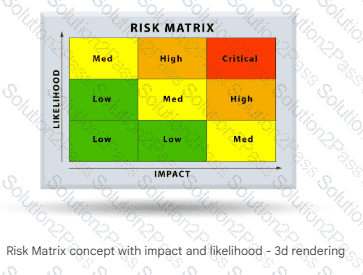
Why Choice C is correct (Plan Risk Responses): After prioritizing risks, the team develops options and actions to enhance opportunities and reduce threats. Common strategies for threats include Avoid, Transfer, Mitigate, or Accept, while strategies for opportunities include Exploit, Share, Enhance, or Accept.
Analysis of other options:
A (Monitor Risk Costs): While costs are monitored in the Control Costs process, there is no specific process named " Monitor Risk Costs " in the Risk Management knowledge area. The correct process for oversight is Monitor Risks, which tracks the status of risks and the effectiveness of responses.
E (Estimate Risk Activity Resources): This is not a standard process. Resource estimation occurs in Project Resource Management (Estimate Activity Resources). While risk responses require resources, the estimation of those resources is integrated into the broader resource and schedule management plans, not as a standalone risk process.
Key Concept: The Project Management Institute (PMI) emphasizes that Risk Management is proactive. By Identifying Risks (Choice B), Analyzing them Qualitatively (Choice D), and Planning Responses (Choice C), a project manager reduces the likelihood of " firefighting " and increases the probability of project success by preparing for uncertainty before it occurs.
An international company that is starting to practice an adaptive approach has several development teams located globally. They are having problems with multiple time zones and repetitive project schedule slippage.
What effective tools should the project teams use to collaborate?
Adopt an iterative development approach and conduct virtual meetings.
Arrange frequent colocated meetings and let the teams work together.
Focus on developing products by only using teams that are colocated.
Benchmark and adopt best practices that are being used by the competition.
The Answer Is:
AExplanation:
Managing globally distributed teams in an Adaptive (Agile) environment requires a shift in how communication and coordination are handled. According to the Agile Practice Guide and the PMBOK® Guide, when physical colocation is impossible, the project manager must implement " Virtual Colocation " (or " Fishbowl Windows " ).
Why Choice A is correct:
Iterative Development: By breaking work into short cycles (iterations/sprints), the teams can synchronize their outputs more frequently. This reduces the " slippage " because issues are identified every 2–4 weeks rather than at the end of a long waterfall phase.
Virtual Meetings: To bridge the time zone gap, teams must use asynchronous communication tools (like wikis or boards) combined with strategic Virtual Meetings (like video conferencing or chat) scheduled during " overlap " hours. This facilitates the necessary face-to-face interaction—even if digital—required for Agile ceremonies like Daily Standups and Retrospectives.
Global Collaboration: This approach acknowledges the reality of a global workforce while providing the structure needed to keep disparate teams aligned.
Analysis of other options:
B (Frequent colocated meetings): While physically working together is the " gold standard " for Agile, it is often financially and logistically impossible for an international company with multiple teams. " Frequent " international travel would likely blow the project budget and cause further delays.
C (Use only colocated teams): This is a regression. It ignores the strategic benefits of a global workforce (such as 24/7 development " follow-the-sun " models or local market expertise) and may not be possible if the required talent is distributed globally.
D (Benchmarking competition): Benchmarking helps with quality or process standards, but it doesn ' t solve the immediate, practical problem of time zone synchronization and team coordination.
Key Concept: The Project Management Institute (PMI) emphasizes that for distributed teams, the Communication Management Plan must be robust. By adopting an iterative approach (Choice A), the project manager creates a " heartbeat " for the project that keeps all global teams moving at the same pace, regardless of their physical location.
What is the total float of the critical path?
Can be any number
Zero or positive
Zero or negative
Depends on the calendar
The Answer Is:
CExplanation:
According to the PMBOK® Guide, specifically within the Develop Schedule process and the Critical Path Method (CPM), the total float is a measure of schedule flexibility.
The Definition of Critical Path: The critical path is the sequence of activities that represents the longest path through a project, which determines the shortest possible project duration.
Total Float on the Critical Path: By definition, activities on the critical path have zero total float. This means there is no flexibility; any delay in a critical path activity will delay the project finish date.
Negative Float: Negative float occurs when a constraint on a finish date (a " Must Finish By " date) is violated. If the calculated early finish of the network is later than the required constraint date, the critical path will show negative float. This indicates that the project is already behind schedule relative to its constraints.
Positive Float: Positive float exists only on non-critical paths. These are sequences of activities that have " slack, " meaning they can be delayed without affecting the project completion date.
Comparison with other options:
A. Can be any number: While float can be many values, it is mathematically constrained by the network logic and project targets. It cannot be " any " number in the context of the critical path ' s definition.
B. Zero or positive: This describes a healthy, unconstrained schedule. However, it ignores the reality of negative float, which is a standard PMI concept for schedules that have missed their mandatory deadlines.
D. Depends on the calendar: While calendars (working vs. non-working days) affect the calculation of dates, the definition of the critical path float is a mathematical result of the forward and backward pass, not the calendar itself.
Which of the following is contained within the communications management plan?
An organizational chart
Glossary of common terminology
Organizational process assets
Enterprise environmental factors
The Answer Is:
BExplanation:
According to the PMBOK® Guide, specifically within the Plan Communications Management process, the Communications Management Plan is a component of the project management plan that describes how, when, and by whom information about the project will be administered and disseminated.
Key Contents: The communications management plan typically includes:
Stakeholder communication requirements: Who needs what information.
Information to be communicated: Including language, format, content, and level of detail.
Reason for the distribution of that information.
Time frame and frequency for the distribution of required information and receipt of acknowledgment or response.
Person responsible for communicating the information.
Glossary of common terminology: This is essential to ensure that all stakeholders have a common understanding of the terms used in the project, which minimizes misunderstandings and communication barriers.
Methods or technologies used to convey the information (e.g., memes, emails, press releases).
Resources allocated for communication activities.
Escalation process for resolving issues that cannot be resolved at a lower staff level.
Comparison with other options:
A. An organizational chart: This is a graphic display of project team members and their reporting relationships. It is typically a component of the Resource Management Plan, not the communications plan, although the communications plan may reference it to determine reporting lines.
C. Organizational process assets (OPAs): OPAs (such as communication templates or historical data) are inputs to the process of creating the communications management plan. They are not " contained within " the plan itself; rather, the plan is developed using them.
D. Enterprise environmental factors (EEFs): Like OPAs, EEFs (such as the organization ' s existing communication infrastructure or regional culture) are inputs that influence the plan. They are external constraints or enablers, not a part of the plan ' s internal documentation.
An example of a group decision-ma king technique is:
Nominal group technique.
Majority.
Affinity diagram.
Multi-criteria decision analysis.
The Answer Is:
BExplanation:
According to the PMBOK® Guide and the Standard for Project Management, specifically within the Collect Requirements and Perform Integrated Change Control processes, Decision Making involves several formal techniques. PMI explicitly categorizes Majority as a fundamental group decision-making technique.
As per PMI standards, group decision-making is an assessment process having multiple alternatives with an expected outcome in the form of future actions. The four most common voting methods used in group decision-making are:
Unanimity: Everyone agrees on a single course of action.
Majority: Support from more than 50% of the members of the group.
Plurality: The largest block in a group decides, even if a majority is not achieved (used when there are more than two options).
Autocratic: One individual takes responsibility for making the decision for the group.
The other options are incorrect based on the following PMI classifications:
Nominal group technique: This is a Data Gathering technique (or a refinement of brainstorming) that enhances brainstorming with a voting process to rank the most useful ideas for further brainstorming or for prioritization. While it involves voting, it is categorized as a data gathering/representation tool rather than a basic decision-making voting method like " Majority. "
Affinity diagram: This is a Data Representation technique. It allows large numbers of ideas to be classified into groups for review and analysis. It is a way to organize data, not a method to reach a final decision.
Multi-criteria decision analysis: This is a Data Analysis technique that uses a decision matrix to provide a systematic analytical approach for establishing criteria, such as risk levels, uncertainty, and valuation, to evaluate and rank many ideas.
As per the PMI Lexicon of Project Management Terms, the use of group decision-making techniques like Majority ensures that stakeholder engagement is maintained and that the project moves forward with collective buy-in.
Which of the following are processes associated with Project Cost Management?
Develop Costs. Estimate Costs, Determine Budget. Control Costs
Develop Budget, Determine Budget, Determine Risks, Control Costs
Plan Cost Management, Estimate Costs. Determine Budget. Control Costs
Plan Budget Management. Determine Budget, Create Cost Accounts. Control Costs
The Answer Is:
CExplanation:
According to the PMBOK® Guide (6th Edition), the Project Cost Management knowledge area is concerned with the processes involved in planning, estimating, budgeting, financing, funding, managing, and controlling costs so that the project can be completed within the approved budget.
There are exactly four processes within this knowledge area:
Plan Cost Management: The process of defining how the project costs will be estimated, budgeted, managed, monitored, and controlled.
Estimate Costs: The process of developing an approximation of the monetary resources needed to complete project work.
Determine Budget: The process of aggregating the estimated costs of individual activities or work packages to establish an authorized cost baseline.
Control Costs: The process of monitoring the status of the project to update the project costs and managing changes to the cost baseline.
Analysis of Distractors:
A (Develop Costs): " Develop Costs " is not a recognized PMI process name. The correct term is " Estimate Costs. "
B (Determine Risks): This process belongs to the Project Risk Management knowledge area. Additionally, " Develop Budget " is not a formal process name (it is " Determine Budget " ).
D (Plan Budget Management / Create Cost Accounts): While cost accounts exist within the Work Breakdown Structure (WBS), " Create Cost Accounts " is not a standalone process. " Plan Budget Management " is also incorrect; the process is " Plan Cost Management. "
Key Document Reference: Section 7.0 of the PMBOK® Guide introduces these four processes as the standard framework for ensuring financial integrity throughout the project life cycle.
Which Knowledge Area involves identifying the people, groups, or organizations that may be impacted by or impact a project?
Project Risk Management
Project Human Resource Management
Project Scope Management
Project Stakeholder Management
The Answer Is:
DExplanation:
According to the PMBOK® Guide and the Standard for Project Management, the Knowledge Area that involves identifying the people, groups, or organizations that could impact or be impacted by a decision, activity, or outcome of the project is Project Stakeholder Management.
As per PMI standards, this Knowledge Area was formally introduced to emphasize the importance of engaging stakeholders to ensure project success. The process specifically referred to in the question is Identify Stakeholders, which is the first process in this Knowledge Area and occurs within the Initiating Process Group. Key elements of this Knowledge Area include:
Stakeholder Identification: Analyzing and documenting relevant information regarding stakeholder interests, involvement, interdependencies, influence, and potential impact on project success.
Stakeholder Analysis: A technique used to systematically gather and analyze quantitative and qualitative information to determine whose interests should be taken into account throughout the project.
Engagement Mapping: Using tools like the Power/Interest Grid, Stakeholder Cube, or Salience Model to categorize stakeholders and determine the appropriate communication and engagement strategy.
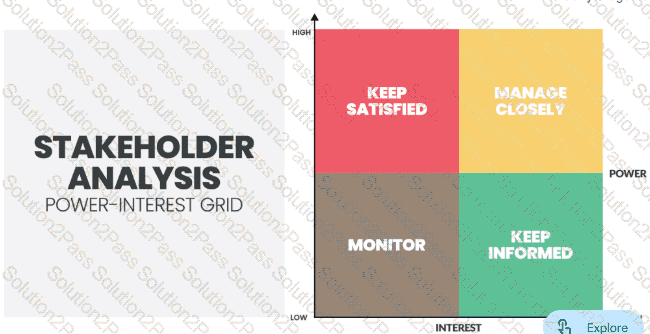
The other options are incorrect based on the following PMI Knowledge Area definitions:
Project Risk Management: Focuses on identifying, analyzing, and responding to project risks (uncertainties). While stakeholders are involved in risk, this area manages the events, not the people.
Project Human Resource Management: (Now referred to as Project Resource Management) Focuses on the internal team—organizing, managing, and leading the project team members. It does not encompass the external entities or organizations impacted by the project.
Project Scope Management: Focuses on ensuring the project includes all the work required, and only the work required, to complete the project successfully. It defines what is being built, not who is affected by it.
As per the PMI Lexicon of Project Management Terms, Project Stakeholder Management is essential for managing expectations and building the necessary support to achieve project objectives.
Which is a method of prototyping that creates a functioning representation of the final finished product to the user?
Low-fidelity prototyping
High-fidelity prototyping
Data prototyping
Report prototyping
The Answer Is:
BExplanation:
According to the PMI Guide to Business Analysis and the PMBOK® Guide, prototyping is a method of obtaining early feedback on requirements by providing a working model of the expected product before actually building it.
High-Fidelity Prototyping: This method creates a version of the product that looks and functions as closely as possible to the final finished product. It includes functional elements, realistic navigation, and polished UI/UX designs. The goal is to allow the user to interact with the system in a way that mimics real-world use, providing the most accurate feedback possible.
User Validation: Because it is a " functioning representation, " high-fidelity prototypes are excellent for usability testing. They help stakeholders confirm that the solution will meet their needs and intentions before the organization commits to full-scale development costs.
Risk Reduction: While more expensive and time-consuming to create than low-fidelity versions, high-fidelity prototypes significantly reduce the risk of a " mismatch " between stakeholder expectations and the final deliverable.
Analysis of other options:
Option A: Low-fidelity prototyping involves simple sketches, storyboards, or paper mockups (like wireframes). While they represent the concept, they are not " functioning representations " and do not look like the finished product.
Option C: Data prototyping (or data modeling) focuses on the structure, relationships, and flow of data within a system. It is a back-end technical activity and does not provide a functioning representation of the finished product for the end-user.
Option D: Report prototyping specifically focuses on the layout and data visualization of output reports. It is a subset of prototyping but does not represent the entire " finished product. "
Per PMI standards, when the objective is to provide users with a functioning, realistic model of the end result, High-fidelity prototyping is the appropriate technique to employ.