Spring Sale Special - Limited Time 70% Discount Offer - Ends in 0d 00h 00m 00s - Coupon code: xmaspas7

Easiest Solution 2 Pass Your Certification Exams

ARA-C01 Snowflake SnowPro Advanced: Architect Certification Exam Free Practice Exam Questions (2026 Updated)

Prepare effectively for your Snowflake ARA-C01 SnowPro Advanced: Architect Certification Exam certification with our extensive collection of free, high-quality practice questions. Each question is designed to mirror the actual exam format and objectives, complete with comprehensive answers and detailed explanations. Our materials are regularly updated for 2026, ensuring you have the most current resources to build confidence and succeed on your first attempt.

Page: 1 / 3
Total 182 questions

A company has a source system that provides JSON records for various loT operations. The JSON Is loading directly into a persistent table with a variant field. The data Is quickly growing to 100s of millions of records and performance to becoming an issue. There is a generic access pattern that Is used to filter on the create_date key within the variant field.

What can be done to improve performance?

A.

Alter the target table to Include additional fields pulled from the JSON records. This would Include a create_date field with a datatype of time stamp. When this field Is used in the filter, partition pruning will occur.

B.

Alter the target table to include additional fields pulled from the JSON records. This would include a create_date field with a datatype of varchar. When this field is used in the filter, partition pruning will occur.

C.

Validate the size of the warehouse being used. If the record count is approaching 100s of millions, size XL will be the minimum size required to process this amount of data.

D.

Incorporate the use of multiple tables partitioned by date ranges. When a user or process needs to query a particular date range, ensure the appropriate base table Is used.

An Architect runs the following SQL query:
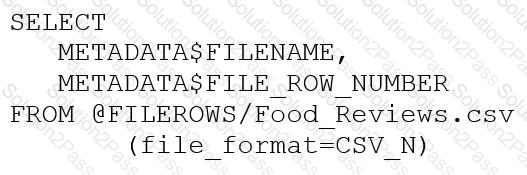
How can this query be interpreted?

A.

FILEROWS is a stage. FILE_ROW_NUMBER is line number in file.

B.

FILEROWS is the table. FILE_ROW_NUMBER is the line number in the table.

C.

FILEROWS is a file. FILE_ROW_NUMBER is the file format location.

D.

FILERONS is the file format location. FILE_ROW_NUMBER is a stage.

A company is using a Snowflake account in Azure. The account has SAML SSO set up using ADFS as a SCIM identity provider. To validate Private Link connectivity, an Architect performed the following steps:

* Confirmed Private Link URLs are working by logging in with a username/password account

* Verified DNS resolution by running nslookups against Private Link URLs

* Validated connectivity using SnowCD

* Disabled public access using a network policy set to use the company’s IP address range

However, the following error message is received when using SSO to log into the company account:

IP XX.XXX.XX.XX is not allowed to access snowflake. Contact your local security administrator.

What steps should the Architect take to resolve this error and ensure that the account is accessed using only Private Link? (Choose two.)

A.

Alter the Azure security integration to use the Private Link URLs.

B.

Add the IP address in the error message to the allowed list in the network policy.

C.

Generate a new SCIM access token using system$generate_scim_access_token and save it to Azure AD.

D.

Update the configuration of the Azure AD SSO to use the Private Link URLs.

E.

Open a case with Snowflake Support to authorize the Private Link URLs’ access to the account.

What does a Snowflake Architect need to consider when implementing a Snowflake Connector for Kafka?

A.

Every Kafka message is in JSON or Avro format.

B.

The default retention time for Kafka topics is 14 days.

C.

The Kafka connector supports key pair authentication, OAUTH. and basic authentication (for example, username and password).

D.

The Kafka connector will create one table and one pipe to ingest data for each topic. If the connector cannot create the table or the pipe it will result in an exception.

A user is executing the following command sequentially within a timeframe of 10 minutes from start to finish:

What would be the output of this query?

A.

Table T_SALES_CLONE successfully created.

B.

Time Travel data is not available for table T_SALES.

C.

The offset -> is not a valid clause in the clone operation.

D.

Syntax error line 1 at position 58 unexpected 'at’.

A company's Architect needs to find an efficient way to get data from an external partner, who is also a Snowflake user. The current solution is based on daily JSON extracts that are placed on an FTP server and uploaded to Snowflake manually. The files are changed several times each month, and the ingestion process needs to be adapted to accommodate these changes.

What would be the MOST efficient solution?

A.

Ask the partner to create a share and add the company's account.

B.

Ask the partner to use the data lake export feature and place the data into cloud storage where Snowflake can natively ingest it (schema-on-read).

C.

Keep the current structure but request that the partner stop changing files, instead only appending new files.

D.

Ask the partner to set up a Snowflake reader account and use that account to get the data for ingestion.

An Architect is designing a solution that will be used to process changed records in an orders table. Newly-inserted orders must be loaded into the f_orders fact table, which will aggregate all the orders by multiple dimensions (time, region, channel, etc.). Existing orders can be updated by the sales department within 30 days after the order creation. In case of an order update, the solution must perform two actions:

1. Update the order in the f_0RDERS fact table.

2. Load the changed order data into the special table ORDER _REPAIRS.

This table is used by the Accounting department once a month. If the order has been changed, the Accounting team needs to know the latest details and perform the necessary actions based on the data in the order_repairs table.

What data processing logic design will be the MOST performant?

A.

Useone stream and one task.

B.

Useone stream and two tasks.

C.

Usetwo streams and one task.

D.

Usetwo streams and two tasks.

What are characteristics of the use of transactions in Snowflake? (Select TWO).

A.

Explicit transactions can contain DDL, DML, and query statements.

B.

The autocommit setting can be changed inside a stored procedure.

C.

A transaction can be started explicitly by executing a BEGIN WORK statement and ended explicitly by executing a COMMIT WORK statement.

D.

A transaction can be started explicitly by executing a BEGIN TRANSACTION statement and ended explicitly by executing an END TRANSACTION statement.

E.

Explicit transactions should contain only DML statements and query statements. All DDL statements implicitly commit active transactions.

How is the change of local time due to daylight savings time handled in Snowflake tasks? (Choose two.)

A.

A task scheduled in a UTC-based schedule will have no issues with the time changes.

B.

Task schedules can be designed to follow specified or local time zones to accommodate the time changes.

C.

A task will move to a suspended state during the daylight savings time change.

D.

A frequent task execution schedule like minutes may not cause a problem, but will affect the task history.

E.

A task schedule will follow only the specified time and will fail to handle lost or duplicated hours.

An Architect on a new project has been asked to design an architecture that meets Snowflake security, compliance, and governance requirements as follows:

1) Use Tri-Secret Secure in Snowflake

2) Share some information stored in a view with another Snowflake customer

3) Hide portions of sensitive information from some columns

4) Use zero-copy cloning to refresh the non-production environment from the production environment

To meet these requirements, which design elements must be implemented? (Choose three.)

A.

Define row access policies.

B.

Use the Business-Critical edition of Snowflake.

C.

Create a secure view.

D.

Use the Enterprise edition of Snowflake.

E.

Use Dynamic Data Masking.

F.

Create a materialized view.

How does a standard virtual warehouse policy work in Snowflake?

A.

It conserves credits by keeping running clusters fully loaded rather than starting additional clusters.

B.

It starts only if the system estimates that there is a query load that will keep the cluster busy for at least 6 minutes.

C.

It starts only f the system estimates that there is a query load that will keep the cluster busy for at least 2 minutes.

D.

It prevents or minimizes queuing by starting additional clusters instead of conserving credits.

Company A would like to share data in Snowflake with Company B. Company B is not on the same cloud platform as Company A.

What is required to allow data sharing between these two companies?

A.

Create a pipeline to write shared data to a cloud storage location in the target cloud provider.

B.

Ensure that all views are persisted, as views cannot be shared across cloud platforms.

C.

Setup data replication to the region and cloud platform where the consumer resides.

D.

Company A and Company B must agree to use a single cloud platform: Data sharing is only possible if the companies share the same cloud provider.

Which of the following are characteristics of how row access policies can be applied to external tables? (Choose three.)

A.

An external table can be created with a row access policy, and the policy can be applied to the VALUE column.

B.

A row access policy can be applied to the VALUE column of an existing external table.

C.

A row access policy cannot be directly added to a virtual column of an external table.

D.

External tables are supported as mapping tables in a row access policy.

E.

While cloning a database, both the row access policy and the external table will be cloned.

F.

A row access policy cannot be applied to a view created on top of an external table.

Which Snowflake data modeling approach is designed for BI queries?

A.

3 NF

B.

Star schema

C.

Data Vault

D.

Snowflake schema

How can the Snowpipe REST API be used to keep a log of data load history?

A.

Call insertReport every 20 minutes, fetching the last 10,000 entries.

B.

Call loadHistoryScan every minute for the maximum time range.

C.

Call insertReport every 8 minutes for a 10-minute time range.

D.

Call loadHistoryScan every 10 minutes for a 15-minutes range.

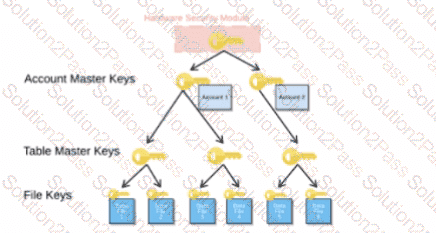
When activating Tri-Secret Secure in a hierarchical encryption model in a Snowflake account, at what level is the customer-managed key used?
A.

At the root level (HSM)

B.

At the account level (AMK)

C.

At the table level (TMK)

D.

At the micro-partition level

What built-in Snowflake features make use of the change tracking metadata for a table? (Choose two.)

A.

The MERGE command

B.

The UPSERT command

C.

The CHANGES clause

D.

A STREAM object

E.

The CHANGE_DATA_CAPTURE command

An Architect has a VPN_ACCESS_LOGS table in the SECURITY_LOGS schema containing timestamps of the connection and disconnection, username of the user, and summary statistics.

What should the Architect do to enable the Snowflake search optimization service on this table?

A.

Assume role with OWNERSHIP on future tables and ADD SEARCH OPTIMIZATION on the SECURITY_LOGS schema.

B.

Assume role with ALL PRIVILEGES including ADD SEARCH OPTIMIZATION in the SECURITY LOGS schema.

C.

Assume role with OWNERSHIP on VPN_ACCESS_LOGS and ADD SEARCH OPTIMIZATION in the SECURITY_LOGS schema.

D.

Assume role with ALL PRIVILEGES on VPN_ACCESS_LOGS and ADD SEARCH OPTIMIZATION in the SECURITY_LOGS schema.

You are a snowflake architect in an organization. The business team came to to deploy an use case which requires you to load some data which they can visualize through tableau. Everyday new data comes in and the old data is no longer required.

What type of table you will use in this case to optimize cost

A.

TRANSIENT

B.

TEMPORARY

C.

PERMANENT

What are characteristics of Dynamic Data Masking? (Select TWO).

A.

A masking policy that Is currently set on a table can be dropped.

B.

A single masking policy can be applied to columns in different tables.

C.

A masking policy can be applied to the value column of an external table.

D.

The role that creates the masking policy will always see unmasked data In query results

E.

A masking policy can be applied to a column with the GEOGRAPHY data type.

Page: 1 / 3
Total 182 questions
Copyright © 2014-2026 Solution2Pass. All Rights Reserved