Workday-Pro-Integrations Workday Pro Integrations Certification Exam Free Practice Exam Questions (2026 Updated)
Prepare effectively for your Workday Workday-Pro-Integrations Workday Pro Integrations Certification Exam certification with our extensive collection of free, high-quality practice questions. Each question is designed to mirror the actual exam format and objectives, complete with comprehensive answers and detailed explanations. Our materials are regularly updated for 2026, ensuring you have the most current resources to build confidence and succeed on your first attempt.
You are configuring an EIB that uses a custom report as its data source. When attempting to transfer ownership of the report to the Integration System User (ISU), the ISU does not appear as an option for new report owners. You confirm that the ISU already has the necessary access to the report data source and related fields.
Within the Custom Report Creation domain, which security configuration should you update to allow the ISU to appear as a valid report owner?
The following XML code was generated using Core Connector: Location.
You need to validate that both the locc:Location_Name and locc:Municipality elements are not empty, and provide custom error messages with a severity level for each.
Which XSLT attributes and values should you use when producing a pipe-delimited file?
Refer to the following scenario to answer the question below. Your integration has the following runs in the integration events report (Date format of MM/DD/YYYY):
Run #1
• Core Connector: Worker Integration System was launched on May 15, 2024 at 3:00:00 AM
• As of Entry Moment: 05/15/2024 3:00:00 AM
• Effective Date: 05/15/2024
• Last Successful As of Entry Moment: 05/01/2024 3:00:00 AM
• Last Successful Effective Date: 05/01/2024
Run #2
• Core Connector: Worker Integration System was launched on May 31, 2024 at 3:00:00 AM
• As of Entry Moment: 05/31/2024 3:00:00 AM
• Effective Date: 05/31/2024
• Last Successful As of Entry Moment: 05/15/2024 3:00:00 AM
• Last Successful Effective Date: 05/15/2024
On May 13, 2024 Brian Hill receives a salary increase. The new salary amount is set to $90,000.00 with an effective date of May 22, 2024. Which of these runs will include Brian Hill ' s compensation change?
You are configuring integration security for a Core Connector integration system. How do you find the web service operation used by the connector template?
You are configuring the Core Connector: Location to send location data to a new global facilities management system. You must meet three specific requirements:
Task A: The facilities system requires that in addition to the default public address, the private address should also be included.
Task B: The facilities system uses the status codes “A” for Active and “I” for Inactive. You need to translate Workday’s “Active” and “Inactive” values from the Location Status field.
Task C: The facilities system requires a “Building Manager” value. You have already built a Calculated Field that retrieves the Facilities Manager role for each location, and you need to send this data in the integration.
How do you configure these tasks in the integration system?
Refer to the following scenario to answer the question below.
You need to configure a Core Connector: Candidate Outbound integration for your vendor. The connector requires the data initialization service (DIS).
The vendor needs a value on the output file which contains the average number of jobs a candidate applied to. This value is not delivered by Workday so you have identified that you will need to build a calculated field to generate this value.
What steps do you follow to output the calculated field?
A vendor needs to create a Date Difference calculated field. However, the two dates needed for that calculation are on two separate business objects.
What additional calculated field do you need to create that Date Difference calculated field?
How does an XSLT processor identify the specific nodes in an XML document to which a particular transformation rule should be applied?
Refer to the following XML to answer the question below.
Refer to the following XML to answer the question below.
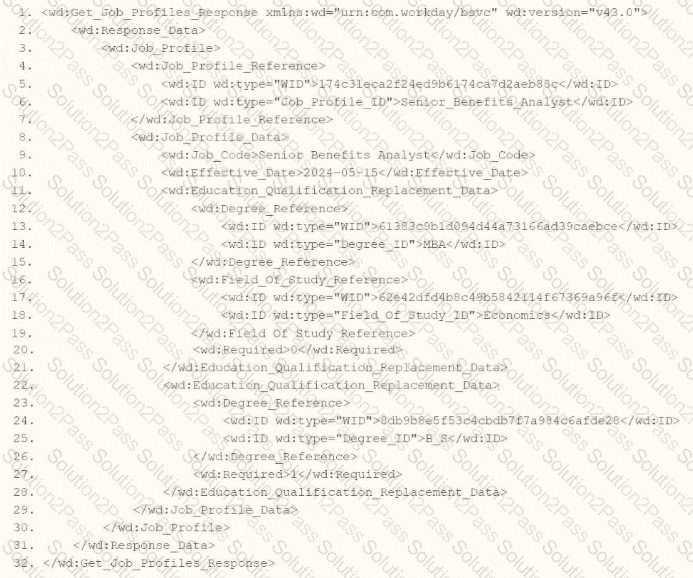
You are an integration developer and need to write XSLT to transform the output of an EIB which is making a request to the Get Job Profiles web service operation. The root template of your XSLT matches on the < wd:Get_Job_Profiles_Response > element. This root template then applies templates against < wd:Job_Profile > . XPath contains a number of delivered functions such as format-date. The format-date function uses the following syntax: format-date ($value as xs: date? $picture as xs:string). Within the template which matches on < wd:Job_Profile > , what XPath syntax would you use to output the value of the < wd:Effective_Date > element formatted with the day-month-year format of " 15-07-2024 " ?
Which three features must all XSLT files contain to be considered valid?
Which features must all XSLT files contain to be considered valid?
You have successfully configured an ISU and an ISSG with the correct security policies and have assigned them to an EIB.
What task do you need to run before you can launch the EIB?