Weekend Sale Special - 75% Discount Offer - Ends in 0d 00h 00m 00s - Coupon code: stp75

Easiest Solution 2 Pass Your Certification Exams

PMP PMI Project Management Professional (PMP) July 2026 Update Free Practice Exam Questions (2026 Updated)

Prepare effectively for your PMI PMP Project Management Professional (PMP) July 2026 Update certification with our extensive collection of free, high-quality practice questions. Each question is designed to mirror the actual exam format and objectives, complete with comprehensive answers and detailed explanations. Our materials are regularly updated for 2026, ensuring you have the most current resources to build confidence and succeed on your first attempt.

Page: 2 / 3
Total 187 questions

A project manager joined an ongoing project to replace another manager. After one iteration, the project manager noticed that team morale is low. Team members are

reluctant to speak at first, but tell the new project manager about a history of conflicts.

What should the project manager do next?

A.

Organize a retrospective meeting and be receptive to feedback.

B.

Send written feedback to functional managers and escalate the issues.

C.

Obtain approval from the project sponsor to organize a team event.

D.

Share the lessons learned from another project team with conflicts.

During a review session, the team reports that the daily coordination meetings have been unproductive. The team asks the scrum master to implement a standard

format for the daily coordination meetings.

What should the scrum master do?

A.

Ask one of the team leads to prepare a structure for the next meeting.

B.

Coach the team about the purpose and objectives of these meetings.

C.

Propose an agenda for the next meeting.

D.

Change the frequency of the meetings to weekly.

During the execution of an agile project, the quality of one vendor ' s deliverables decreases significantly. After analyzing possible solutions, the project manager identifies an alternative vendor who can deliver similar components in smaller batches.

What should the project manager do?

A.

Meet with the current vendor to discuss alternatives for solving the situation.

B.

Adjust the project execution cadence to consider the alternative vendor.

C.

Update the project management plan and inform all the stakeholders about the new iteration lengths with the current vendor.

D.

Register the occurrence in the issue log and continue the project execution with the new vendor and shorter iterations.

A strategic project is nearing completion. The project manager discovers the project team is reluctant to prepare the knowledge transfer documentation to the relevant business department because they are being assigned to a new, urgent project.

What should the project manager do?

A.

Emphasize the importance of knowledge transfer to the project team.

B.

Ask project sponsor to push the project team for knowledge transfer.

C.

Get all the details from project team members to provide knowledge transfer.

D.

Convince project team to outsource the knowledge transfer work.

A project manager is leading an important development project. A key deliverable has been completed but does not meet the quality standards defined in the quality management plan.

What should the project manager do?

A.

Return the deliverable and ensure that the reworked deliverable meets the quality standards.

B.

Approve the deliverable because it will not affect the project’s overall quality standard.

C.

Accept the deliverable and instruct the team to continue working without reporting the issue.

D.

Adjust the quality standards to align them with the deliverable’s current quality level.

A project manager is working for a multinational financial services company that does business in more than 100 countries. The company is rolling out a time

management system in multiple countries.

What should the project manager do?

A.

Invite stakeholders to monthly, informal meetings.

B.

Email the project schedule frequently to all stakeholders.

C.

Communicate progress to stakeholders in their preferred ways.

D.

Share the work breakdown structure (WBS) with stakeholders regularly.

A project sponsor provides a charter and appoints a project manager to implement a large project over 5 years. The sponsor then requests the project budget and

outcomes from the project manager.

What should the project manager do first?

A.

Review the provided charter, identifying and engaging stakeholders.

B.

Review timelines based on the sponsor ' s provided charter and determine outcomes.

C.

Discuss and agree on a budget and plan with the project sponsor.

D.

Hire experts to decide on budget, develop the project management pian, and determine outcomes.

Midway through a product launch, a major supplier announces a three-week shutdown due to a warehouse fire. This supplier provides hardware that is critical to integration testing.

What should the project manager do?

A.

Escalate the situation to the sponsor and request additional funding.

B.

Reprioritize the backlog to focus on unaffected deliverables.

C.

Pause the sprint temporarily and reassess the release timeline.

D.

Replace the vendor and continue with the current sprint goals.

One of the key team members working on a critical path task resigns without any notice. Another resource is hired as a temporary replacement but does not have the same skillset and is taking too long to complete the work.

What should the project manager do?

A.

Estimate the cost and schedule impact of the resource change.

B.

Ask the new resource to work faster while maintaining quality.

C.

Discuss options with the team to reassign tasks to other resources.

D.

Contact human resources (HR) to find if another resource is available.

A project manager works for a communications company. The manager of the mobile equipment department is concerned about the current project ' s activities.

According to the current project management plan, the department will need to purchase special equipment, but the cost was not planned. The project sponsor insists

the project should move forward because customers will be impacted if the equipment is not available.

What should the project manager do?

A.

Escalate the conflict to the project sponsor.

B.

Use the contingency reserve to fund the equipment cost.

C.

Resolve the issue in favor of the department manager to continue the project.

D.

Estimate the cost of purchasing the equipment and submit a change request.

A project manager works for a company that recently won a big government contract. The company has a flat hierarchy and self-organized teams. The client wants

the project manager to use a predictive management approach and an up-front project management plan. However, the project manager knows that a more agile

approach would be better due to the high uncertainty of the project scope.

What should the project manager do?

A.

Use a predictive management approach and update the risk register to account for uncertainties.

B.

Comply with the client ' s request and adjust the team ' s way of working to a predictive approach.

C.

Propose a hybrid style to the client to accommodate the nature of the project and their work structure.

D.

Identify the best project life cycle in collaboration with the project team and the stakeholders.

The project manager is creating a status report to show the progress of completed training artifacts intended for delivery to bank branches for a new project for both

new and existing customers. During the review process, it is discovered that some of the artifacts were duplicated by two project team members.

What should the project manager do?

A.

Motivate and inspire team members consistently to concentrate diligently on their designated tasks.

B.

Speak with both team members individually and assign them specific new tasks.

C.

Take a proactive approach and select what artifacts they want to work on.

D.

Create a RACI (responsible, accountable, consulted, informed) matrix to communicate roles and responsibilities.

Aclient in a consulting firm presents an aggressive product implementation schedule. Key aspects of the scope have not been defined, and several internal

stakeholder decisions are still pending. This situation is delaying the request for proposals (RFPs) from the vendors.

What should the project manager do?

A.

Contact the client and offer to facilitate sessions with internal stakeholders to finalize the decisions.

B.

Negotiate the initial proposals with the vendors and update the proposal accordingly once the scope definition is complete.

C.

Inform the client that the key scope decisions must be completed before the proposals can be sent.

D.

Update the schedule to accommodate the delays and set up a meeting to inform the client.

A project manager notices that every time a new member joins the team, they spend too much time learning business terminology. This trend has impacted system

integrations and creates delays on a few tasks that other teams depend on.

What should the project manager do?
A.

Ask the subject matter expert (SME) to organize their documentation in a centralized repository.

B.

Ask the new team member to timebox the knowledge transfer to reduce the time spent with the team.

C.

Ask the testing team to share their use case scenarios to familiarize the new team member.

D.

Ask the new team member to research the terminology via the internet to avoid disruption.

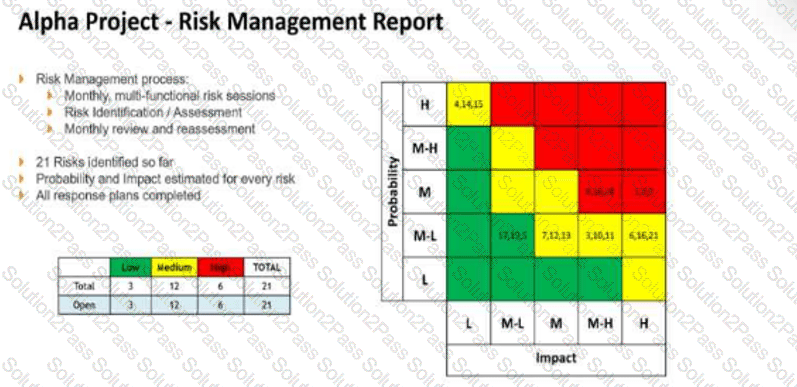
According to the Alpha project’s risk management report, which risks should the project manager prioritize?

(Refer to Alpha Project — Risk Management Report exhibit.)

A.

1, 2, 9

B.

4, 14, 15

C.

8, 18, 20

D.

17, 19, 5

During the planning phase of a project, the local project team presents a task to the project manager. This task will require several months to complete, and the

duration will affect the expected timeline.

What should the project manager do first?

A.

Communicate to stakeholders the updated schedule after considering how long each task will take.

B.

Add more resources during the task execution phase to complete the project on time.

C.

Meet with the project team to assess the task and any possible improvement to reduce its duration.

D.

Procure services to execute the task so the local project team can progress with other project activities.

During a sprint review, the customer described a strong market trend that will highly impact the product vision and the project management plan. What should the

project manager do?

A.

Acknowledge the changed value proposition and request the team undo the scope of the last sprint.

B.

Interrupt the customer and underline the importance to stick to the approved documents.

C.

Review the customer ' s needs and define the backlog items according to the situation.

D.

Continue executing the project backlog as planned and introduce the changes in later stages.

During a daily coordination meeting, the team reports that due to considerable challenges with the infrastructure, the planned tasks are now blocked and cannot move

forward. What should the project manager do?

A.

Ask the product owner to suggest issue resolution.

B.

Escalate the issue and its impact to the project sponsor.

C.

Determine and apply a suitable strategy to remove or minimize the issues.

D.

Ask the team members to explore trainings while waiting for issue resolution.

At the postevent review of an annual conference, the project manager realizes that the team could benefit from improvements in how they handle sponsorship

agreements and event logistics. Specifically, the team found that having clearer contracts with sponsors earlier in the planning process would help avoid last-minute

issues.

How should the project manager handle the organizational process assets (OPAs)?

A.

Focus on updating the OPAs with feedback from attendees about the sponsor contract process.

B.

Align the OPAs with general event management guidelines based on industry good practices.

C.

Wait until the next event is completed before updating the OPAs so the recommendations are validated before documenting.

D.

Update the OPAs with the recommendations based on the current project evaluation of the sponsor contract process.

Acompany is transitioning all projects under the portfolio of IT from a predictive to an adaptive approach. Some of the project managers and project team members

are unhappy about this change because they have been working in a predictive environment for years, and several projects are currently in progress.

What are two tasks the project manager should ask support from the company ' s management team to ensure smooth transition to the new approach? (Choose 2)

A.

Allow projects in the portfolio to operate freely for the next three months without measuring their performance.

B.

Organize learning programs for everyone in the portfolio to educate them about the adaptive approach.

C.

Highlight the pros of an adaptive approach and convince everyone that change is inevitable.

D.

Enforce the change on everyone and on every project without taking time to acknowledge their resistance.

E.

Develop new processes, standards, guidelines, and templates to follow for working in the adaptive way.

Page: 2 / 3
Total 187 questions
Copyright © 2014-2026 Solution2Pass. All Rights Reserved