PMP PMI Project Management Professional (PMP) July 2026 Update Free Practice Exam Questions (2026 Updated)
Prepare effectively for your PMI PMP Project Management Professional (PMP) July 2026 Update certification with our extensive collection of free, high-quality practice questions. Each question is designed to mirror the actual exam format and objectives, complete with comprehensive answers and detailed explanations. Our materials are regularly updated for 2026, ensuring you have the most current resources to build confidence and succeed on your first attempt.
A project manager is assigned to a multimillion-dollar project. Senior stakeholders are not happy with the project objectives.
What should the project manager do?
A project manager is responsible for building a new data center and developing new monitoring software before a fixed deadline. Although the software features are not fully defined, the project scope is set, and a contract has been signed.
What should the project manager do?
The regional sales manager (RSM) calls the project manager and expresses the need to add functionalities to the project scope and change the project ' s priorities. Making these alterations as soon as possible will significantly increase the project ' s adoption.
What should the project manager do?
A project manager conducts weekly virtual project meetings with all stakeholders to keep them updated on project progress and discuss key issues. Some stakeholders appear disengaged or are occupied with other work during the meetings. Other stakeholders have stopped attending.
What should the project manager do?
During the execution phase of a complex project, a key government stakeholder was replaced by a new representative from the same agency. During a project
meeting, the new stakeholder expressed complaints about not being informed of recent on-site changes. The stakeholder also said they would not have approved
these changes.
What should the project manager do first?
A project manager has been assigned to complete a project within the approved budget. Midway through the implementation, the project budget is reduced by the
sponsor.
What should the project manager do?
During project implementation, the project manager is communicating information about changes only at the executive level. Many people within the organization are uncertain about the project ' s status. There are rumors about changes to the project and how they may affect work activities.
What should the project manager do?
A team is working on a hospital construction project and is using a predictive approach. The team has encountered a challenge affecting their deadline because a
critical team member is on medical leave. The project is in jeopardy of falling behind schedule.
What should the project manager do first?
Recently, the company ' s leadership team attended a management conference where they discussed project management approaches. The leadership team has
tasked the software project team with using an adaptive approach on the current project. The project manager anticipates the team will struggle to adapt to this
approach in the next 3-month.
What should the project manager do next?
A project team is working for a client in the international banking sector, where frequent regulatory changes are common. On the current project, the team will verify compliance with a new
legal framework which aims to strengthen regulation, supervision, and risk management.
What should the project manager do first?
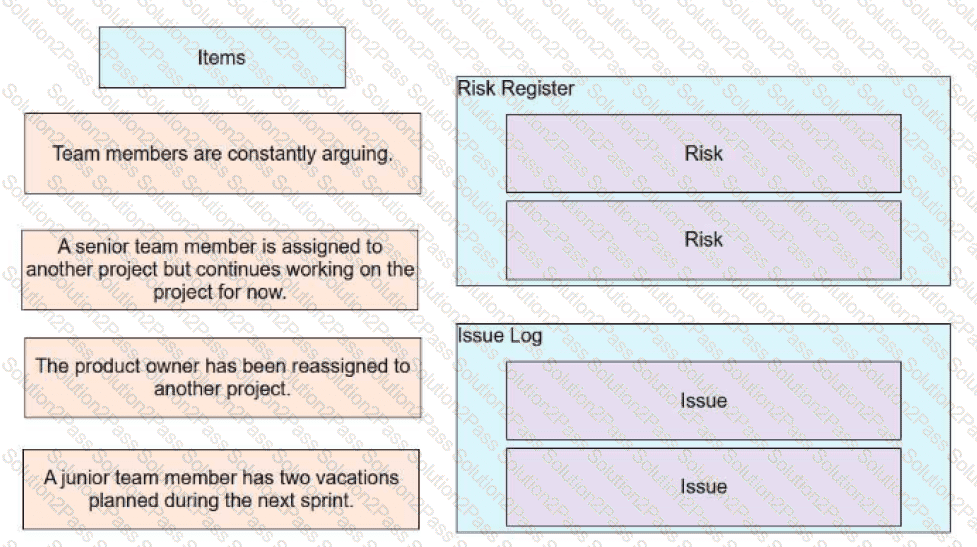
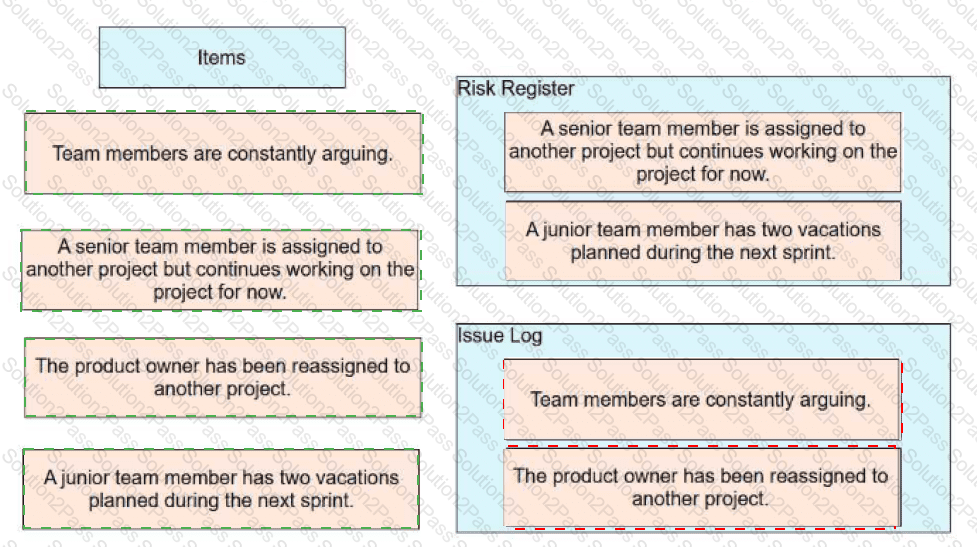
A logistics project is anticipating significant delays in the next few months. The project manager makes a list of the causes of the delays before thinking about how to minimize them.
How should the project manager prioritize which delays to take action on? (Select each box from the Items list and drag and drop it into either the Risk Register or Issue Log box.)
Top management is considering terminating a failing project. A newly hired project manager is invited to attend a meeting at which this will be discussed.
What should the new project manager do?
During a project kickoff meeting, two key stakeholders are arguing about the project scope and the acceptance of the deliverable. What should the project manager focus on to address the argument?
A project manager is leading a construction project for a retail store. The project manager is using a Gantt chart to present the workflow. One part of the project
includes custom software development to manage the store ' s lighting system, which uses solar energy.
How should the project manager accommodate software development in the project?
Solution Development Case Study
A project manager was assigned to a project to deliver a corporate IT security solution within a 12-month timeline and a budget of $2.5 million USD. To help ensure project success, the project manager established a governance framework featuring a steering committee of senior executives from relevant functional areas. The project manager conducted a detailed stakeholder analysis using a power/interest grid to prioritize engagement strategies and developed a quality management plan incorporating quality metrics, control charts, and acceptance criteria for each deliverable.
Project work required specialized security testing tools, so the project manager collaborated with the procurement team to develop vendor selection criteria and contract terms. The team used an agile approach to develop software coupled with a predictive approach to manage other aspects of the project. The project manager implemented a configuration management system to track changes and maintain version control of project information.
During execution, the project manager coordinated between various teams, including software development, cybersecurity, quality assurance, compliance, and customer experience, each with its own methodologies and tools. To address integration challenges, the project manager developed a comprehensive project management plan, with a detailed work breakdown structure (WBS), a master schedule using the critical path method, and earned value management (EVM). The team helped the project manager create and tailor a risk management plan focusing on integration points between teams, along with a communications matrix to ensure consistent cross-functional meetings with stakeholders.
During the project, challenges such as resource conflicts, scope creep, and technical integration issues arose. The project manager addressed these challenges using a resource optimization plan, a formal change control process, and technical working groups.
The project was delivered within budget and was concluded 2 months later than the original baseline due to an approved change. Stakeholders accepted the delay due to additional security features added during execution. The final product met all quality metrics and received positive feedback from beta customers. The project provided valuable lessons on early stakeholder alignment, integrated change control, cross-functional communication, and regular risk reassessment, which informed good practices for future projects within the organization.
What should the project manager do to facilitate and improve communications between the multiple teams within this project?
(Refer to the Solution Development Case Study exhibit.)
A project in a fast-changing, demanding business environment has been initiated. An agile approach has been chosen to maximize collaboration and transparency.
What should the agile project manager do to support these goals?
A new technology has been released into the market. The project sponsor realizes that incorporating this new technology into the project will significantly improve the
final deliverable. The project manager informs the project sponsor that the internal resources have no working experience with the technology and its related activities,
What should the project sponsor do?
Acustomer has agreed in a contract that interactive displays will be delivered to 14 locations by the end of the year. The contract also states that only software
approved by the customer will be installed on these displays. The customer has not approved this new software because they lack the resources to test and approve
it.
What should the project manager do?
While facilitating the weekly team meeting, a developer raises the concern that a team lead from a different department is frequently asking for status updates on
ongoing tasks. The project manager was not aware of these interferences.
What should the project manager do next?
Alarge company is planning on automating their current manual processes. The project manager wishes to assess whether there are monetary benefits to be gained
by automating these processes.
What should the project manager do?