Pre-Summer Sale Special - Limited Time 70% Discount Offer - Ends in 0d 00h 00m 00s - Coupon code: xmaspas7

Easiest Solution 2 Pass Your Certification Exams

PMP PMI Project Management Professional (PMBOK 7th Version) Free Practice Exam Questions (2026 Updated)

Prepare effectively for your PMI PMP Project Management Professional (PMBOK 7th Version) certification with our extensive collection of free, high-quality practice questions. Each question is designed to mirror the actual exam format and objectives, complete with comprehensive answers and detailed explanations. Our materials are regularly updated for 2026, ensuring you have the most current resources to build confidence and succeed on your first attempt.

Page: 6 / 11
Total 2191 questions

A customer complains that the user stories released so far contain too much jargon and do not reflect the expectations of the product. What should the project manager do

next?

A.

Request approval from the company director to conduct training for the team.

B.

Ask the senior developer to rewrite all the stories.

C.

Engage with the customer and rewrite all the stories.

D.

Rewrite the stories to include the technical vision of the product.

In the planning phase of a software implementation project, two of the team members disagree on how to approach end-user training. The

discussion has intensified and the team members are not able to agree.

What should the project manager do next?

A.

Remove one of the team members from the project to improve team dynamics.

B.

Make a decision based on expert judgment as a project manager.

C.

Consider the view of each team member about the issue in order to reach consensus.

D.

Remove both team members since they are not productively adding to the team.

During a retrospective, one of the team members reports that a functional manager wants to be involved in task allocation. What should the project manager do?

A.

Inform the functional manager that self-organization includes task allocation.

B.

Confirm with the team members that the functional manager is responsible for the delivery.

C.

Ask the product owner to clarify the roles and responsibilities of the project team.

D.

Inform the functional manager that task allocation is the responsibility of the product owner.

A project manager is assigned to a large construction project with more than 100 project team members. The project manager is having a hard time keeping the project on track and deriving the planned benefits. The project manager wants to make sure that each requirement is linked to the business and project objective.

What should the project manager do?

A.

Review the requirements on a weekly basis.

B.

Implement a requirements traceability matrix.

C.

Add the requirements to the project charter.

D.

Understand the project management plan.

Two teams are engaged on a global project which uses a follow-the-sun approach in order to speed up delivery. After the first release, many issues were identified on the product, which could easily have been avoided with better communication.

What should the project manager do?

A.

Improve the videoconferencing system to provide better availability and quality in order to increase communication.

B.

Have team ambassadors from each location travel to the other in order to facilitate communication and minimize issues.

C.

Facilitate a meeting with both teams so that they can agree on the issues and propose solutions that work for both teams.

D.

Move working windows so that team members can have increased overlap for the handover of status and issues to their counterparts.

A key team member has recently gone through some personal issues that has affected their performance. The project manager noticed that the

team member's emotional situation has affected the rest of the team's performance.

How should the project manager handle this situation?

A.

Help all team members learn to deal with their emotions by building a culture of empathy.

B.

Separate the key team member and replace them while they emotionally recover.

C.

Meet with the team to discuss how to handle the performance problem.

D.

Ask the human resources (HR) department for their support providing emotional help.

A new team member is assigned to a team that consistently delivers each iteration. The new team member is does not understand many of the processes followed and begins to negatively impact the schedule.

What should the project manager do?

A.

Place the new team member on a performance improvement program.

B.

Ask another team member to take some of the new team member's work.

C.

Assign easier activities to the new team member.

D.

Allocate time within the iterations to mentor the new team member.

A project manager who takes over halfway through a project determines that the cost performance index (CPI) is 0.65. A detailed audit identifies that the project cost was analogously estimated, and the audit team thinks that something was missing in the way the estimates were done.

What should have been done to avoid this problem?

A.

Included lessons learned from past projects

B.

Used bottom-up estimating

C.

Utilized three-point estimates

D.

Validated the schedule performance index (SPI) to evaluate deviation

A project manager holds meetings every Monday to review the team members' progress. The project sponsor is insisting on daily updates to ensure improved delivery on products developed by all of the teams, including this one. Some learn members indicate they are on a very light time line and would attend me Monday meeting, but not the daily update meetings.

What should the project manager do to ensure all team members participate in daily meetings?

A.

Analyse the team members' influence levels and schedule a training on the importance of daily standups and the time-bound feature of the meetings.

B.

Require all team members to attend the daily review meetings as they ate requested by the project sponsor.

C.

Inform the functional manager and replace (earn members who cannot join the daily progress meetings.

D.

Review the influence of each team member, call the team members with the highest influence to a meeting, and convince them to join the daily standups.

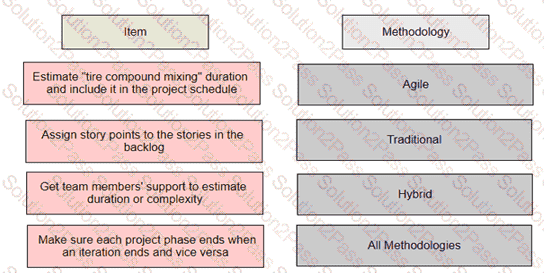
A project manager in an automotive company is scheduling activities for a complex project Some of the project requirements are fixed and some are flexible Match the items on the left with the methodology on the right that the project manager is using.
In an agile project, some stakeholders are asking to have a meeting with the team every 2 weeks in order to understand project progress. What

should the project lead do next?

A.

Invite the stakeholders to the retrospective meetings.

B.

Invite the stakeholders to the sprint review meetings.

C.

Hold a meeting every 2 weeks with the stakeholders.

D.

Negotiate by sending an informative email to stakeholders.

A project manager is working on a project with three virtual teams. Team A is in a different time zone than teams B and C. The project was going

well, but recently team A has started feeling left out. Information reaches team A late or is sometimes missed, and teams B and C give preference

to each other's problems over team A. The project manager has already set project guidelines, but realizes they need to be improved.

Which two things should the project manager do to help the teams collaborate better? (Choose two)

A.

Schedule weekly progress meetings with all three teams and have them take turns as key players.

B.

Plan for team members to temporarily work at each other's locations to better provide a sense of community.

C.

Update the communications management plan and encourage the teams to review it promptly and proactively.

D.

Create a status reporting template and share it with all team members before the day ends.

E.

Schedule daily meetings with each team to understand their progress and concerns in detail.

In a project steering committee meeting, a few stakeholders raise concerns that the project manager's report shows that the outcome of the project is already in the market

while the project is still in development. The project manager explains that the project is being delivered in sprints and involves different releases.

What should the project manager do to avoid a reoccurrence of this scenario?

A.

Ensure the content of the project report is clearly understood and request any necessary feedback.

B.

Invite critical stakeholders to the daily project review meetings to ensure their full engagement and involvement.

C.

Send a detailed report to each steering committee member ahead of the meeting.

D.

Ensure that all product features are completed as per the communicated specifications before releasing to market.

A software delivery project began having technical impediments. The issue may cause a delay of the deliverables. The technical service team has been working on the issue, but the issue is unresolved even after 1 week of maintenance.

What should the senior project manager do now?

A.

Use interpersonal skills to expedite the issue.

B.

Send a gentle reminder to the technical service team.

C.

Update the issue log with the status and priority.

D.

Issue a formal warning to the technical service team.

The project manager's firm is executing a construction project. The project is stalled due to reemerging conflicts and misunderstandings among stakeholders.

What should the project manager do to ensure a smooth start and completion of the project?

A.

Conduct an on-site survey, start the project to avoid any undue delays, and ensure costs are under control

B.

Invite all the stakeholders to a change control board (CCB) meeting, share feedback and facts, and come to a consensus.

C.

Advise the firm to cancel the project due to misunderstandings among the stakeholders and the associated risks.

D.

Determine the root cause of the misunderstandings, get all parties to reach a consensus, and help to implement the outcome.

A project manager is assigned to a project team midway through execution. Several dependencies are impacting the project, and the project manager feels the team is not adequately informed of the impacting changes.

What should the project manager do first?

A.

Convene an impact analysis meeting.

B.

Escalate the issue to the product owner.

C.

Consult the communications management plan.

D.

Review the stakeholder register.

A project has come to the closing stage. The work is generally finished, and the project manager wants to commence the closure process for the project. What should the project manager ensure is in place prior to the closing process?

A.

The organizational process assets (OPAs) have been updated.

B.

The contractual deliverables of the project have been accepted.

C.

It The handover and deliverable acceptance have been completed.

D.

The lessons learned sessions have been conducted.

A project manager determines that a critical path activity is going to be delayed. The team proposes a fallback plan that could get the project back on track; however, the plan would require an additional cost to an already tight budget.

What should the project manager do?

A.

Use the existing budget for executing the fallback plan and update the baseline.

B.

Add additional resources to the project to fast track certain activities and reduce delays.

C.

Evaluate the fallback plan proposed by the team and submit a change request, if required.

D.

Communicate the delay to stakeholders and maintain the existing budget baseline.

A project manager has been assigned to manage multiple agile project teams. The project manager wants to empower the teams and make them self-organizing.

What should the project manager do to create a positive environment?

A.

Establish the team ground rules and share them with the team for strict adherence.

B.

Copy the ground rules established by another project and provide them to the teams.

C.

Extract the organization's policies and processes, customize them, and give them to the teams to adhere to.

D.

Help the teams in establishing and adhering to their ground rules and revisit after regular intervals.

A project manager is about to slant the testing phase of a new project. Historical data show there is a high risk of failing the agreed acceptance criteria.

How should the project manager ensure the acceptance criteria are ret?

A.

Perform tests and routinely track results as per the quality management plan.

B.

Make sure the stakeholders are aware of the acceptance criteria.

C.

Negotiate to obtain approval if most of the tests have passed.

D.

Modify the acceptance criteria before the official delivery.

During the implementation phase of a project, functional managers are adding new requirements, which may impact cost and schedule baselines. The project manager

notices that some of the team members are communicating with their managers directly to fulfill their requests. This will lead the project to go beyond the agreed baselines.

How should the project manager handle this situation?

A.

Set up a proper governance structure to ensure functional managers’ requests are processed correctly.

B.

Modify the communications management plan to enable functional managers to add changes to the project.

C.

Follow the project constraints and move forward with the agreed schedule baseline and the cost baseline.

D.

Ask the functional managers to communicate with their peers and emphasize the impact of their requirements.

A company has decided to initiate a project to eliminate a sales channel that has been unprofitable for the past 3 years. Some members of the project team are pessimistic about the project.

What should the project manager do in this situation?

A.

Engage the functional managers to describe the project's impact to the team members directly.

B.

Provide team members with specific and clear instructions on the project objectives and tasks.

C.

Communicate the project's impact and plans to engage the project team throughout the project.

D.

Escalate the team's concerns and ask the project sponsor to change the team's composition.

A project manager has been assigned to an important project that will help set the future of the company. Meanwhile, the project management office (PMO) is implementing

adaptive tools in a mostly predictive environment and has requested that the project manager follow this process as well. However, the functional manager has expressed concerns about the use of new tools on such an important project.

What should the project manager do?

A.

Review the adaptive tools' impact and obtain agreement from the functional manager.

B.

Follow the functional manager's recommendation to implement only predictive tools in the project.

C.

Make the decision on which project approach to use that would best fit the project.

D.

Follow the project management office's (PMOs) request to implement the adaptive tools in the project.

A technical team for a project is managed by the lead who was recently promoted to this role. Inside the team, a mature and experienced engineer is constantly questioning the actions of the team lead and is currently ignoring part of the team lead's decisions. The team lead asks the project manager for help.

What should the project manager do?

A.

Suggest to the team lead how to deal with this team member and discuss the situation with the engineer.

B.

Organize a meeting with all of the project stakeholders and inform them about the new risk and its impact on the project.

C.

Organize a meeting with the project team and discuss the situation and its impact on project delivery.

D.

Suggest to the engineer how to work efficiently with the lead and discuss the situation with the lead's functional manager.

A prefeasibility study for a new renewable energy project is nearing approval. To ensure that the project time lines are maintained, activities associated with the feasibility study must continue while the prefeasibility study is being approved.

How should the project manager proceed?

A.

Proceed with both the prefeasibility and feasibility studies in parallel while waiting for (he final approvals

B.

Include the feasibility activities in the prefeasibility study and apply for a change of scope and budget.

C.

Obtain approval to proceed with the feasibility study as a parallel activity while the prefeasibility study is approved

D.

Secure approval of the prefeasibility study before proceeding with the feasibility activities.

A team member in an agile project informs the project manager they might not be able to finish an assigned task on time, which could generate an obstacle for the rest of

the team. What should the project manager do?

A.

Move the task to the next sprint.

B.

Ask the team member to bring up the concern in the next daily meeting.

C.

Send an email explaining the issue to all team members.

D.

Reassign the task to another team member.

The current incremental revenue expected by a project deliverable is not fulfilling the business case requirement The deliverable was already closed and handed over to the operations team

Which two actions should the project manager take? (Choose two)

A.

Review the issue with project sponsor and submit a change request

B.

Report the issue to the product manager and business segments

C.

Analyze the business benefits criteria and assumptions

D.

Discuss the issue with the operations team to assess expense overruns

E.

Schedule a project review meeting to analyze the root cause

A key team member informs the project manager that they have been accepted to a master’s degree program. The team member explains that the first semester of the master's program will coincide with the last phase of the project.

What should the project manager do?

A.

Ask the team member to delegate some of their tasks to another colleague during the last phase of the project.

B.

Suggest the team member postpone their enrollment in the master's program until the project is completed.

C.

Ask the team member to inform human resources (HR) about their enrollment in the master's program.

D.

Assess the team member's commitment to the master's program and its impact on project performance.

A project manager is leading a multiyear project that involves internal and external stakeholders. As the project manager begins to gather requirements, additional business stakeholders express interest in being involved.

Which three actions should the project manager take to ensure proper stakeholder involvement? (Choose three)

A.

Prioritize stakeholders based on the project phase and need.

B.

Develop a stakeholder impact influence matrix to determine the level of engagement

C.

Perform a stakeholder assessment to align with the project objectives.

D.

Include all stakeholders in the stakeholder engagement plan and provide the same level of communication.

E.

Classify and rank stakeholders based on their positions in the organization.

A key project stakeholder has started to escalate all issues and main requirements to the project sponsor. The project manager is concemed about the team not receiving direct communications from this stakeholder.

Which two actions should the project manager take to improve the relationship with the stakeholder? (Choose two)

A.

Schedule regular meetings with the key stakeholder to provide updates and receive feedback,

B.

Share weekly status reports with detailed information about the project and team performance.

C.

Submit performance reports and task assignments to keep the stakeholder informed.

D.

Promote an adaptive and transparent environment where the team can easily communicate with the stakeholders.

E.

Provide training to the team on emotional intelligence and status reporting techniques.

A project manager wants to ensure that the project acceptance criteria are met for all project deliverables. What should the project manager do to accomplish this?

A.

Schedule regular meetings with project stakeholders to make sure they are satisfied.

B.

Include project stakeholder expectations and needs while creating project acceptance criteria.

C.

Create a statement of work (SOW) and ensure it remains unchanged during the project life cycle.

D.

Discuss project acceptance criteria with the project sponsor before the execution phase.

A company changed the product owner on an existing project. The new product owner has less knowledge of the product than everybody else on the team. Due to the product owner's lack of knowledge, the team does not consider the opinions of the product owner seriously and mostly relies on the project manager's opinion.

What should the project manager do?

A.

Assume the role of the product owner while the product owner gets familiar with the product.

B.

Schedule time to share insights with the new product owner about the product and project information.

C.

Work with the project management office (PMO) manager to generate an onboarding plan for the new product owner.

D.

Organize a team-building activity and ask the team to respect the opinions of the new product owner.

A project manager is working on a time and materials (T&M) project using a hybrid approach. The milestones and outcomes are defined for the first 6 months with

incremental releases every month. After the first 2 months, the client communicates their dissatisfaction with the results and asks to change the course of the project. The project manager held a face-to-face meeting with the client and now has a better understanding of the newly desired milestones and outcomes.

What should the project manager do first?

A.

Forward the client's request to management as a change request to get formal approval.

B.

Document the information in the meeting minutes and share it with the project stakeholders.

C.

Draft a contract change with the desired scope changes and send it to the client for approval.

D.

Finish the current monthly release as it was planned and replan for the future months.

A new marketing vice president just joined a software startup and is concerned that the agile model does not provide the needed accountability for their role. What should the responsible project manager do to ensure the vice president is comfortable with the project meeting its agreements?

A.

Require proper approval of all requirements from the marketing vice president and formally document the agreements.

B.

Foster an environment of open communication where all parties can discuss issues and agree on objectives.

C.

Establish an executive review board where all stakeholders discuss and approve features and requirements.

D.

Leverage the use of the review/demo sessions with the vice president to acknowledge that the agreements were met.

A telecommunications project consists of departments spread across several countries with different cultures. The project team rarely meets in person, and each team member works independently using online reporting tools.

What should the project manager do to ensure team members are committed to project success?

A.

Control and follow the project's mam goals, budget, and schedule

B.

Plan regular virtual meetings to motivate and support the team.

C.

Meet in small groups and share information by email with the rest of the team

D.

Create a monthly report so everyone will be informed of the current status.

A project manager is nearing completion of an automation project. One of the key stakeholders requests a meeting to discuss some new ideas that would make the project even more appealing to end users. As a result, the stakeholder suggests that the project manager does not close the project.

What should the project manager do first?

A.

Update the project charter with the new requirement.

B.

Add a risk to the risk register.

C.

Add it to the issue log as an ongoing issue.

D.

Review and validate the scope management plan.

A project manager is managing a technical project that requires intensive documentation as part of the key deliverables. Ina project review meeting, a key stakeholder reports that the latest documentation provided by the project manager includes a reference to unrelated products.

What should the project manager do?

A.

Ask the project management office (PMO) to support and review all deliverables.

B.

Log the issue in the risk register and the issue log.

C.

Assign a technical writer to the project.

D.

Develop a standard for document quality control.

During the daily standup meeting that is assessing progress against the current sprint, a team member reports some delays due to a component

managed by an external vendor. How should the project manager address the team member's concern?

A.

Ask the team member to resolve the issue independently to minimize further delays.

B.

Ask the team member to provide details to address the issue with the vendor.

C.

Implement fast tracking to reduce the impact of the delay on the sprint.

D.

Update the communications management plan to prevent future reoccurrence.

At a meeting, the project manager for an agile project indicates that the sprint goals were not met. The product owner leaves the meeting early. and the team discusses how the meeting went. Team members are confused as there were no defects for the new user stories and no new requirements were discussed.

What should the project manager do in the future to avoid this situation?

A.

Create better plans to test the functionality in more detail.

B.

Review the definition of done (DoD) with the product owner.

C.

Include previous sprint defects and close them in the actual sprint.

D.

Get approval from the product owner on the user stories.

A risk was identified at the beginning of a project, and a response plan was established. Unforeseen consequences resulted in a higher level of

risk. The project manager has an idea that could address the new risk in an efficient way, but the response is different from the original risk

mitigation plan.

What should the project manager do?

A.

Submit the new response plan to the stakeholders for their review.

B.

Obtain management approval prior to implementing the new risk response.

C.

Use the management reserve to mitigate the risk.

D.

Implement the new response to address the risk.

A project team member wants to select specific challenging tasks in the subsequent iteration. How can the project lead help the team member in the next iteration?

A.

Assign the challenging tasks to the team member.

B.

Ask the product owner to assign the challenging tasks.

C.

Reprioritize the challenging tasks to future sprints.

D.

Coach the team member to pick up the challenging tasks.

A few new team members working on a public housing project are unfamiliar with the system. They do not understand how to evaluate residents applying for a subsidy to build a house, including the rules and criteria for applicant approval.

What should the project manager do?

A.

Plan a training session for the new team members not familiar with the system.

B.

Communicate the rules and criteria to the team members through email.

C.

Work only with the team members familiar with the system

D.

Document which rules and criteria the new team members are not familiar wit

An iteration is almost finished, but the team is struggling to complete the stories that require more time. What should the project manager do first?

A.

Meet with the project team to develop a proper resolution to the issue.

B.

Update the project artifacts to reflect the new deadlines reported.

C.

Request approval from the project sponsor to add more resources,

D.

Prepare documentation to explain the issue and communicate accordingly.

A project manager is assigned to a project with a long timeline and complex scope. The client requires a high-level, long-term plan as well as

something that will work immediately, adding features to the product as the project progresses.

How should the project manager plan and deliver this project?

A.

Plan the project with a predictive approach with a work breakdown structure (WBS) and then execute it using an agile approach to delivervalue incrementally.

B.

Plan the project with a predictive approach and a work breakdown structure (WBS) following the plan and deliver value at the end of theproject.

C.

Agree on a minimum viable product (MVP) first to be delivered immediately with the client and then release the rest of the scope at the endof the project.

D.

Select an agile approach and manage the project according to best practices to ensure value is delivered to the client.

A project manager is working on an agile project. The organization decided to implement the Scrum framework. The project manager organized a workshop to explain the differences between traditional project artifacts and the Scrum approach. The most frequent question raised is what artifact will replace the project schedule.

What should be me project manager's response?

A.

Sprint plan and product roadmap

B.

Product roadmap and sprint backlog

C.

Product backlog and scrum board

D.

Sprint backlog and scrum board

After an executive-level reorganization, the new project sponsor is not keen on continuing with the project. What should the project manager do?

A.

Ask management to replace the new sponsor with the previous sponsor.

B.

Request the previous sponsor to discuss changes with the project team.

C.

Explore ways to share the project vision and outcome with the new sponsor.

D.

Find ways to bypass the new sponsor and reach management for support.

A project manager is managing a few innovation projects with a high level of uncertainty. The project manager is experiencing challenges with the large number of change

requests issued due to the nature of the project.

What should the project manager do?

A.

Add a fixed number of change requests allowed by the client on the project baseline.

B.

Request sponsor approval for all change requests to reduce the number of changes.

C.

Initiate the number of iterations to reduce the number of change requests.

D.

Reduce the number of approvers required to implement a change request.

During a team meeting, the new agile project manager becomes aware that there are many complaints from the customer regarding project stability and other critical issues.

A team member states that the deliverables were developed by experienced employees who confirmed that the project was stable.

How should the new project manager address these concerns?

A.

Allow the agile team to decide what they are able to deliver in each iteration

B.

Ask the team for additional feedback and add tasks to the task board,

C.

Hold a brainstorming session to identify the root cause of the complaints.

D.

Document the customer's complaints and critical issues in the issue log.

In an agile project that is about 45% complete, most team members are siloed and lack an understanding of each other's work. What would have

most likely caused this communication breakdown?

A.

The sprint review meetings were not held regularly.

B.

The daily standup meetings were not consistently attended.

C.

The project manager failed to develop a communications management plan.

D.

The weekly project status reports were not published regularly.

A project manager is leading a cross-organizational project that is replacing a platform on which various solutions used by 15 business units were built. The project is part of a large program of work, and some of the resources are shared with other projects outside of the program initiated by the respective business units.

Which stakeholders should the project manager consult with first to manage interdependencies?

A.

Project sponsors

B.

Other project managers

C.

Business unit managers

D.

Program managers

A Scrum team is analyzing the burndown chart on day four of a 15-day sprint. The burndown chart is shown below. What should the team do next?
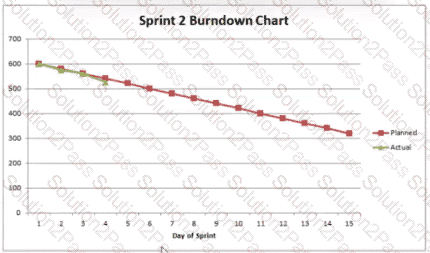
A.

Ask the product owner if some low-priority stories could be cut from the sprint.

B.

Continue with the sprint as the progress shows buffers for potential interruptions.

C.

Ask the project team to select any additional stories as they have additional capacity than planned.

D.

Continue with the sprint work as planned and keep monitoring.

During the setup of an agile project, the product owner expressed clear interest in

having features released during product development over having the product completed in

one year. What should the project manager do?

A.

Promote a productive environment where everybody can work without interruptionsfrom the rest of the team members.

B.

Create a reward system recognizing group contributions to get people motivated andimprove performance.

C.

Facilitate sprint planning sessions with a focus on defining the minimum viable product(MVP).

D.

Design a set of metrics including velocity, which is a good measure of value delivered.

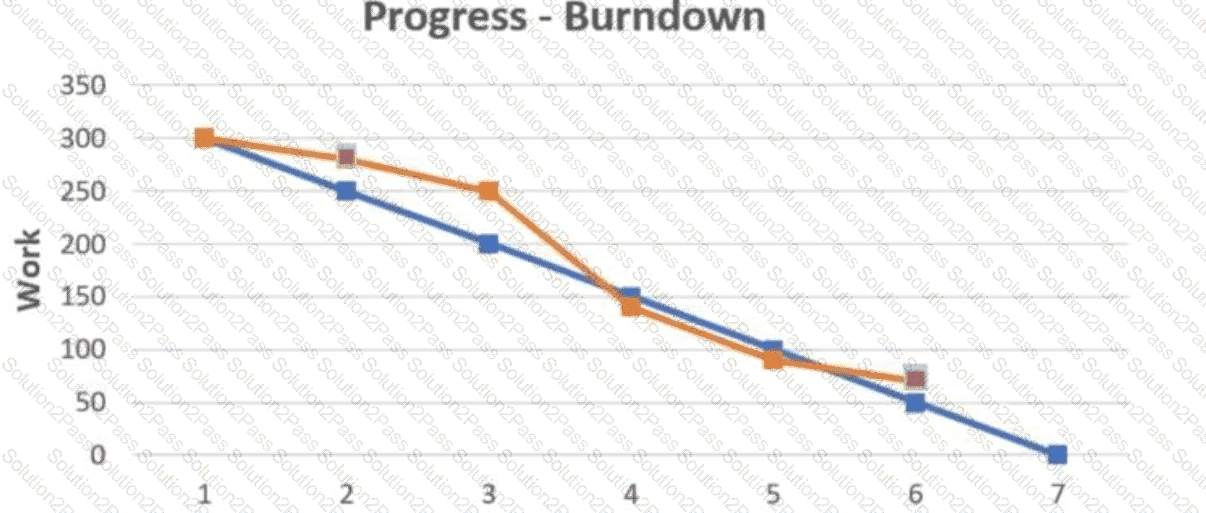
A project is on its sixth iteration out of seven. Select the two points where the team is

performing better than expected. (Choose two.)
A project manager is leading an electrical project that spans five towns. The project

manager is informed by the team that one of the towns is not allowing the team to work there even though the town was included in stakeholder engagements before the start of the project.

What should the project manager do?

A.

Change the project scope and seek approval to exclude this town from the overallproject.

B.

Engage with the town's authorities to discuss the reason for the change in commitmentand agree on a solution.

C.

Instruct the team to move to the next town and continue the project to avoid further delays.

D.

Retrieve all minutes of stakeholder engagements and send to the town as a reminder of their commitment to the project.

An agile leader notices that one team member consistently fails to complete the deliverables on time The agile leader suspects that this team member does not have the proper training.

What should the agile leader do?

A.

Reassign the task to another team member and require the team member to complete training

B.

Use the retrospective meeting to remind the entire team that they must complete all deliverables in each sprint

C.

Review the definition of done (DoD) with the team so that everyone understands what the team must deliver in this sprint.

D.

Speak directly with the team member about improvements and commit to an agreed-upon time frame.

An engineer working on a project team has tasks that require an additional skill that the engineer does not have a designer on the team is experienced with this skill from previous jobs and is willing to teach this skill even though it is not part of the current work

What should the project manager do?

A.

Escalate the situation to the engineer's manager

B.

Request external training for the engineer

C.

Request external training for the engineer and designer

D.

Allow the engineer and designer to cross-train with each other

A project team that is very experienced in enterprise resource planning (ERP)

systems implementation is currently planning the delivery of a new ERP project. There is a

requirement to reuse the client's security subsystem developed by a third party. The client

states that integration with the security subsystem must be done by the client's team. The

project manager does not want to have such an external dependency.

What should the project manager do first?

A.

Plan the implementation of this integration in the first iteration to help reduce risks.

B.

Record the issue in the issue log and closely manage this dependency.

C.

Inform the client that the project team will take care of the integration.

D.

Document the client's responsibility for the integration with the security subsystem.

A project manager is leading a project at a contracting company, and the project

team just completed an iteration. The product passed inspection, but an additional feature was added to the product. The customer notices the additional feature and thinks it will introduce new risks to the product.

What should the project manager do to avoid this situation in the future?

A.

Manage the scope baseline to influence the factors that drive change.

B.

Follow the proper change control process and evaluate the change for further impact.

C.

Work with the customer to ensure the feature adds value.

D.

Perform frequent reviews with the customer to ensure that the product is working asexpected.

A new privacy law will go into effect at the beginning of the next calendar year. The project manager realizes the project needs to be compliant with the new law. What should the project manager do next?

A.

Inform the project steering committee of this constraint.

B.

Inform the project team and create a spike for the next Iteration.

C.

Inform the legal department that the project scope will be updated.

D.

Inform the product owner that the project will continue as planned.

A project manager is working on a cost-reimbursable contract from the client's side. During project execution the project manager notices a major deliverable is missing. The project manager raises this with the seller but the seller advises the project manager that the subject deliverable is not part of the contract. The project manager remembers negotiating and agreeing to this deliverable during the tender process but cannot find it in the contract

What should the project manager do?

A.

Request a change in the contract in order to add the deliverable

B.

Add this deliverable to the requirements traceability matrix

C.

Terminate the contract and commence the closeout process

D.

Look to see if the deliverable is described in the statement of work (SOW)

Page: 6 / 11
Total 2191 questions
Copyright © 2014-2026 Solution2Pass. All Rights Reserved