3V0-23.25 VMware Advanced VMware Cloud Foundation 9.0 Storage Free Practice Exam Questions (2026 Updated)
Prepare effectively for your VMware 3V0-23.25 Advanced VMware Cloud Foundation 9.0 Storage certification with our extensive collection of free, high-quality practice questions. Each question is designed to mirror the actual exam format and objectives, complete with comprehensive answers and detailed explanations. Our materials are regularly updated for 2026, ensuring you have the most current resources to build confidence and succeed on your first attempt.
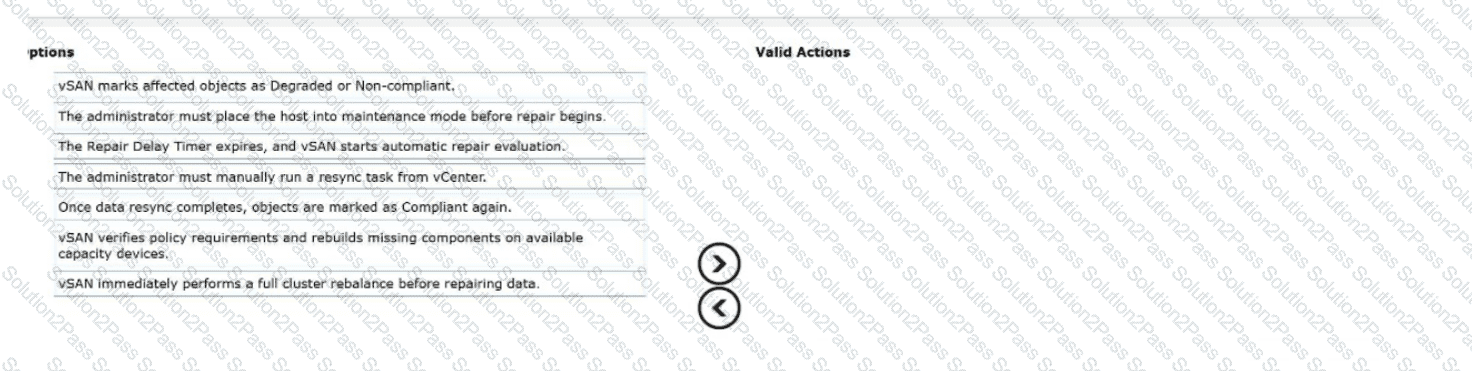
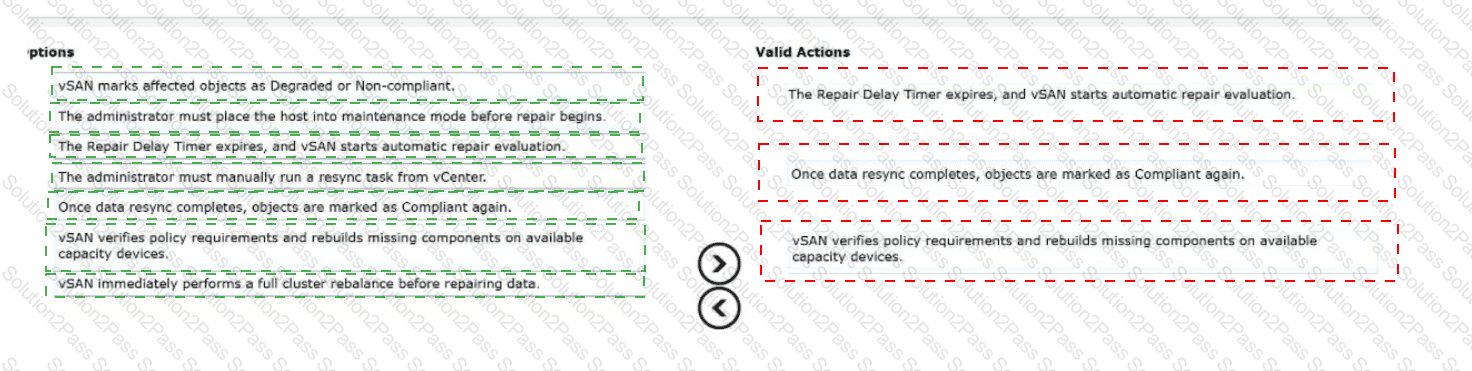
In a vSAN ESA cluster, one host goes offline unexpectedly for more than an hour.
When it returns online, vSAN needs to rebuild and restore compliance for several objects that became degraded during the outage.
Drag and drop the three correct options for the automatic recovery process from the Options list on the left and place them into the Valid Actions on the right in any order. (Choose three.)
An administrator has been tasked with suggesting storage models for a new VMware Cloud Foundation (VCF) Private Cloud with the following characteristics:
• Single VCF Instance with a single Workload Domain.
• The VCF Management Workload Domain will consist of a single cluster that uses a highly scalable, integrated storage solution that does not require additional management software or hardware.
• The VCF Workload Domain consists of a single Cluster that requires a multiple-tier storage solution consisting of:
A highly scalable, policy-based storage solution for critical application workloads.
A file-based storage solution that can scale independently of the cluster for workloads with large data requirements. Which three storage models should the administrator recommend? (Choose three.)
An administrator is managing a local vSAN 3-node cluster running the Express Storage Architecture (ESA) as part of a VMware
Cloud Foundation (VCF) Workload Domain.
The following parameters apply at the cluster level:
• HA is enabled
• Reserved Failover Capacity = 25% for both CPU and Memory
The administrator is tasked with configuring the VSAN storage policy so it will tolerate the maximum number of failures.
What two protection levels can the administrator configure? (Choose two.)