3V0-23.25 VMware Advanced VMware Cloud Foundation 9.0 Storage Free Practice Exam Questions (2026 Updated)
Prepare effectively for your VMware 3V0-23.25 Advanced VMware Cloud Foundation 9.0 Storage certification with our extensive collection of free, high-quality practice questions. Each question is designed to mirror the actual exam format and objectives, complete with comprehensive answers and detailed explanations. Our materials are regularly updated for 2026, ensuring you have the most current resources to build confidence and succeed on your first attempt.
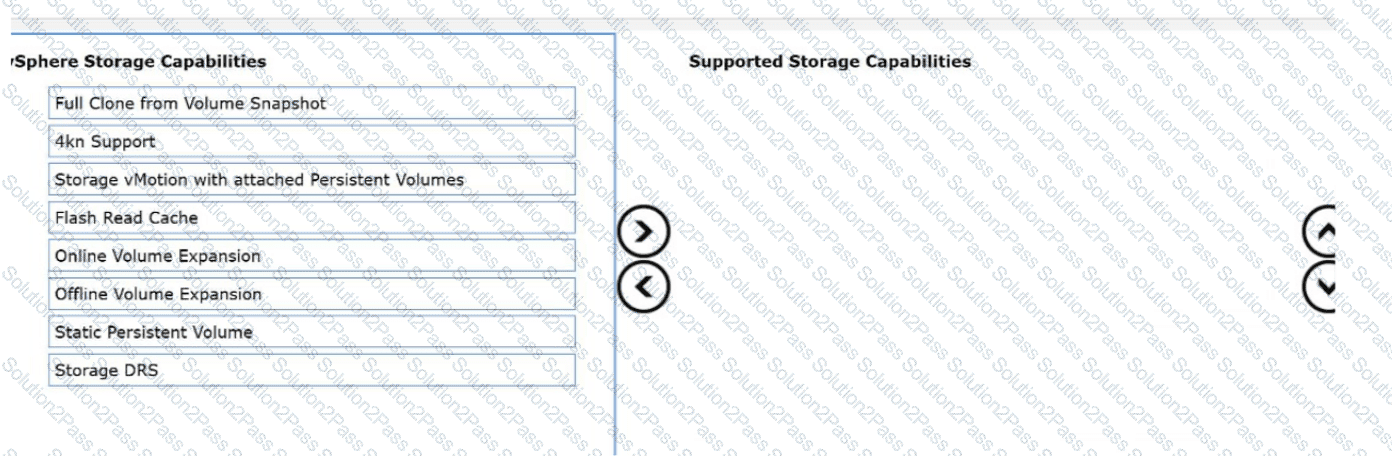
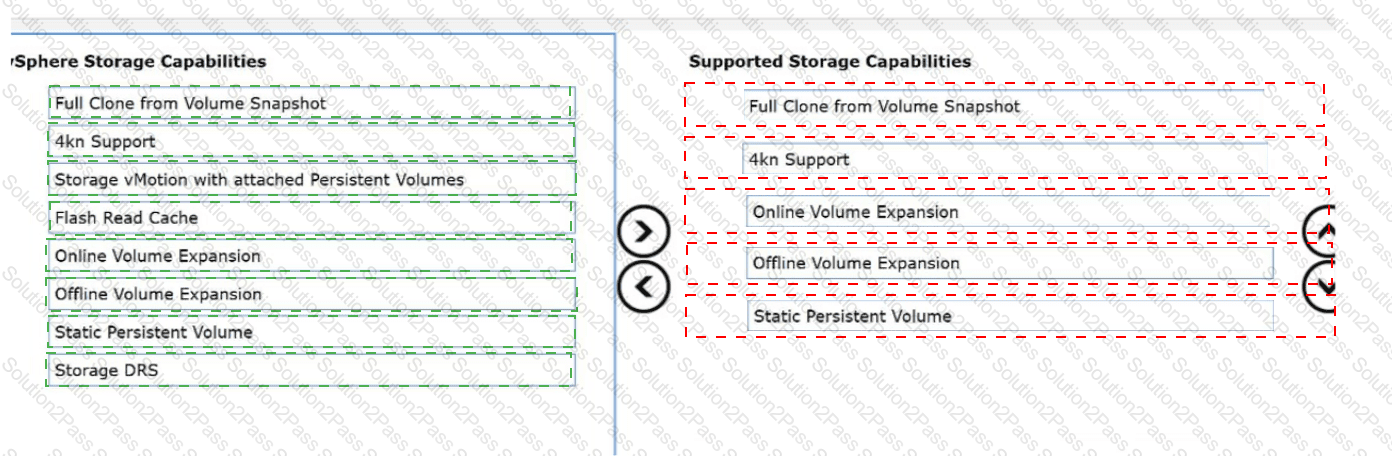
Select the storage capabilities supported for use with persistent volumes in the VMware Kubernetes Service (VKS) in VMware Cloud Foundation (VCF).
Drag and drop the five supported capabilities from the vSphere Storage Capabilities list on the left and place them into the Supported Storage Capabilities list on the right in any order. (Choose five.)
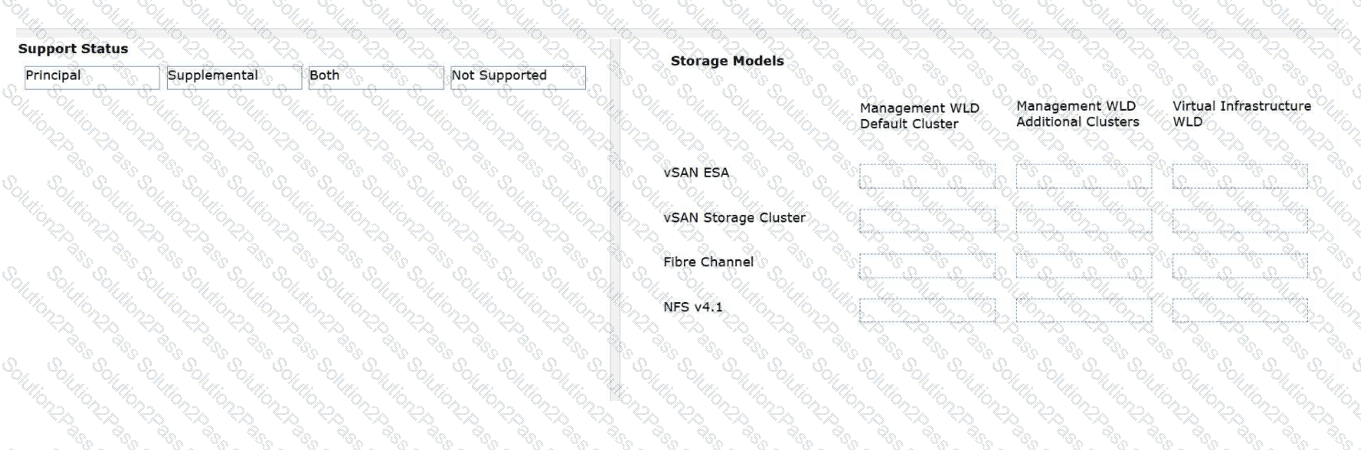
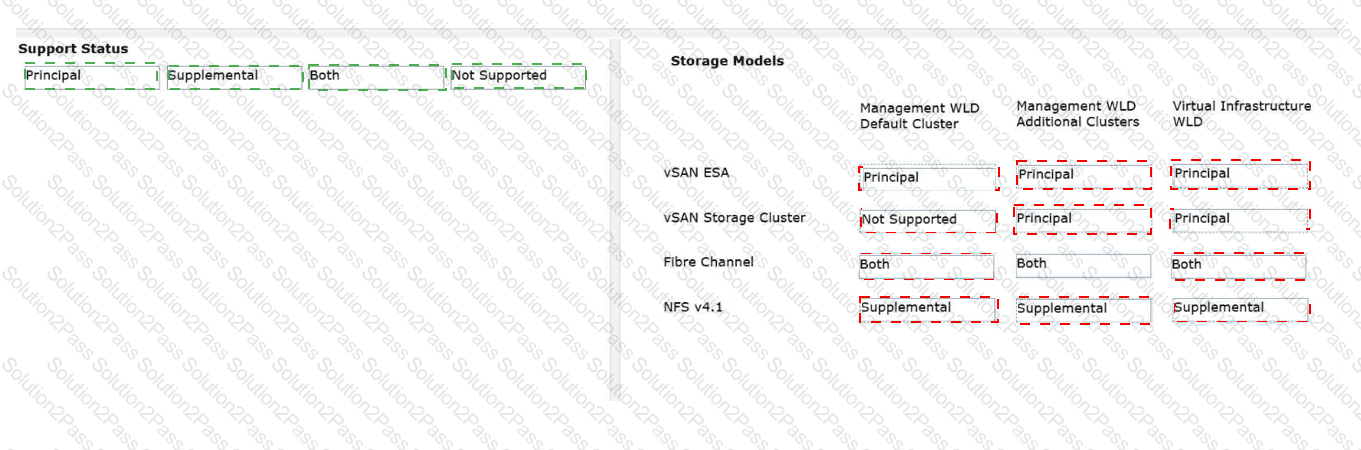
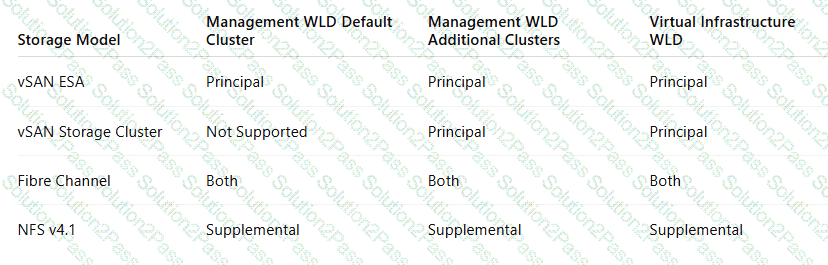
An architect is describing the for a client which storage platforms are supported in which types of Domains for automated installation in VMware Cloud Foundation (VCF) Private Clouds.
Drag and drop the Support Status of each storage model on the left to each type of Workload Domain on the right.
An administrator is managing a stretched vSAN ESA cluster where each site has three hosts.
The following parameters apply to the storage policy being configured at the datastore level:
• The policy is configured at the datastore level
• Site disaster tolerance = Site mirroring - stretched cluster
• Failures to tolerate = 1 failure - RAID-1 (mirroring)
• Number of disk stripes = 1
When inspecting some of the Virtual Machines (VMs), why do objects have 3 disk stripes?
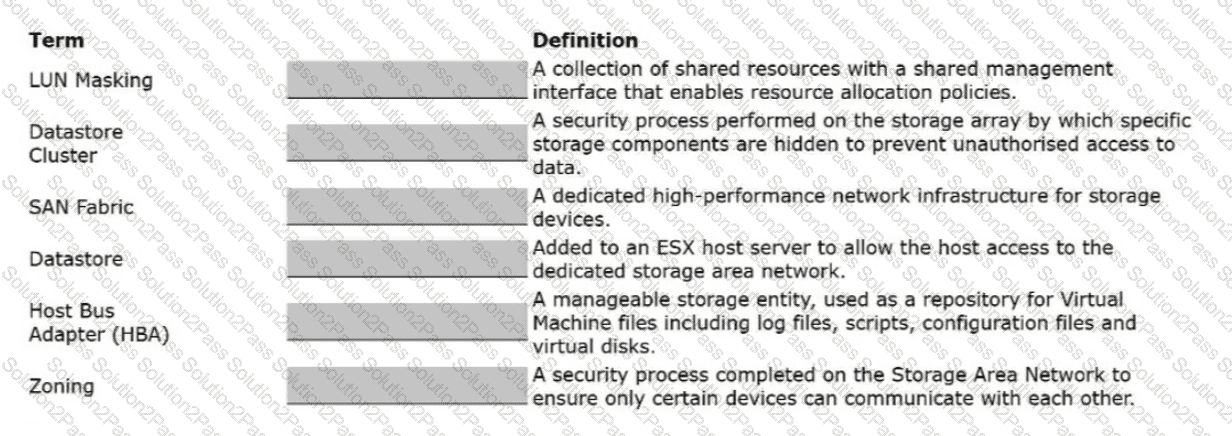
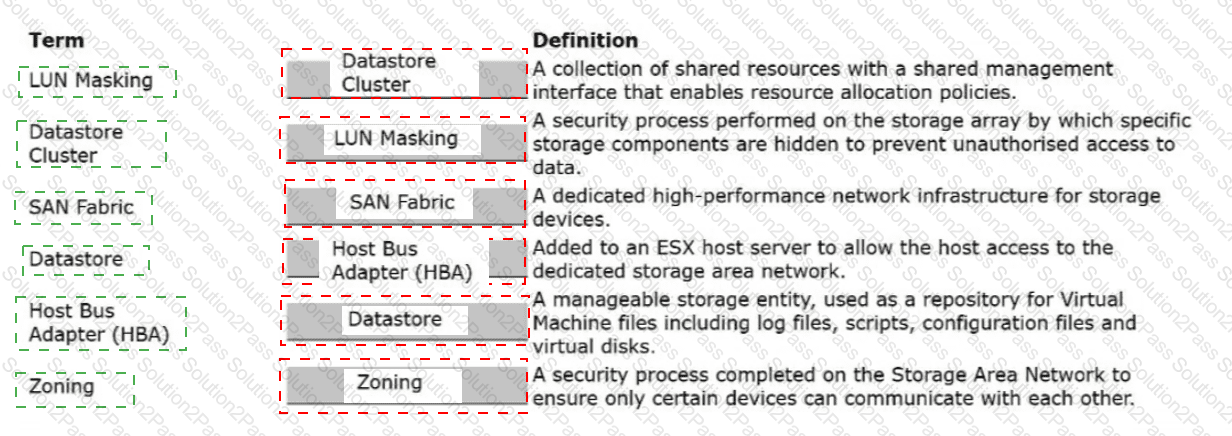
An administrator is responsible for a VMware Cloud Foundation (VCF) Private Cloud and has been tasked with identifying and explaining the different Fibre Channel (FC) Storage Area Network (SAN) components within a VCF Workload Domain cluster.
Drag and drop the correct Term onto its matching Definition.
A storage architect has been called into a meeting with the accounting team who is trying to determine why 20% of their raw capacity is not available for consumption. Their vSAN cluster was created with the following characteristics:
• 2 x 2 TB NVMe disks in 6 hosts in their vSAN cluster.
• FTT=1, RAID-1 for the default policy.
• Host Rebuild Reserve not activated for this cluster.
Which two items should the Architect say accounts for most of the unusable capacity? (Choose two.)
An administrator is tasked with vertically scaling a vSAN ESA deployment. The current cluster contains 6 hosts each with the following configuration:
• 8 x 7.68 TB drives
• 2 x 25 GB NICs
• 2 x Intel Gold CPUs
What are the three reasons to add the same model and capacity drives when scaling each host? (Choose three.)
An administrator has been tasked with recommending a principal storage type for a new cluster within an existing VMware Cloud
Foundation (VCF) Workload Domain.
The following information has been provided:
• The customer has a 25GbE capable network.
• The customer has an existing 3rd party storage solution that supports connectivity by either FibreChannel and NFS
• The new cluster will consist of two host servers that will be recycled from a previous project.
• Each of the host servers have the following configuration:
o One 500GB Enterprise-grade SSD drive.
o Two 2-Port IOGbE network cards.
• There is no budget for additional hardware.
Which approach should the administrator recommend for the principal storage type?
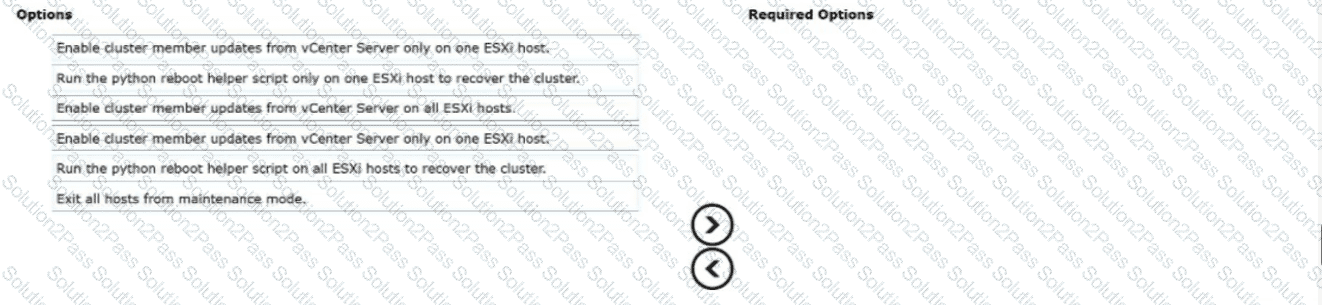
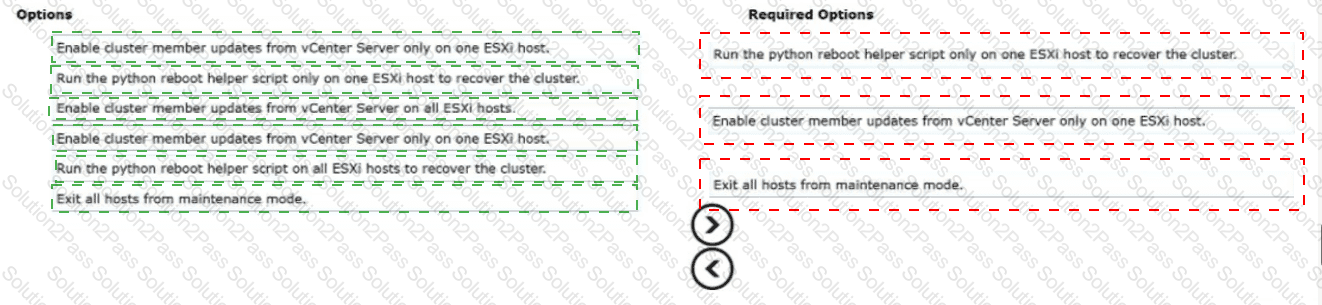
After a planned power outage, an administrator decided to restart the vSAN cluster manually.
Drag and drop the three correct options from the Options list on the left and place them into the Required Options on the right in any order. (Choose three.)
A customer attaches an external Fibre Channel (FC) VMFS datastore to a VMware Cloud Foundation (VCF) workload domain for backup staging. The administrator must confirm that the datastore is visible to all hosts, and that path and device health alarms will trigger should a fabric link or path fail.
Which action should the administrator take to verify this?
During maintenance on hosts in a four-node vSAN cluster, a host is placed in maintenance mode with the “Ensure Accessibility” option.
All VMs are running with the Default Storage Policy (RAID-1, FTT=1) which has not been modified from the default settings.
While one of the hosts in the cluster is down for firmware upgrade, a second host in the cluster loses network connectivity.
How will the cluster be affected?
The security team has notified the VMware Cloud Foundation (VCF) Storage Administrator of a new security vulnerability that must be patched immediately. The vSAN Cluster uses vSphere Lifecycle Manager images.
After updating the image with the patch, what method should the administrator use to apply this patch with the least amount of disruption to the cluster?
An administrator has deployed a three-host vSphere cluster with a small amount of VMFS storage and wants to add additional capacity from a vSAN ESA cluster located in the same vCenter Server.
When the administrator selects the vSphere cluster and navigates to the Configure tab, the Datastore Management option is missing under the vSAN section.
What prerequisite must be met before the administrator can mount the remote datastore?
An architect has been tasked with designing a vSAN OSA storage solution for a VMware Cloud Foundation (VCF) Private Cloud. The following requirements and constraints have been gathered from the client:
• 2 x 4 TB NVMe disks per host
• 6 hosts
• FTT=1/RAID-5 for all deployed Virtual Machines
• Expected Dedupe/Compression Ratio = 2 (100%)
• Reserve enough capacity to rebuild a host completely in case of a failure (Host Rebuild Reservation)
• Operational Reserve of 10%
• Expected Overhead for Filesystem, Object, etc. of 25%
What is the approximate expected usable capacity of the resulting array?
An administrator is planning the deployment of a new VMware Cloud Foundation (VCF) Workload Domain. The storage design decisions for the solution are:
• NFS
• NVMe over RDMA
• No local storage is available to the hosts
What is the storage solution build order for the Workload Domain?
An administrator is working on a VMware Cloud Foundation (VCF) Workload Domain that was configured to use vSAN for principal storage. The administrator wishes to create and configure a datastore cluster to host tenant VMs using that vSAN backed storage across multiple clusters, mixed OSA and ESA, in the domain.
What should the administrator consider?
An administrator is tasked designing a vSAN storage solution while respecting the following requirements:
• Must use vSAN ESA
• Must be stretched between two data centers
• Must configure Failures to tolerate = 1
• Must configure Erasure Coding
How many components per Virtual Machine (VM) will be created?
vSAN encounters a noncompliant Virtual Machine and is able to locate a full replica of 55% of the votes for the noncompliant objects.
What action will vSAN do with the Virtual Machine?
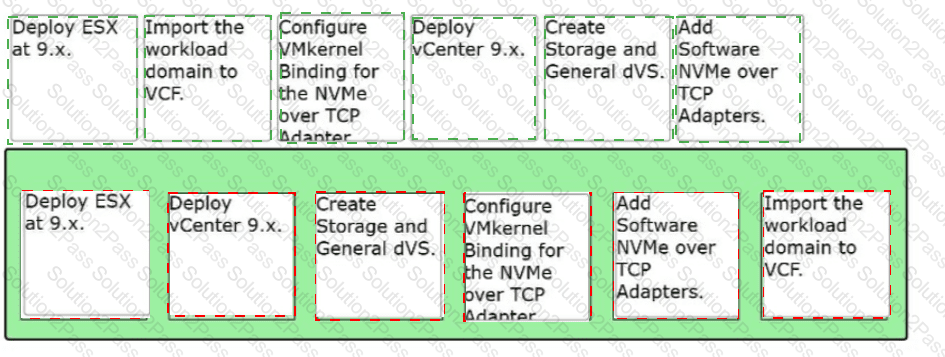
A VMware Cloud Foundation (VCF) Workload Domain is requested to be deployed with the following information:
. 6 blade style hosts with no local storage beyond the operating system.
. 4 25 Gb networking cards installed in each host.
. A 30 TB external array configured to support NVMe/TCP only.
. 2 dVS switches, one configured for storage isolation and one for all other traffic.
. NVMe/TCP multi-path configuration required.
. Existing Management Domain is deployed with VCF.
Place the steps for importing VCF on to this configuration.
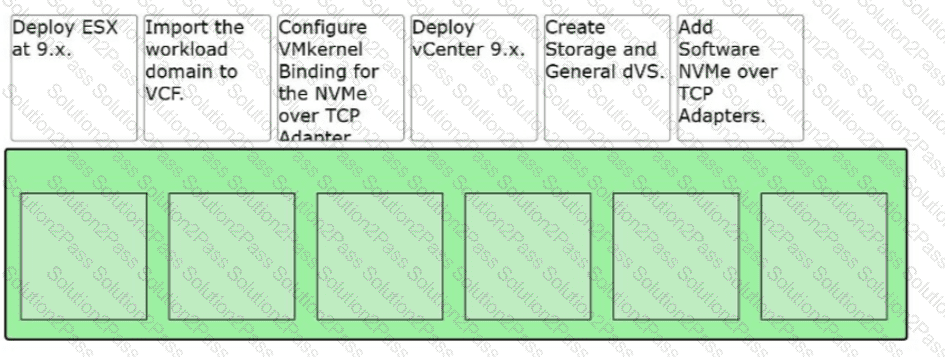
An administrator is tasked with deploying a vSAN ESA Stretched Cluster for a VMware Cloud Foundation (VCF) workload domain. The stretched cluster must meet the following requirements:
• Ensure the cluster supports a storage policy with a secondary level of resilience of FTT=2 using RAID-6 erasure coding.
• Allow vSAN to regain its prescribed level of resilience in the event of a sustained host outage.
What is the minimum number of hosts required in each availability zone?
An administrator attempts to enable vSAN Data-at-Rest Encryption on a cluster but receives the following error message:
“Key provider < vSphere Native Key Provider > is not available on host.”
The administrator configured the vSphere Native Key Provider (NKP) using the default settings.
What should the administrator validate before enabling vSAN Data-at-Rest Encryption?